3.2.5.1 - General Properties of Transition Metals
Use electron configurations to recognise transition metals, then describe their characteristic ions, ligands and co-ordinate bonds.
Which elements count as transition metals
The first-row d-block runs from scandium to zinc. The key definition is more precise than simply saying "d-block element". A transition element is one that forms at least one stable ion with an incomplete d sub-level.
An incomplete d sub-level means neither empty () nor full (). That idea explains why the first-row transition elements are usually taken as titanium to copper.
- Titanium forms ions such as and , both of which have incomplete sub-levels.
- Copper atom is , but is , so copper still shows transition-metal chemistry.
- Zinc forms , which is , so its d sub-level is full.
- Scandium forms , which is , so its d sub-level is empty.
The diagram below maps that definition onto the first-row d-block, showing why scandium and zinc are excluded while copper still counts through .
[DIAGRAM: asset_name: 2.5.1 - General Properties of Transition Metals - Diagram 1; asset_slug: 2.5.1 - General Properties of Transition Metals - Diagram 1; recommended_method: retained_png; description: First-row d-block shown as a single row from Sc to Zn. Highlight Ti, V, Cr, Mn, Fe, Co, Ni, and Cu as transition elements, but show Sc and Zn as excluded. Add callout annotations Sc^3+ = d^0 and Zn^2+ = d^10, both labelled not transition elements, and Cu^2+ = d^9 to show why copper still counts.]
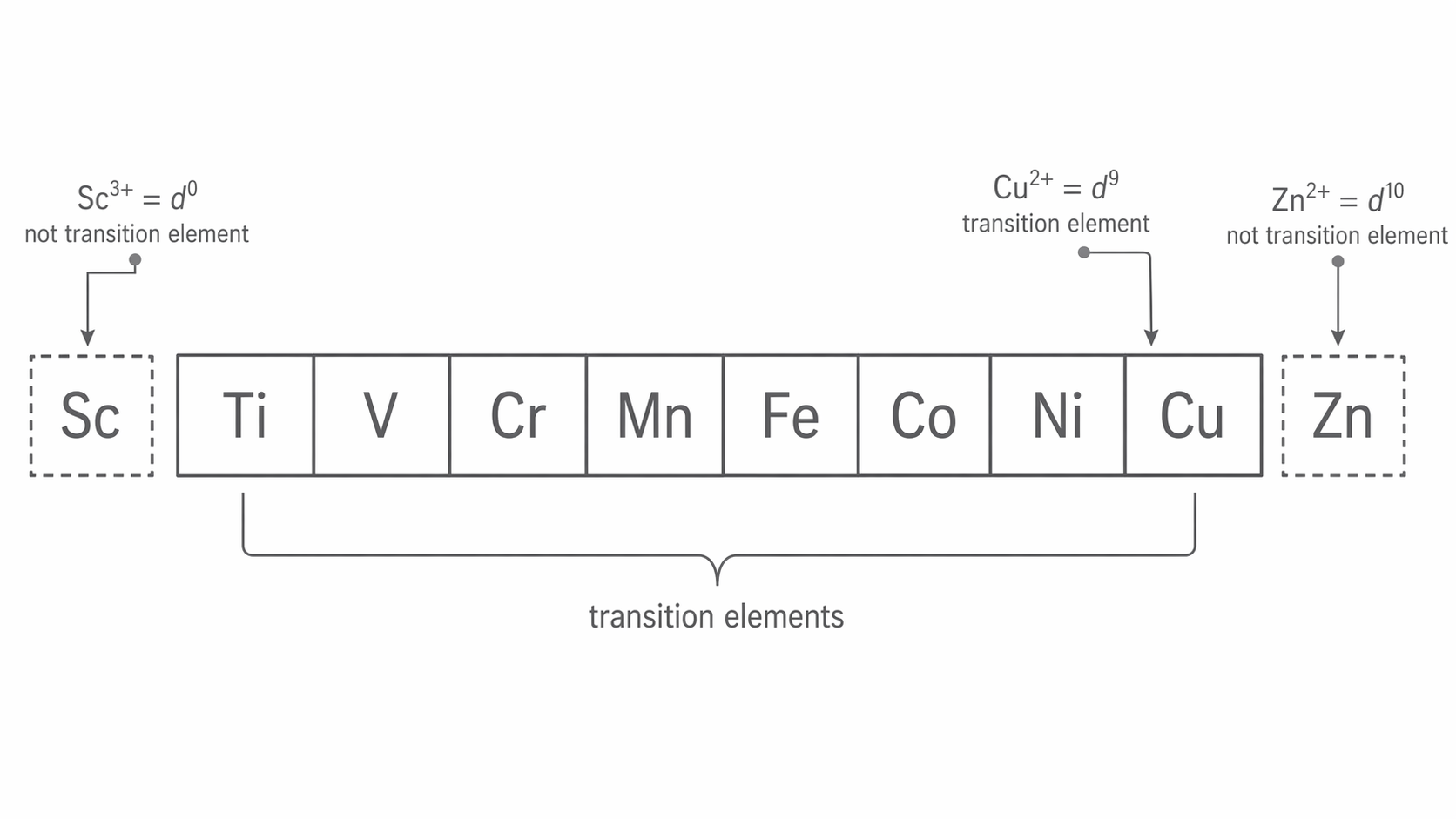
The atom on its own is not always enough. For some elements, especially copper, the important incomplete d sub-level is in the ion rather than the neutral atom. That is why the definition asks whether the element forms at least one stable ion with an incomplete d sub-level.
Why an incomplete d sub-level matters
The characteristic chemistry of transition metals comes from the fact that their and electrons are close in energy. That gives these elements more flexibility than most s-block and p-block metals.
One important result is variable oxidation state. In simple terms, transition metals can form more than one stable ion because they can use different numbers of and electrons in bonding.
- Iron commonly forms and .
- Copper commonly forms and .
- Manganese shows an even wider range of oxidation states in its compounds.
That same flexibility helps explain catalytic activity. A catalyst speeds up a reaction without being used up overall. Many transition-metal catalysts work because the metal or its compound can change oxidation state during the reaction and then change back again. Metal surfaces can also adsorb reactant particles, bringing them together in a better arrangement for reaction.
Transition metals also form coloured ions. Many aqueous transition-metal ions absorb some frequencies of visible light and transmit or reflect the rest, so the ion appears coloured. An incomplete d sub-level is essential for this behaviour. That is why ions such as are coloured, whereas is typically colourless.
Transition-metal catalysts are central to industrial chemistry. Iron is used in the Haber process, vanadium(V) oxide in the Contact process, and nickel in hydrogenation, because transition metals can interact with reactants effectively without being consumed overall.
These characteristic properties are not four unrelated facts. Complex formation, coloured ions, variable oxidation state, and catalytic activity all connect back to the incomplete d sub-level.
An incomplete d sub-shell explains the characteristic d–d absorption considered here. Do not reverse every characteristic into a definition: zinc can form complexes despite not being a transition metal, and an incomplete d sub-shell is not required for all possible origins of colour.
Continue this lesson.
You’re previewing NovaLearn without an account. Create a free account to read the rest.
Create free account