3.3.7 - Optical Isomerism
Optical isomerism is the point where molecular shape stops being a small detail and becomes the whole story. Two compounds can have exactly the same atoms joined in the same order, yet still be different because their 3D arrangements are mirror images. In this lesson you will learn how to spot a chiral centre, how to draw the two enantiomers, and why a 50:50 mixture of them shows no overall optical activity.
Spotting the chiral centre
Optical isomerism is a type of stereoisomerism. That means the structural formula stays the same, but the arrangement of atoms in space changes.
Stereoisomerism
Compounds with the same structural formula but a different arrangement of atoms in space.
Here, optical isomerism is treated for molecules with a single chiral centre. The key test is not "does this carbon look unusual?" but "are all four groups attached to it different?"
Chiral centre
A chiral centre is a carbon atom bonded to four different groups.
A carbon atom with four bonds is very common; a carbon atom with four different groups is much rarer. For example, in the middle carbon is attached to -H, -, -, and -, so it is chiral. In the middle carbon is attached to -H, -, -, and another -, so it is not chiral.
The diagram below compares a chiral tetrahedral carbon with a similar carbon that is not chiral.
[DIAGRAM: asset_name: 3.7 - Optical Isomerism - Diagram 1; asset_slug: 3.7 - Optical Isomerism - Diagram 1; recommended_method: retained_png; description: Side-by-side tetrahedral comparison on a white background. Left: CH3CH(OH)COOH drawn around a starred central carbon with OH above, H below, CH3 on a solid wedge, and COOH on a dashed bond, plus the note four different groups -> chiral. Right: CH3CH(OH)CH3 drawn with OH above, H below, CH3 on a solid wedge, and a second CH3 on a dashed bond, with no star on the central carbon and the note two groups the same -> not chiral.]
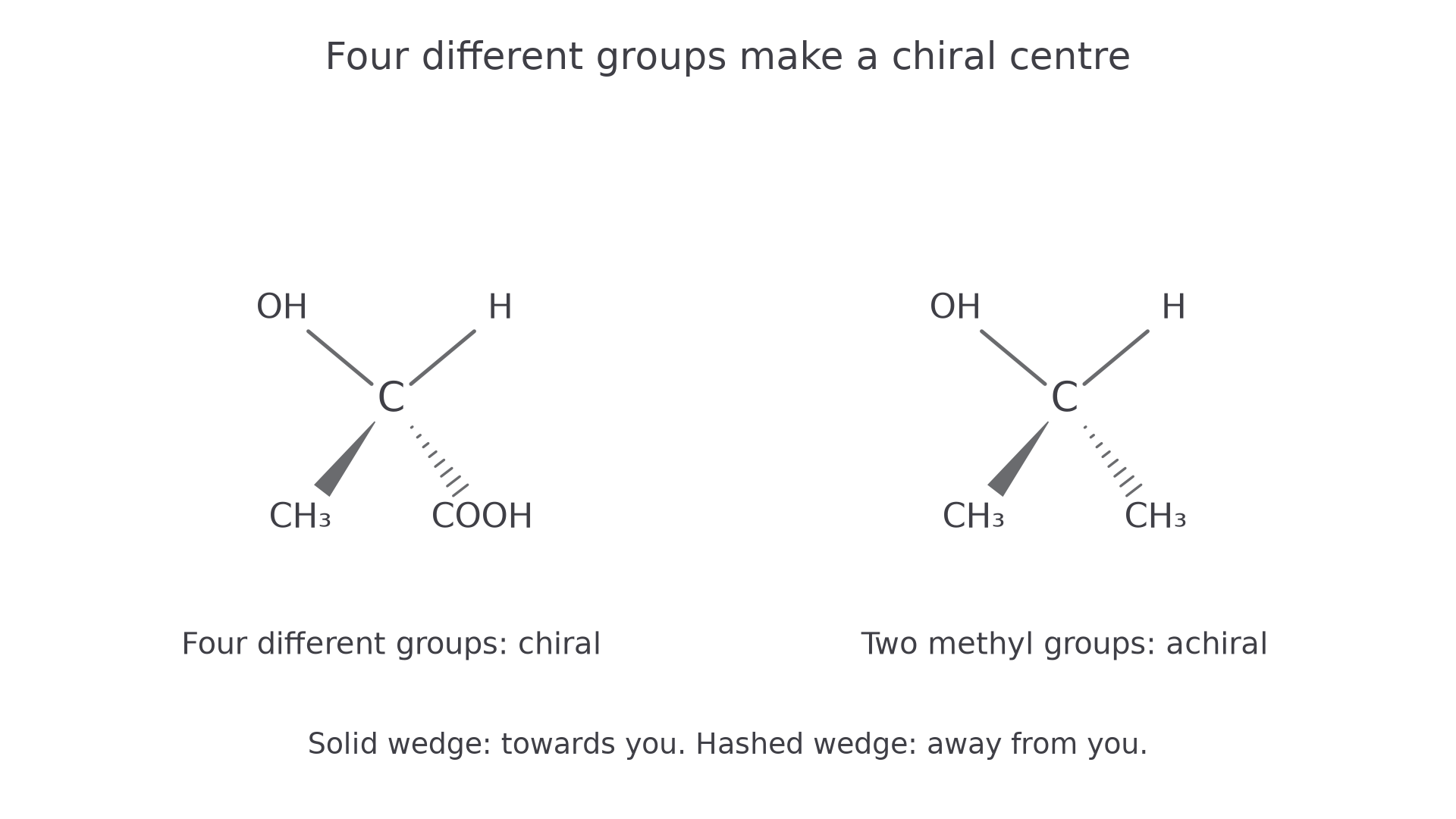
A quick reliable method is to find the candidate carbon, then list its four attached groups carefully. Count the whole group, not just the first atom, so - and - are different even though both begin with carbon.
Once one chiral centre is present, two optical isomers are possible. The next step is being able to show them clearly in a drawing.
Drawing enantiomers correctly
The two optical isomers formed from one chiral centre are called enantiomers. They are mirror images, but you cannot rotate one in space and make it fit exactly on top of the other.
Enantiomers
A pair of non-superimposable mirror-image optical isomers.
The structural formula of both enantiomers is the same. For example, both optical isomers of 2-hydroxypropanoic acid can be written as . To show the difference, you need a displayed formula that makes the tetrahedral arrangement around the chiral carbon visible.
A reliable drawing method is:
- Draw the same groups attached to the same central carbon in both molecules.
- Show two bonds in the plane of the page, one solid wedge coming out towards you, and one dashed bond going away from you.
- Draw the mirror image by reversing the 3D arrangement around the chiral centre, not by changing which atoms are connected.
One valid construction keeps above the central carbon and to its left, both in the plane. Draw on a solid wedge and H on a dashed bond for one isomer. Keep the two planar groups fixed and swap only and H between the wedge and dashed bond for the other. Swapping one pair reverses the configuration; swapping two pairs would give another view of the same configuration.
[DIAGRAM: asset_name: 3.7 - Optical Isomerism - Diagram 2; asset_slug: 3.7 - Optical Isomerism - Diagram 2; recommended_method: deterministic_code; description: Correct tetrahedral mirror pair for lactic acid, solid wedges towards the viewer and hashed wedges away, with four distinct groups.]
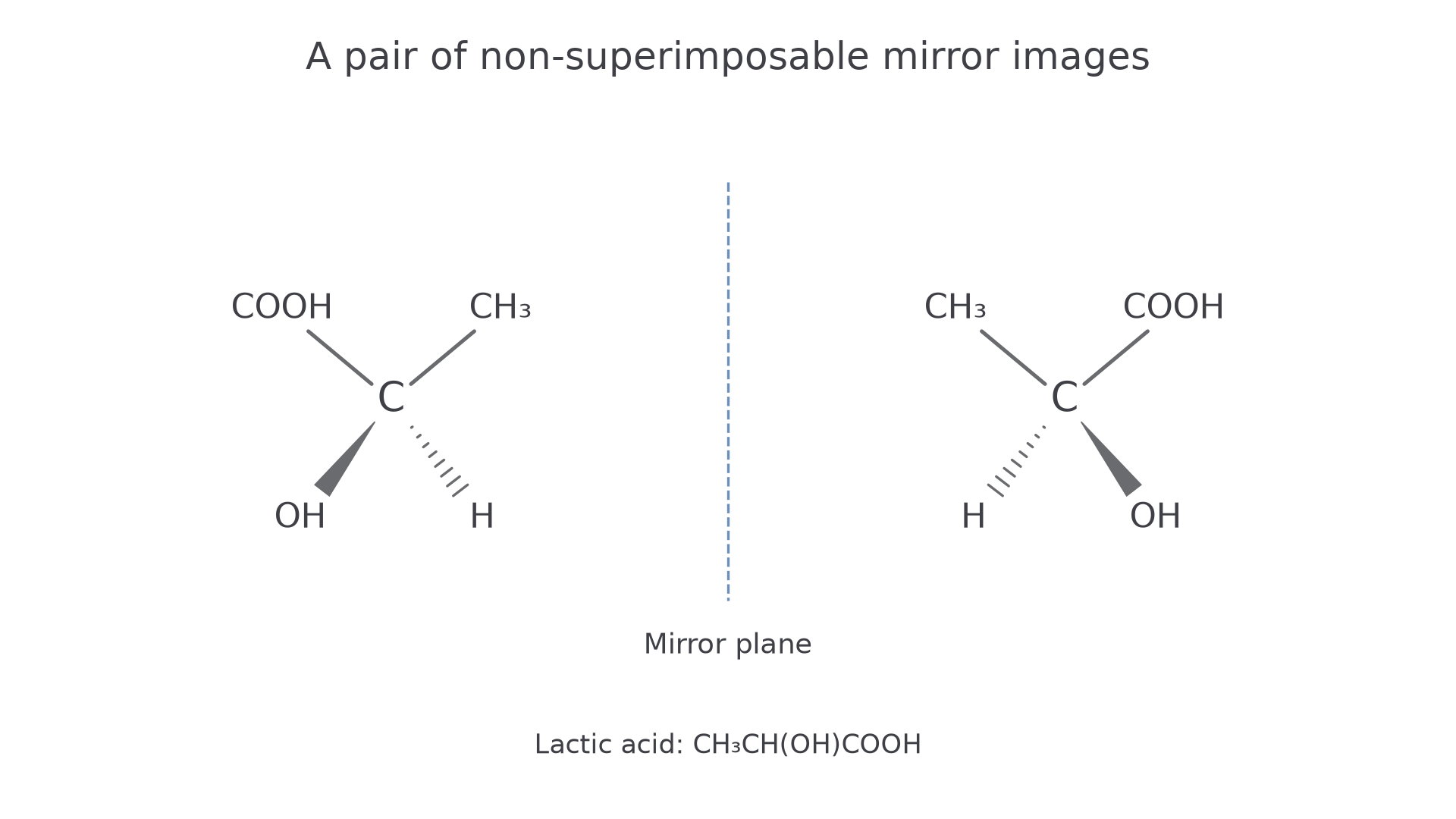
The two ordinary bonds in a tetrahedral projection should not be drawn as a straight 180° line: the real bond angles are approximately 109.5°. Models or careful wedge drawings help distinguish an actual reflection from a rotation.
A common mistake is to draw the second molecule as just another view of the first. If a simple rotation would make the two drawings match perfectly, you have not drawn enantiomers. Mirror image and non-superimposable must both be true.
Continue this lesson.
You’re previewing NovaLearn without an account. Create a free account to read the rest.
Create free account