3.3.10.2 - Electrophilic Substitution
Benzene does react with electrophiles, but it does so in a very controlled way. The key idea is that the delocalised pi system makes the ring electron-rich, while the unusual stability of the aromatic ring means the reaction pathway must restore that delocalisation at the end. This is why nitration and Friedel-Crafts acylation are electrophilic substitutions, limited here to monosubstitution of the benzene ring.
Why benzene prefers substitution
Benzene contains a ring of delocalised electrons above and below the plane of the carbon atoms. That delocalised cloud is an area of high electron density, so it attracts species that are short of electrons.
Electrophile
An electrophile is an electron-pair acceptor. In organic mechanisms, it is the species that is attacked by a region of high electron density.
When an electrophile approaches benzene, a pair of electrons from the delocalised ring forms a new bond to the electrophile. At that moment the aromatic ring is temporarily disrupted, so the intermediate is unstable. A proton is then removed from the carbon that now carries the new group, and the delocalised ring is restored.
Electrophilic substitution
Electrophilic substitution is a reaction in which an electrophile replaces a hydrogen atom on an aromatic ring and the aromatic system is restored by the end of the mechanism.
That final restoration step explains why benzene usually undergoes substitution rather than addition. An addition reaction would leave the ring less stable because the delocalised pi system would not be fully regained. In this specification, we focus on monosubstitution only: one hydrogen on the ring is replaced by one incoming electrophile.
The diagram below shows the shared three-step pattern for electrophilic substitution: attack by the electrophile, formation of the sigma-complex, and loss of to restore the aromatic ring.
[DIAGRAM: asset_name: 3.10.2 - Electrophilic Substitution - Diagram 1; asset_slug: 3.10.2 - Electrophilic Substitution - Diagram 1; recommended_method: code_generated; description: General electrophilic substitution with arrow from benzene circle, positively charged horseshoe intermediate open at the attacked carbon, and arrow from the C–H bond into the ring.]
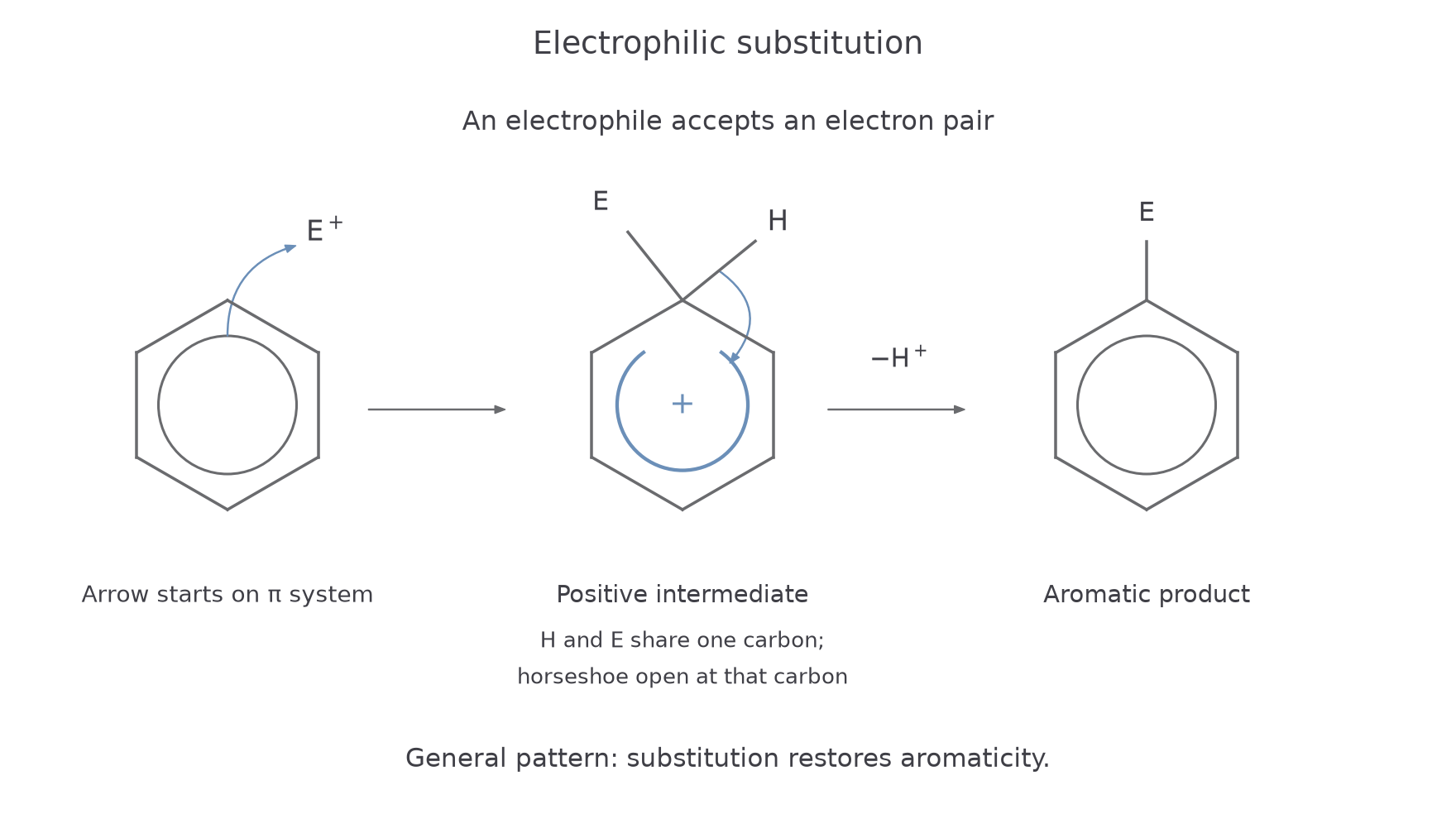
A reliable way to tell any electrophilic substitution mechanism is to use the same three-step pattern: make the electrophile, attack the ring, then remove to restore aromaticity.
In a drawn mechanism, start the first curly arrow on the aromatic circle (or a drawn pi bond) and end it at the electrophilic atom. In the intermediate the attacked carbon has both H and E and four single bonds. Draw a horseshoe inside the other five carbon atoms, open at the attacked carbon, with a positive charge inside the ring. Do not draw a complete aromatic circle in this intermediate. To restore the ring, start the second curly arrow on the C–H bond of that same carbon and point into the ring; show lost. An arrow pointing from the ring towards would wrongly send the bonding electrons away with the proton.
Nitration of benzene
Nitration is one of the most important electrophilic substitution reactions because it introduces a nitro group, , onto the ring. That matters in synthesis because nitrobenzene can later be reduced to an aromatic amine, and nitration steps are also used in the manufacture of explosive nitro compounds.
The reagents are concentrated nitric acid and concentrated sulfuric acid, warmed to about . Sulfuric acid is the stronger acid, so it helps generate the actual electrophile needed for the reaction: the nitronium ion, .
Once has formed, a pair of electrons from benzene attacks the nitrogen atom. That gives the usual unstable intermediate. A base in the mixture, commonly , then removes from the ring carbon, and the aromatic ring is restored to give nitrobenzene.
Catalyst
A catalyst increases the rate of a reaction and is regenerated by the end of the mechanism, so it is not used up overall.
In nitration, sulfuric acid is regenerated after reacts with , so sulfuric acid acts as a catalyst as well as helping generate the electrophile. Keeping the temperature around matters because higher temperatures make further substitution more likely, while this specification point is limited to monosubstitution.
The diagram below lays out the nitration mechanism from generation of to deprotonation and formation of nitrobenzene.
Continue this lesson.
You’re previewing NovaLearn without an account. Create a free account to read the rest.
Create free account