3.2.6 - Reactions of Ions in Aqueous Solution
Explain the acidity of aqua ions and use hydroxide, ammonia and carbonate reactions to distinguish copper, iron and aluminium ions.
Aqua ions and why 3+ ions are more acidic
When these ions are in water, they do not exist as bare metal ions. Water molecules donate lone pairs to the metal ion, so the species in solution are hexa-aqua complex ions. In this lesson, the ones you need are:
- and
- and
Their starting solution colours help anchor the later observations: is pale green, is blue, is often described as pale violet but usually appears yellow-brown in aqueous solution because hydrolysis occurs, and is colourless.
Aqua ion
A complex ion in which water molecules act as ligands and bond to a central metal ion by co-ordinate bonds.
The important acid-base idea is that the metal ion pulls electron density away from the oxygen atoms in the bonded water molecules. That weakens the - bonds in those ligands. If the - bond is weakened enough, a proton can be released, so the aqua ion behaves as an acid.
The reason ions are more acidic than ions is their higher charge/size ratio. A 3+ ion has more positive charge and, in these cases, is also typically smaller than the corresponding 2+ ion. That higher charge density means it attracts electron density from the water ligands more strongly, so the - bonds are more polarised and break more easily.
To explain the idea clearly, keep the chain complete:
higher charge/size ratio -> stronger attraction to the atom -> greater polarisation of the - bond -> easier loss of -> greater acidity
The diagram below compares a and hexa-aqua ion and shows why the ion releases more readily.
[DIAGRAM: asset_name: 2.6 - Reactions of Ions in Aqueous Solution - Diagram 1; asset_slug: 2.6 - Reactions of Ions in Aqueous Solution - Diagram 1; recommended_method: retained_png; description: Side-by-side comparison of [Fe(H2O)6]2+ and [Fe(H2O)6]3+ with six water ligands around each ion; show a weaker attraction from Fe2+ to the ligand oxygen atoms, a stronger attraction from Fe3+ to the ligand oxygen atoms, greater O-H bond polarisation in the 3+ complex, and an arrow showing H+ released more readily from the 3+ ion.]
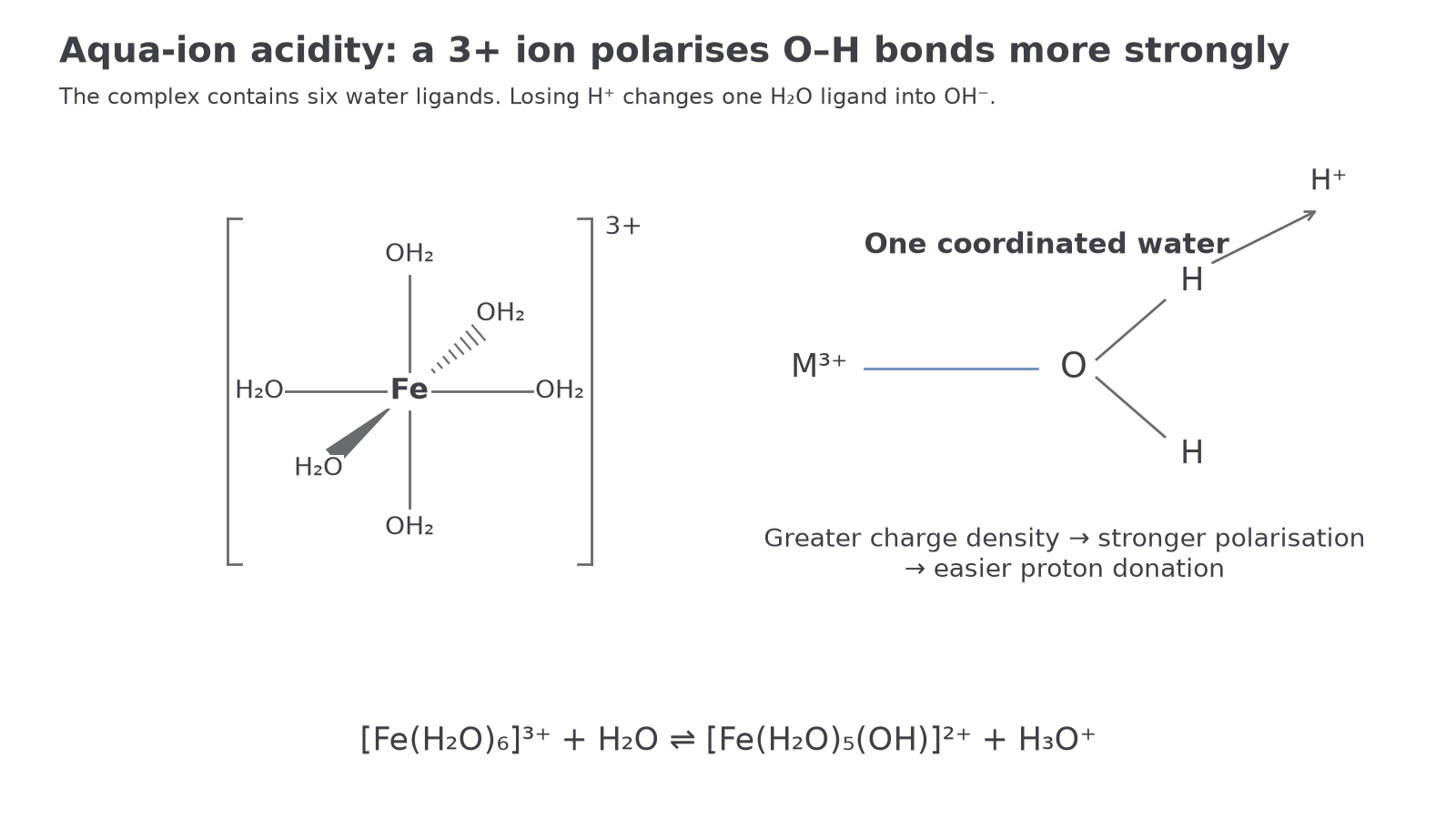
This is why and react more strongly with bases than and . Keep that idea in mind, because it explains both the hydroxide reactions and the carbonate reactions later.
This comparison concerns charge density, not charge alone. A small 3+ ion strongly polarises the O–H bonds in its water ligands, making proton loss easier. Sodium ions have much weaker polarising power, so sodium chloride solution does not show the same aqua-ion acidity.
Reactions with hydroxide ions
When is added, it acts as a base and removes protons from the coordinated water molecules. This turns aqua ions into hydroxide-containing species, and once a neutral complex is formed it becomes insoluble and precipitates.
For 2+ ions:
For 3+ ions:
The observations matter just as much as the equations:
| Ion added to | Observation with a few drops | Observation in excess |
|---|---|---|
| green precipitate of hydrated iron(II) hydroxide | precipitate remains insoluble and turns brown on standing in air | |
| pale blue precipitate of hydrated copper(II) hydroxide | precipitate remains insoluble | |
| brown precipitate of hydrated iron(III) hydroxide | precipitate remains insoluble | |
| white precipitate of hydrated aluminium hydroxide | precipitate dissolves to give a colourless solution |
Only aluminium hydroxide dissolves in excess hydroxide because it is amphoteric.
The precipitate is a common observation to learn carefully. It is green at first, but on standing it turns brown because oxygen in the air oxidises iron(II) to iron(III), producing hydrated iron(III) hydroxide.
Continue this lesson.
You’re previewing NovaLearn without an account. Create a free account to read the rest.
Create free account