3.2.2 - Group 2, the Alkaline Earth Metals
Compare magnesium, calcium, strontium and barium, then use their reactions and the solubilities of their compounds to explain practical tests and applications.
Electronic structure, atomic radius and ionisation energy
The Group 2 elements in this part of the specification are magnesium, calcium, strontium, and barium. Each atom has an outer electron arrangement of , so in reactions they tend to lose two electrons and form ions.
As you go down the group, each element has one more occupied electron shell than the one above it. That means the outer electrons are further from the nucleus, so the atoms get larger.
First ionisation energy
The energy required to remove one electron from each atom in one mole of gaseous atoms to form one mole of gaseous 1+ ions.
The first ionisation energy decreases from to for two linked reasons. First, the outer electron is further from the nucleus, so the attraction is weaker. Second, there is more inner-shell electron shielding, so the nucleus pulls less strongly on the outer electron. Extra shells do more than make the atom larger: they increase shielding and weaken the pull on the outer electron.
This is also why reactivity increases down Group 2. If it is easier to remove electrons, it is easier for the metal to form ions in reactions such as those with water.
The diagram below shows the extra occupied shells from to and the weakening attraction between the nucleus and the outer electron.
[DIAGRAM: asset_name: 2.2 - Group 2, the Alkaline Earth Metals - Diagram 1; asset_slug: 2.2 - Group 2, the Alkaline Earth Metals - Diagram 1; recommended_method: retained_png; description: Four simplified Bohr-style atoms labelled Mg, Ca, Sr and Ba, showing 3, 4, 5 and 6 occupied shells respectively; each has a highlighted outer electron, with arrows labelled increasing atomic radius and weaker attraction between nucleus and outer electron from Mg to Ba.]
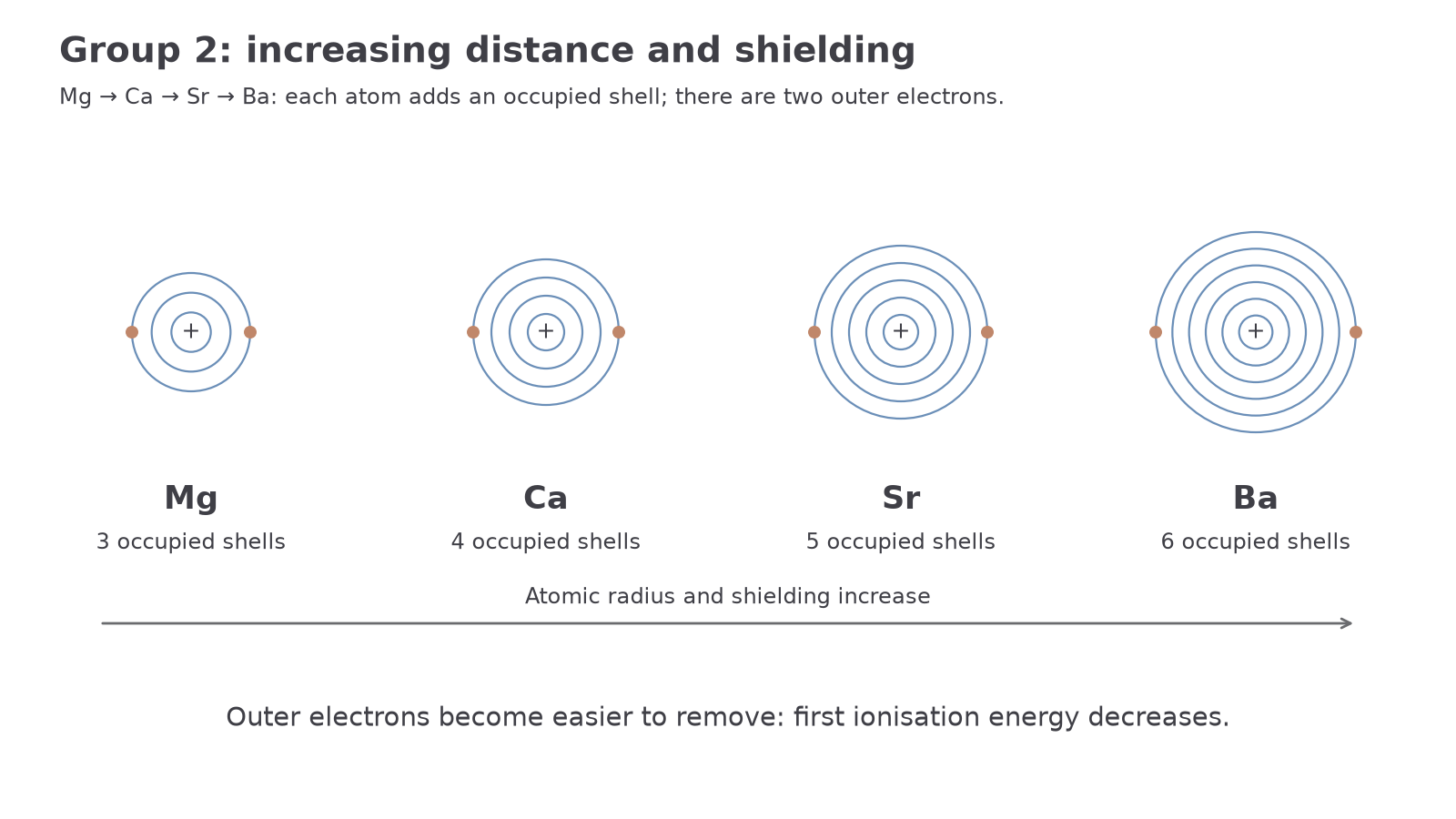
Nuclear charge increases down the group, but the extra distance and shielding outweigh it. The first and second ionisation energies are relatively low compared with the third: after two outer electrons are removed, the next electron is in an inner shell. For example, a large jump between the second and third successive ionisation energies is evidence for two outer-shell electrons, not three.
Metallic bonding and melting point
Group 2 elements are metals with giant metallic structures.
Metallic bonding
The electrostatic attraction between positive metal ions and delocalised electrons in a giant lattice.
In a Group 2 metal, each atom contributes two electrons to the sea of delocalised electrons and becomes a positive ion in the lattice. Going down the group, the metal ions get larger. The delocalised electrons are therefore, on average, further from the positive nuclei, so the electrostatic attraction is weaker.
That is why the melting points generally decrease down the group from calcium to barium: weaker metallic bonding means less energy is needed to melt the lattice. Magnesium is an anomaly with an unexpectedly low melting point, but the main trend is still explained by bonding: larger ions lead to weaker metallic bonding overall down the group.
So the change is not simply "bigger atoms". In the giant metallic lattice, the greater distance between positive ions and delocalised electrons weakens the electrostatic attraction.
Reactions with water
The reactions with water show the increase in reactivity very clearly. Calcium, strontium, and barium all react with cold water to form the metal hydroxide and hydrogen:
As you go down from to , the reaction becomes more vigorous because the metal loses electrons more easily. You would see faster fizzing and a more rapid disappearance of the metal. The solution produced is alkaline because hydroxide ions are formed.
Oxidation
Oxidation is loss of electrons.
In these reactions, the metal is oxidised from oxidation state to . Hydrogen in water is reduced from to , so these are redox reactions.
Magnesium behaves differently. It reacts only very slowly with cold water, partly because magnesium is less reactive than the metals below it and partly because the small amount of formed is only sparingly soluble, so it coats the metal and slows further reaction. With steam, however, magnesium reacts much faster:
Magnesium with cold water and magnesium with steam are genuinely different reactions. With steam, the product is oxide, not hydroxide.
The diagram below compares the reactions with water and includes the separate steam reaction for magnesium.
[DIAGRAM: asset_name: 2.2 - Group 2, the Alkaline Earth Metals - Diagram 2; asset_slug: 2.2 - Group 2, the Alkaline Earth Metals - Diagram 2; recommended_method: retained_png; description: Four test tubes labelled Mg, Ca, Sr and Ba containing cold water and metal strips; Mg shows almost no fizzing, Ca gentle fizzing, Sr vigorous fizzing and Ba very vigorous fizzing. A separate equation panel distinguishes hot Mg with steam, forming white MgO and H2.]
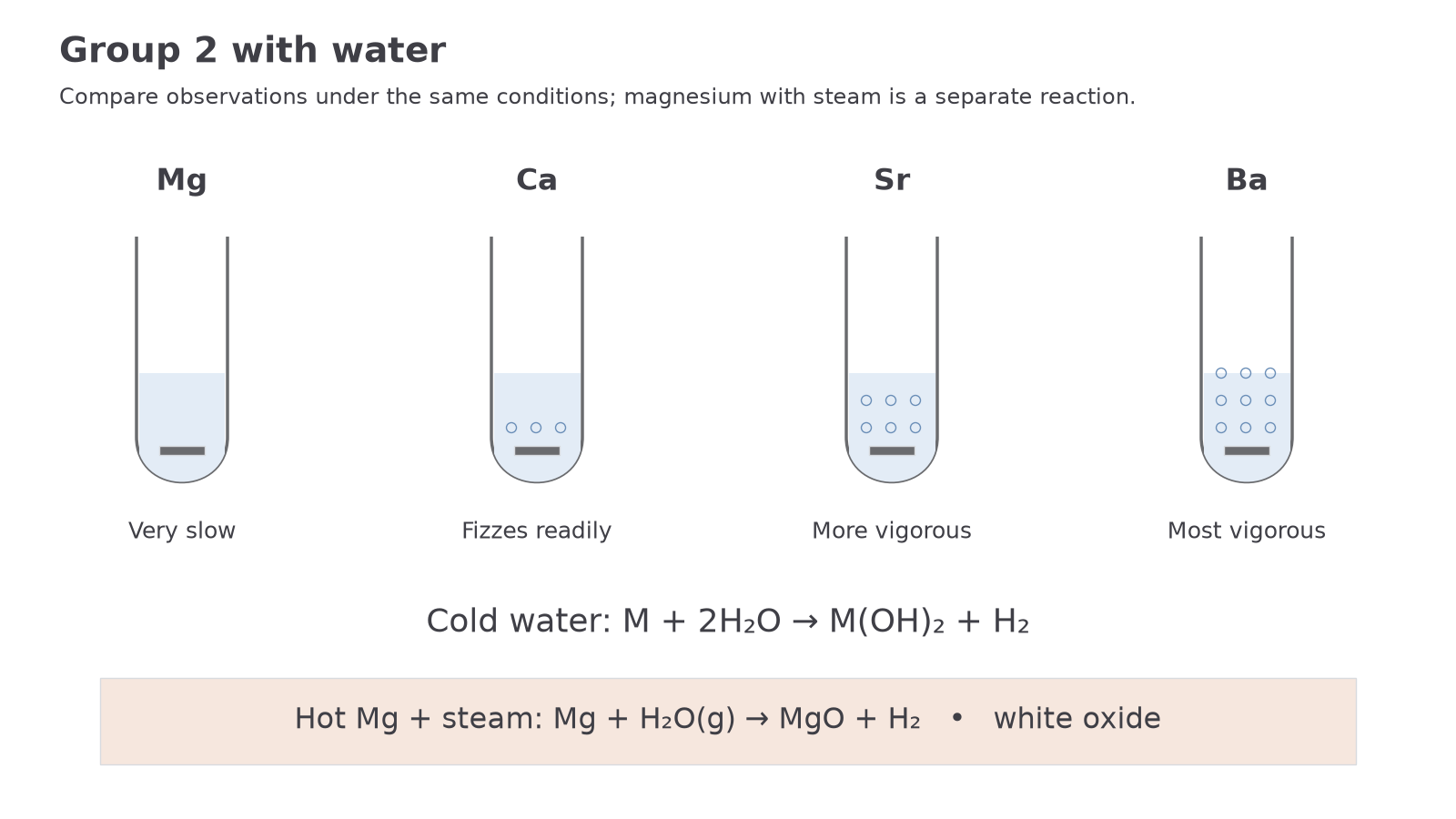
To compare rates fairly, use small freshly cleaned pieces with comparable exposed surface areas and the same water volume and temperature. Start timing when each piece enters the water; compare gas volume in a fixed time, rather than bubble size alone. Record fizzing, disappearance of metal and the indicator colour separately from the explanation. A teacher-supervised magnesium–steam demonstration requires a heat-resistant tube, an unobstructed gas outlet and protection against hot apparatus and hydrogen ignition. Its white solid is magnesium oxide.
Continue this lesson.
You’re previewing NovaLearn without an account. Create a free account to read the rest.
Create free account