3.3.6.2 - Mass Spectrometry
Mass spectrometry is especially useful when a chemist needs the molecular formula of an unknown compound. The key idea here is that a high-resolution mass spectrometer measures the mass of the molecular ion so precisely that formulae with the same rounded can still be told apart. We can then compare that precise molecular mass with values calculated from precise atomic masses to see which formula really fits.
What the key peak represents
When a molecule is ionised in a mass spectrometer, one important possibility is that it forms a positive ion without breaking apart. That ion keeps the same molecular formula as the original molecule, so it is the best starting point when you want the molecular formula.
Molecular ion
A molecular ion is a positive ion formed when a molecule loses one electron but remains otherwise intact, so it has the same molecular formula as the original molecule.
At this level, the molecular ion is usually treated as having a charge of +1. That means its mass-to-charge ratio, written as , is numerically the same as its mass. So if the molecular ion peak appears at , the molecule has a precise relative molecular mass of 60.0210.
The important word here is precise. A low-resolution spectrum might only suggest a value of 60, but that alone is not enough to pin down one unique formula. High-resolution mass spectrometry gives several decimal places, and those decimal places are what make the method powerful.
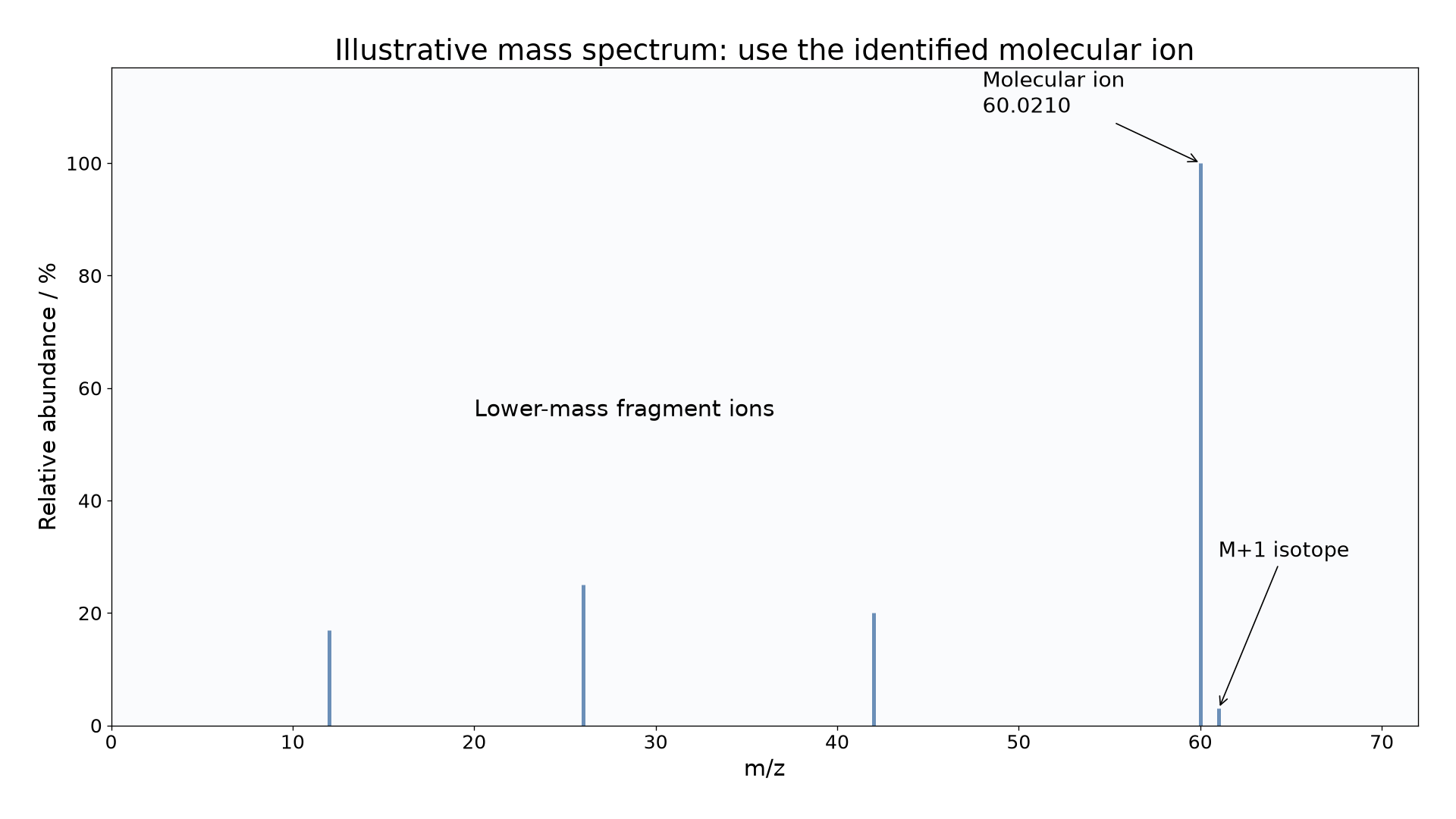
The diagram below shows a simplified high-resolution mass spectrum. The tall molecular ion peak at is the one used for molecular-formula work, while the smaller lower-mass peaks are fragments and the tiny peak just to the right is the peak.
[DIAGRAM: asset_name: 3.6.2 - Mass Spectrometry - Diagram 1; asset_slug: 3.6.2 - Mass Spectrometry - Diagram 1; recommended_method: retained_png; description: Simplified high-resolution mass spectrum drawn as thin vertical peaks on a white background, with x-axis labelled m/z and y-axis labelled relative abundance. Show small fragment peaks at lower m/z values around 12, 26, and 42, one tall molecular ion peak labelled "molecular ion peak 60.0210", and a tiny M+1 peak just to the right near 61. Label the molecular ion peak "use this for molecular formula" and label the lower-mass peaks "fragments - not used for this calculation".]
Why whole numbers are not enough
Different atoms do not all have exact whole-number masses. Carbon-12 is exactly 12.0000 by definition, but hydrogen, nitrogen, and oxygen are not exact integers. That means two different molecular formulae can both round to the same whole-number while still having different exact masses.
For example, some useful precise atomic masses are:
- C = 12.0000
- H = 1.0078
- N = 14.0031
- O = 15.9949
Exact molecular mass
So the method is not "spot the formula with the right whole number". It is "calculate the exact mass of each possible formula, then compare with the precise molecular ion mass". That is why you need both precise atomic masses and a precise molecular mass.
If you round too early, you can lose the tiny difference that separates the correct formula from the wrong one. Keep the decimal places until the final comparison.
Continue this lesson.
You’re previewing NovaLearn without an account. Create a free account to read the rest.
Create free account