3.3.11.2 - Amines as Bases
Amines behave like ammonia because the nitrogen atom has a lone pair that can bond to a proton. The key question in this topic is not just whether they are bases, but how the availability of that lone pair changes from one compound to another. By the end of the lesson, you should be able to explain why primary aliphatic amines are stronger bases than ammonia, while primary aromatic amines are weaker.
Why amines are weak bases
A base is a proton acceptor, so amines act as bases because the nitrogen lone pair can form a bond to . For a primary amine in water, the reaction is:
Weak base
A weak base is a base that only partially reacts with water, so the equilibrium lies mainly to the left.
This is why amines are described as weak bases. They do accept protons, but only a small proportion of amine molecules are protonated at any one time. Here, "weak" is about the position of equilibrium, not about concentration. A concentrated amine solution can still contain a weak base.
Ammonia behaves in the same general way:
So when you compare ammonia with amines, the chemistry is similar in type. The difference is how easily the nitrogen lone pair can reach out and bond to a proton.
The diagram below compares ammonia, methylamine and phenylamine. It shows that each can accept a proton through the nitrogen lone pair, but that the key difference is how available that lone pair is.
[DIAGRAM: asset_name: 3.11.2 - Base Properties (Amines) - Diagram 1; asset_slug: 3.11.2 - Base Properties (Amines) - Diagram 1; recommended_method: code_generated; description: Explicit nitrogen lone pairs on ammonia, methylamine and phenylamine donating to H+, with conventional aqueous basicity order.]
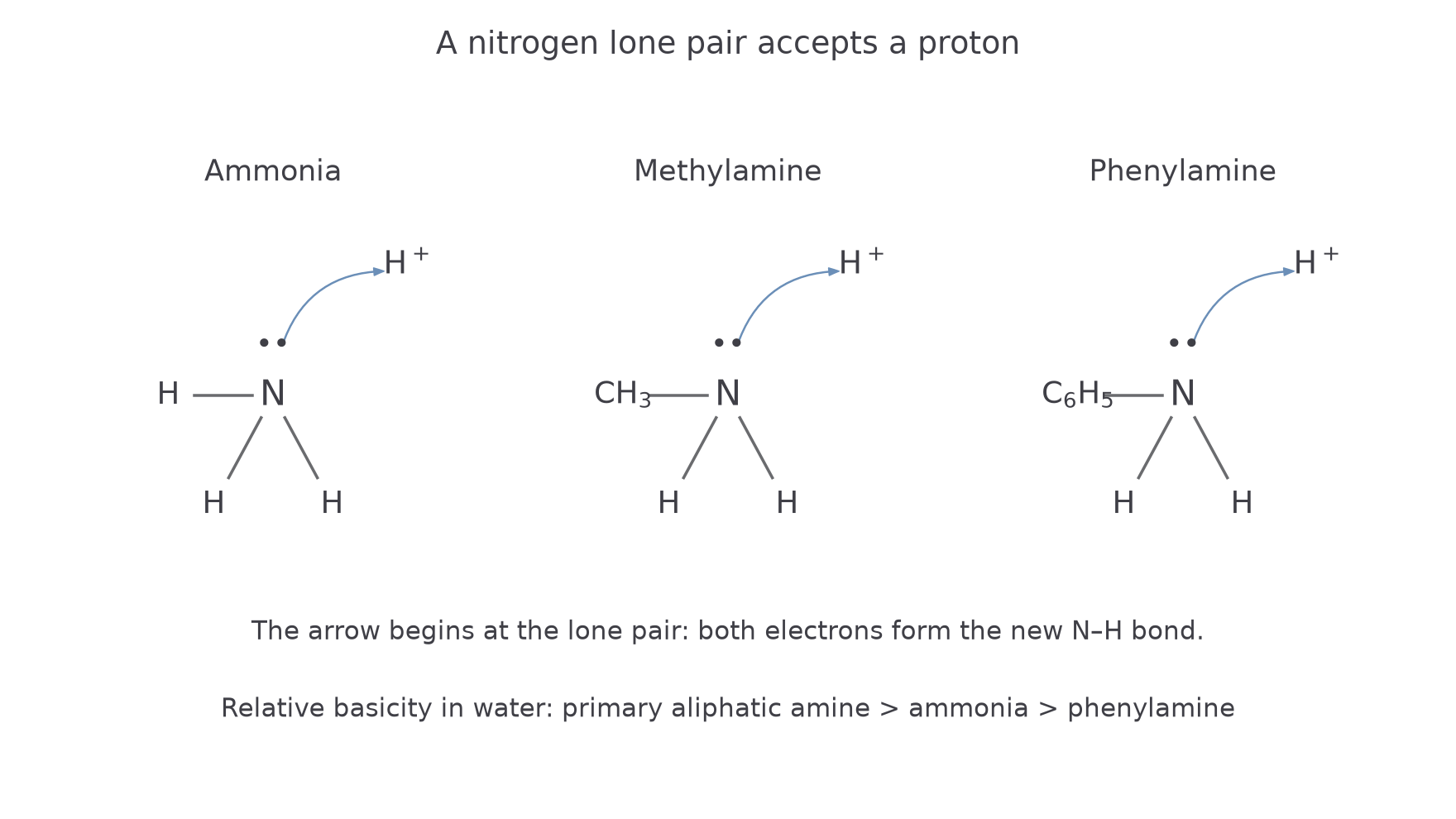
That idea of partial protonation is the foundation for the rest of the lesson. Base strength depends on how available the lone pair is on the nitrogen atom.
Why primary aliphatic amines are stronger bases than ammonia
Now compare ammonia with a primary aliphatic amine such as methylamine, , or ethylamine, . In ammonia, the nitrogen lone pair is available for bonding to , but in a primary aliphatic amine the attached alkyl group pushes electron density towards the nitrogen atom.
Inductive effect
The inductive effect is the permanent pulling or pushing of electron density through sigma bonds caused by the groups attached to an atom.
The historically accepted AQA explanation treats alkyl groups as having a positive inductive effect. That means they release electron density towards the nitrogen atom, making the lone pair more concentrated around nitrogen and therefore more available to bond to a proton. A more available lone pair means a stronger base.
So the comparison is simple. In ammonia, the lone pair is available on nitrogen. In a primary aliphatic amine, the electron-releasing alkyl group makes that lone pair even more available. That is why a primary aliphatic amine is a stronger base than ammonia.
The diagram below shows this comparison directly. The methyl group in methylamine releases electron density towards nitrogen, so the lone pair is more available than it is in ammonia.
[DIAGRAM: asset_name: 3.11.2 - Base Properties (Amines) - Diagram 2; asset_slug: 3.11.2 - Base Properties (Amines) - Diagram 2; recommended_method: retained_png; description: Side-by-side comparison of NH3 and CH3NH2. Show the lone pair on each nitrogen as two dots above N. In CH3NH2, add a small arrow along the C-N bond pointing towards N and label it "alkyl group releases electron density". Label the methylamine lone pair "more available".]
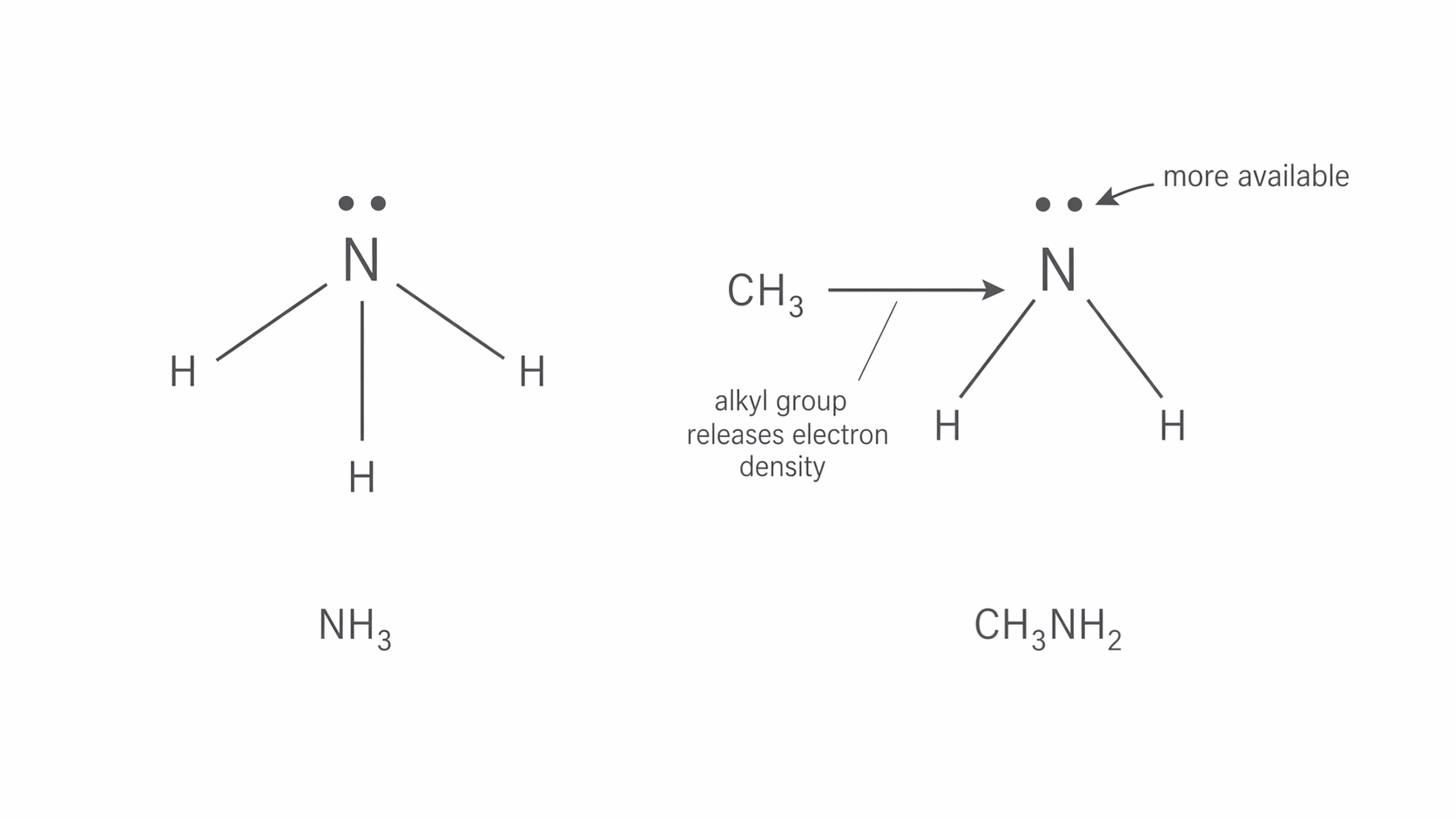
The useful habit here is not to stop at "because of the alkyl group". Follow the full chain: the alkyl group releases electron density, the lone pair on nitrogen becomes more available, and the molecule accepts a proton more readily.
Keep the chemistry thread clear here: stronger base means "more available lone pair", not simply "more electrons somewhere in the molecule". AQA’s 5 February 2025 guidance permits this historical account throughout the current specification and also credits scientifically coherent answers informed by newer research about alkyl groups.
Continue this lesson.
You’re previewing NovaLearn without an account. Create a free account to read the rest.
Create free account