3.3.16 - Chromatography
Chromatography is used when we need to separate and identify substances in a mixture that may look very similar. The key idea is simple: each substance divides its time differently between a moving phase and a stationary phase. In this lesson, you will see how that idea explains thin-layer chromatography, column chromatography, gas chromatography, and the extra identifying power of GC-MS.
Why chromatography separates mixtures
Chromatography works because different substances are not equally attracted to the two phases involved in the separation.
Chromatography
A method used to separate the components of a mixture because each component has a different balance between movement with a mobile phase and retention by a stationary phase.
The mobile phase is the part that moves. It may be a liquid, such as a solvent, or a gas. The stationary phase stays in place and holds substances back to different extents. A substance that is more soluble in the mobile phase, or less strongly attracted to the stationary phase, will move faster. A substance that is less soluble in the mobile phase, or more strongly retained by the stationary phase, will move more slowly.
That means separation depends on a balance. You should not think of a substance as "liking" only one phase. Instead, it is constantly partitioning between the two. Even substances that are quite similar can still separate because the balance is slightly different for each one.
This is also why identification must be done carefully. An value or a retention time is useful only when it is compared with a standard analysed under the same conditions. Change the solvent, temperature, stationary phase, or gas flow, and the value can change as well.
Thin-layer chromatography and Rf values
Thin-layer chromatography, or TLC, uses a plate coated with a solid such as silica or alumina as the stationary phase. A solvent acts as the mobile phase and rises up the plate. The mixture is spotted near the bottom on a pencil baseline, with the solvent level starting below the spot so the sample does not dissolve straight into the solvent reservoir.
The diagram below shows the solvent starting below the pencil baseline and rising up the TLC plate until the solvent front is marked near the top.
[DIAGRAM: asset_name: 3.16 - Chromatography - Diagram 1; asset_slug: 3.16 - Chromatography - Diagram 1; recommended_method: retained_png; description: Front-on TLC setup in a sealed chamber. Show a covered chamber with a shallow solvent level at the bottom, one TLC plate standing vertically, a pencil baseline clearly above the solvent, one small sample spot on the baseline, and a solvent front line marked near the top of the plate. Label the stationary phase on the plate, the mobile phase in the solvent reservoir, the baseline, the sample spot, the solvent level, the solvent front, and the chamber lid.]
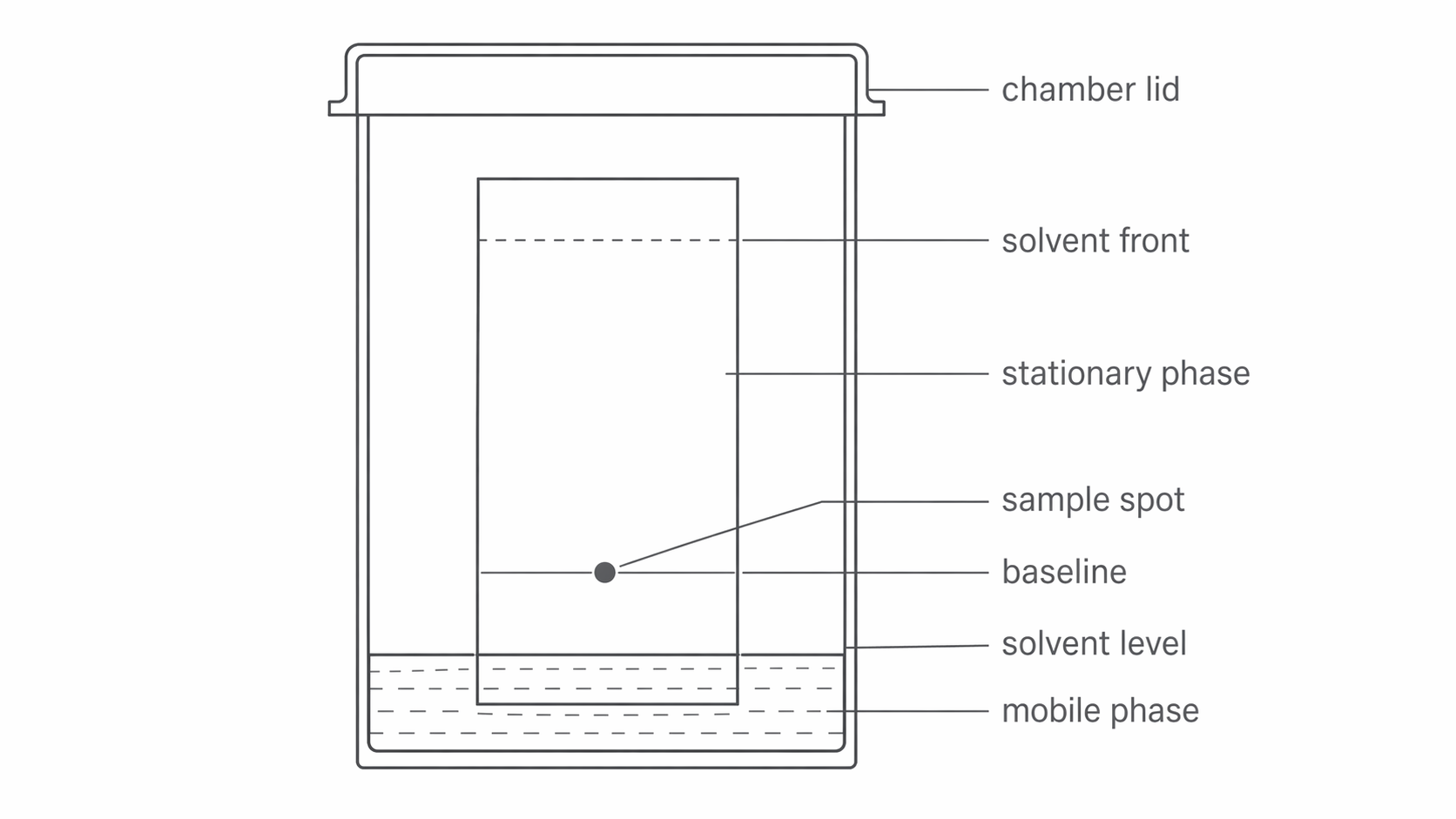
As the solvent rises, the components of the mixture move at different speeds. More strongly retained substances stay lower on the plate. Substances that spend more time dissolved in the solvent travel further. Once the solvent front is near the top, the plate is removed and the solvent front is marked immediately. Colourless substances may then be revealed using UV light or a locating agent.
Rf value
The ratio of the distance moved by a substance to the distance moved by the solvent front on a chromatogram.
For TLC:
Rf value
Both distances are measured from the baseline, to the centre of a spot or the solvent front. A spot cannot move beyond the solvent front, so . The ratio is dimensionless; a spot at the baseline has and one at the solvent front has .
Suppose a spot moves 2.8 cm and the solvent front moves 3.5 cm. Then:
That value can be compared with standards run on the same plate, or at least under the same conditions, to help identify the substance. A match is useful evidence, but only when the comparison was made under the same conditions.
For an actual TLC run, use the solvent-specific risk assessment: keep flammable solvents away from ignition sources, avoid inhaling vapour, and use eye protection and suitable ventilation. Reveal spots in a shielded UV cabinet so eyes and skin are not exposed directly. The detailed extraction, spotting and measurement sequence is developed in Required practical 12.
Continue this lesson.
You’re previewing NovaLearn without an account. Create a free account to read the rest.
Create free account