3.3.1.1 - Nomenclature
Organic chemistry becomes much easier when you can move fluently between a name, a formula, and a structure. This lesson builds that fluency. You will learn what the main organic formula types show, what makes compounds belong to the same homologous series, and how to name or build simple organic molecules with chains or rings of up to six carbons.
Representing organic compounds
In organic chemistry, different formula types answer different questions. Sometimes you only need the ratio of atoms. Sometimes you need the exact number of atoms. Sometimes you need the arrangement of the atoms and bonds.
Empirical formula
The simplest whole-number ratio of the atoms of each element in a compound.
For example, but-2-ene has molecular formula , but its empirical formula is . Those are not interchangeable: tells you the actual composition of one molecule, whereas only tells you the simplest ratio.
A few representations you must be able to recognise are:
- Molecular formula: the actual number of each type of atom, for example .
- General formula: the formula shared by a homologous series, for example acyclic alkenes with one double bond are .
- Structural formula: a condensed arrangement of the atoms, for example .
- Displayed formula: every atom and every bond is shown.
- Skeletal formula: carbon atoms are implied by line ends and vertices; hydrogens bonded to carbon are omitted; heteroatoms such as O, , and are shown.
The diagram below places the main representations of but-2-ene side by side, so you can see exactly what each one includes and what each one leaves out.
[DIAGRAM: asset_name: 3.1.1 - Nomenclature - Diagram 1; asset_slug: 3.1.1 - Nomenclature - Diagram 1; recommended_method: retained_png; description: Five-panel comparison of but-2-ene representations: molecular formula C4H8; empirical formula CH2; structural formula CH3CH=CHCH3; a correct displayed formula for CH3-CH=CH-CH3 with the double bond between the middle carbons; and the corresponding skeletal line-angle formula.]
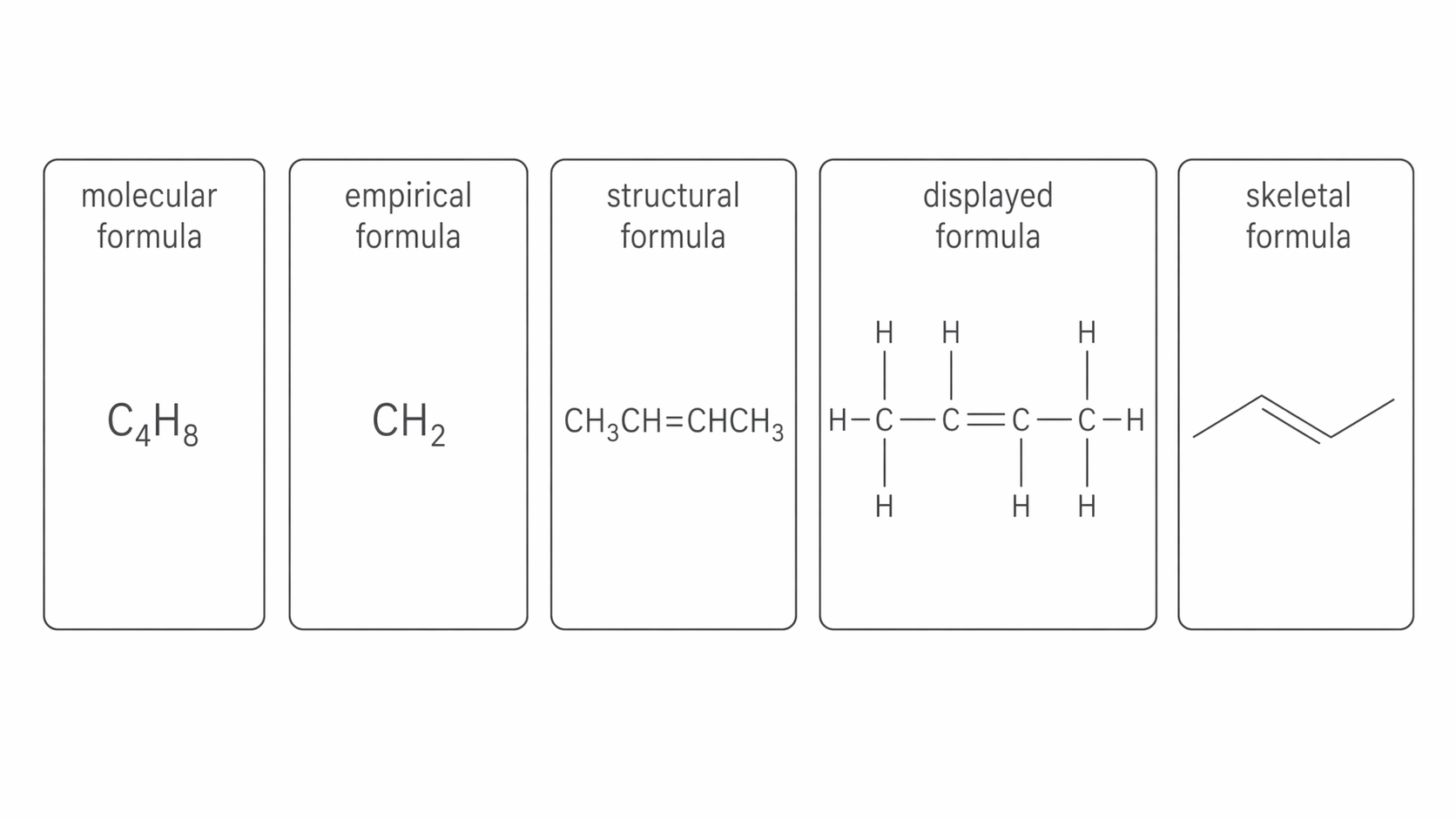
A skeletal formula is especially useful once molecules become larger, because it makes the carbon framework much easier to read quickly. For rings, the ring is drawn as a polygon, so cyclohexane appears as a hexagon rather than six written carbon atoms.
That distinction matters because chemists switch between representations depending on what they need to show. If you treat them as interchangeable, you can misread the molecule from the start.
Homologous series and roots
Organic compounds are usually learned in families rather than as isolated molecules. That is what makes naming patterns predictable.
Homologous series
A family of organic compounds with the same functional group and the same general formula, in which successive members differ by .
Members of a homologous series have similar chemical reactions because the same functional group controls the chemistry. Their physical properties change more gradually with chain length. For example, boiling point tends to increase as molecules get larger because intermolecular forces become stronger.
Functional group
The atom or group of atoms in an organic molecule responsible for its characteristic reactions.
So, all alkenes contain a functional group, all alcohols contain -, and all haloalkanes contain a halogen atom attached to the carbon chain. Changing the length of the hydrocarbon chain changes the size of the molecule, but it does not remove the key reactive feature.
For names up to six carbons, you need these roots:
| Number of carbons | 1 | 2 | 3 | 4 | 5 | 6 |
|---|---|---|---|---|---|---|
| Root | meth- | eth- | prop- | but- | pent- | hex- |
You then combine the root with a suffix or prefix:
- -ane for an alkane
- -ene for an alkene
- -ol for an alcohol
- cyclo- for a ring
- chloro-, bromo-, iodo-, fluoro- for halogen substituents
Other functional groups use the same parent-chain logic. Learn the following endings alongside the groups as you meet them; the carbon of an aldehyde, carboxylic acid, nitrile or amide belongs to the parent chain.
| Group | Naming pattern | Example |
|---|---|---|
| Aldehyde, terminal | -al | , ethanal |
| Ketone, internal | -one, with position if needed | , propanone |
| Carboxylic acid, | -oic acid | , ethanoic acid |
| Ester, | alkyl alkanoate | , ethyl ethanoate |
| Nitrile, | -nitrile | , propanenitrile |
| Amine, | -amine | , ethylamine (ethanamine) |
| Amide, | -amide | , ethanamide |
In an ester name, the alkyl name comes from the alcohol side of the oxygen; the alkanoate name includes the carbonyl carbon. Thus methyl propanoate is , not . A benzene ring has six carbons: methylbenzene has a methyl group attached to that ring. Cyclohexane and benzene have different bonding and are not alternative names.
Continue this lesson.
You’re previewing NovaLearn without an account. Create a free account to read the rest.
Create free account