3.1.12.2 - Definition and Determination of pH
pH gives chemists a compact way to describe hydrogen ion concentration in aqueous solution. That matters because the values involved are often very small, so writing them directly in standard form can make patterns hard to spot. In this lesson, you will learn exactly what pH means, how to convert between pH and , and how to calculate the pH of a strong acid from its concentration.
What pH Means
The concentration of hydrogen ions in solution can vary over many powers of ten. For example, a solution with is far more acidic than one with . A logarithmic scale makes that wide range easier to handle.
pH
pH is the negative logarithm to base 10 of the hydrogen ion concentration in aqueous solution. In symbols, .
In this expression, the square brackets mean concentration in . The minus sign is important: because the log of a number smaller than 1 is negative, the extra minus sign turns the answer into a positive pH value in most familiar aqueous solutions.
One pH unit corresponds to a tenfold change in hydrogen ion concentration. So a solution of pH 2 has ten times the hydrogen ion concentration of a solution of pH 3, and one hundred times the hydrogen ion concentration of a solution of pH 4.
The diagram below links selected pH values to hydrogen ion concentration and makes the tenfold change between neighbouring pH values easier to see.
[DIAGRAM: asset_name: 1.12.2 - Definition and Determination of pH - Diagram 1; asset_slug: 1.12.2 - Definition and Determination of pH - Diagram 1; recommended_method: retained_png; description: Clean horizontal pH scale labelled 0 to 14 with evenly spaced tick marks. Emphasise pH 1, pH 3, and pH 7 with filled dots and vertical guide lines down to the labels pH 1, pH 3, and pH 7, and place the matching hydrogen ion concentrations beneath them as 1.0 × 10^-1 mol dm^-3, 1.0 × 10^-3 mol dm^-3, and 1.0 × 10^-7 mol dm^-3. Add a left-pointing arrow above the scale labelled lower pH means higher [H+]. Include a note at the lower right that each step of 1 pH unit changes [H+] by a factor of 10.]
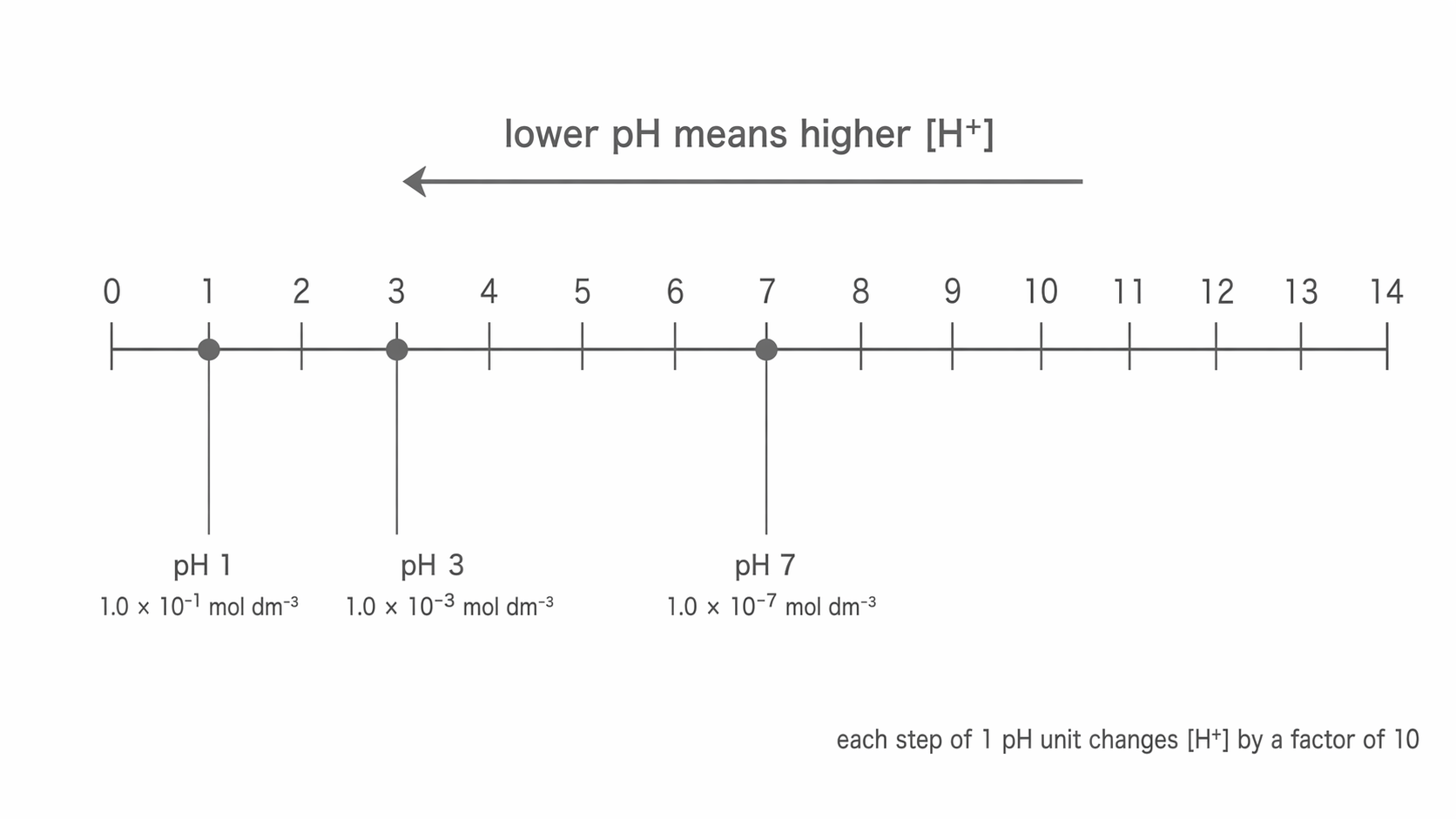
The key idea is that pH is not a separate property unrelated to concentration. It is simply a different way of expressing , chosen because it is much easier to compare.
Converting Between [H+] and pH
To find pH from hydrogen ion concentration, substitute the concentration into the formula and use the button on your calculator:
pH and hydrogen ion concentration
- in ; pH has no unit and is usually given to 2 decimal places
- a change of 1 pH unit is a tenfold change in
Worked example: if ,
pH values are usually written to 2 decimal places unless a different level of precision is specified.
To go the other way, rearrange the formula:
Worked example: if ,
This is the antilog step that students often miss. A negative pH does not mean a negative concentration. Always use the exponent : if pH is negative, that exponent is positive. For example, pH = -1 gives in the concentration-based A-level model.
Continue this lesson.
You’re previewing NovaLearn without an account. Create a free account to read the rest.
Create free account