3.3.2.4 - Chlorination of Alkanes
When methane reacts with chlorine, the visible outcome is simple: one hydrogen atom is replaced by a chlorine atom. The interesting chemistry lies in how that replacement happens. This lesson shows the reaction as a free-radical substitution mechanism and breaks it into the three stages: initiation, propagation, and termination.
Starting the reaction
The first substitution can be summarised by the overall equation:
The reaction is described as a substitution because a hydrogen atom in methane is replaced by a chlorine atom.
Free-radical substitution
A substitution reaction in which a free radical causes an atom or group in a molecule to be replaced by another atom or group.
For the mechanism to begin, chlorine molecules must first produce reactive particles.
Free radical
A species with an unpaired electron. Free radicals are very reactive because the unpaired electron makes them unstable.
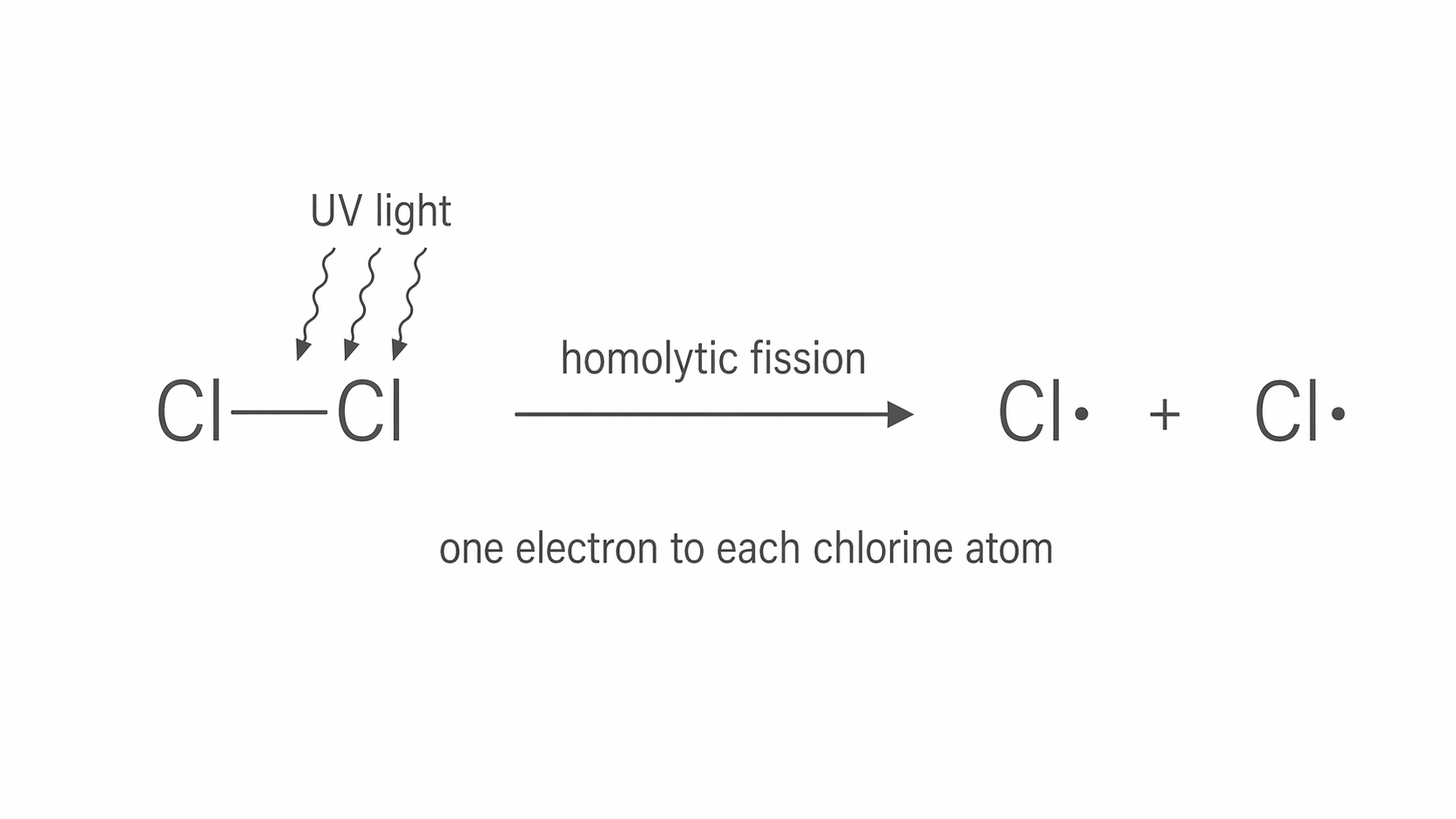
UV light provides enough energy for the bond to break by homolytic fission. That means the bonding pair splits equally, so one electron goes to each chlorine atom:
This is the initiation step because it creates the radicals that start the chain. A common mix-up is to write chlorine ions here, but there are no charges involved: these are chlorine atoms with single unpaired electrons.
The diagram below shows the chlorine molecule absorbing UV light and splitting evenly into two chlorine radicals.
[DIAGRAM: asset_name: 3.2.4 - Chlorination of Alkanes - Diagram 1; asset_slug: 3.2.4 - Chlorination of Alkanes - Diagram 1; recommended_method: retained_png; description: Exam-clean monochrome chemistry mechanism diagram on a pure white background, in a wide 16:9 layout. On the left, show a chlorine molecule as Cl-Cl with the bond clearly visible. Above the bond, add "UV light". Draw a reaction arrow labelled exactly "homolytic fission" to two separated chlorine radicals on the right. Show each radical as Cl with one unpaired electron dot, with no charges anywhere. Add the note exactly "one electron to each chlorine atom". Use only fine grey lines and light sans-serif labels, with no decorative effects or extra species.]
Propagation and the chain reaction
Once a chlorine radical has formed, the reaction can continue without UV being involved in every single step. The mechanism now enters propagation, the stage in which a radical reacts to form another radical.
The first propagation step is:
The chlorine radical removes a hydrogen atom from methane. This forms hydrogen chloride and leaves a methyl radical.
The second propagation step is:
Now chloromethane is formed, and a new chlorine radical is regenerated. That detail matters: the radical is not used up overall during propagation. Instead, one radical creates another radical, so the sequence can repeat again and again.
This is why chlorination of methane is called a chain reaction. The chain keeps running until radicals are removed in termination. A compact way to say it is: propagation steps regenerate a free radical, so the reaction can continue.
You can also now see why the reaction is specifically a free-radical substitution:
- free radical: the reacting intermediate is a radical
- substitution: one H atom in methane has been replaced by a atom
If chloromethane remains in the reaction mixture, further substitutions can happen because it still contains bonds. That is why free-radical chlorination is difficult to control perfectly, but for this specification point the main focus is the mechanism for methane with chlorine.
Continue this lesson.
You’re previewing NovaLearn without an account. Create a free account to read the rest.
Create free account