Required practical 10 - Organic Purification and Purity
Required Practical 10 is really about control and separation. The starting reaction can vary, but the core chemistry stays the same: make the product, remove impurities without losing too much of it, and then use a physical property to judge how pure it is. Once the purpose of each stage is clear, the practical stops feeling like a list of apparatus and starts feeling like a sequence of deliberate chemical choices.
The overall plan
In this required practical, the product may be a solid such as aspirin or methyl 3-nitrobenzoate, or it may be a liquid organic product. The exact reaction changes, but the workflow always has the same shape: run the reaction safely, isolate the crude product, purify it, then test purity. Accurate measurement of masses, volumes, and temperatures matters throughout, because yield and purity judgements are only useful if the practical method is controlled carefully.
Reflux
Reflux is continuous boiling and condensing of a reaction mixture so it can be heated for a sustained time without losing volatile reactants or products.
When heating organic mixtures, a water bath, electric heater, or sand bath is safer than a naked flame because many organic liquids are flammable. Anti-bumping granules are added before heating starts so the liquid boils smoothly rather than ejecting hot liquid violently.
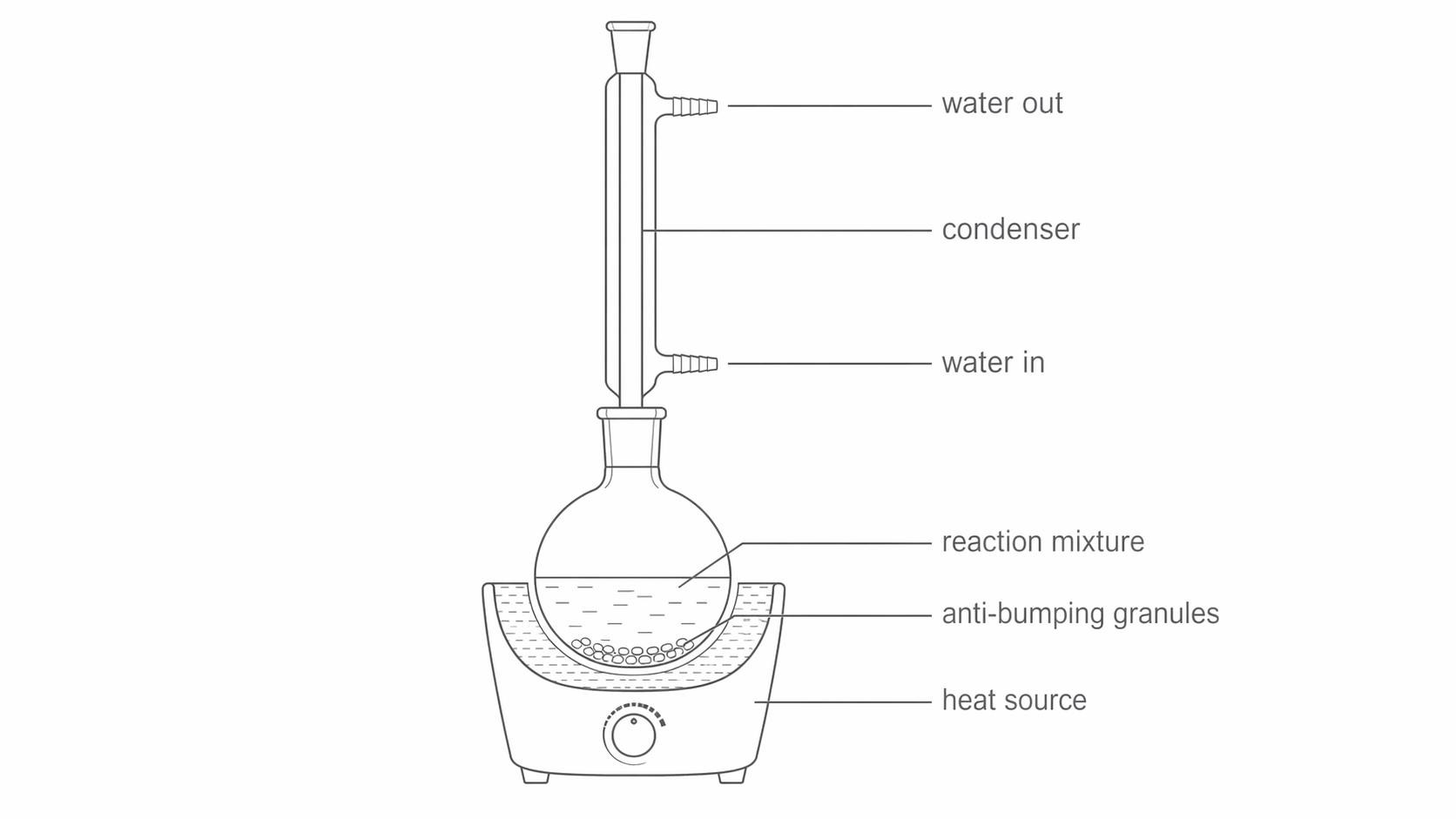
The diagram below shows a standard reflux setup, with cooling water entering the condenser at the bottom and leaving at the top so the condenser jacket stays full.
[DIAGRAM: asset_name: RP 10 - Preparation of a Pure Organic Solid and Test of Its Purity - a Pure Organic Liquid - Diagram 1; asset_slug: RP 10 - Preparation of a Pure Organic Solid and Test of Its Purity - a Pure Organic Liquid - Diagram 1; recommended_method: retained_png; description: Labelled vertical reflux apparatus showing a round-bottom flask containing reaction mixture and anti-bumping granules, heated by a safe heat source such as a water bath or heating mantle, with a condenser above and cooling water entering at the bottom and leaving at the top.]
A good mental model is this:
- for a solid product, purification usually means recrystallisation, filtration, washing, drying, and then melting point
- for a liquid product, purification usually means separation of layers, drying, distillation, and then boiling point
The rest of the lesson explains why each of those stages works.
Use the centre's written procedure and risk assessment. For example, a supervised aspirin preparation mixes measured salicylic acid and ethanoic anhydride with a few drops of acid catalyst, warms the mixture in a controlled water bath, then cools it before carefully adding water to destroy excess anhydride and precipitate crude aspirin. Collect the crude solid before recrystallising it. A supervised ethyl ethanoate preparation instead heats ethanol and ethanoic acid with a small amount of sulfuric acid catalyst under reflux, then separates, washes, dries and distils the ester. Quantities and heating times come from the validated procedure; do not improvise them.
Clamp the flask and condenser securely to a stand without sealing the condenser top. Cooling water enters at the lower connection and leaves at the upper connection. A heated closed apparatus can pressurise. Record actual reagent masses and volumes with instrument resolution and units, the observations during heating/cooling, and any departure from the method.
Purifying an organic solid
If the desired organic product is a solid, the first isolated sample is usually crude. It can contain leftover reactants, catalyst, acid, solvent, or side-products. The aim is to keep the desired compound but remove as many of those impurities as possible.
Recrystallisation
Recrystallisation is purification of a solid by dissolving the impure sample in hot solvent and then allowing purer crystals to form as the solution cools.
A suitable solvent is one in which the product dissolves well when hot but only slightly when cold. That matters because you want the product to go fully into solution at high temperature, then come back out as crystals when the temperature falls.
A typical sequence is:
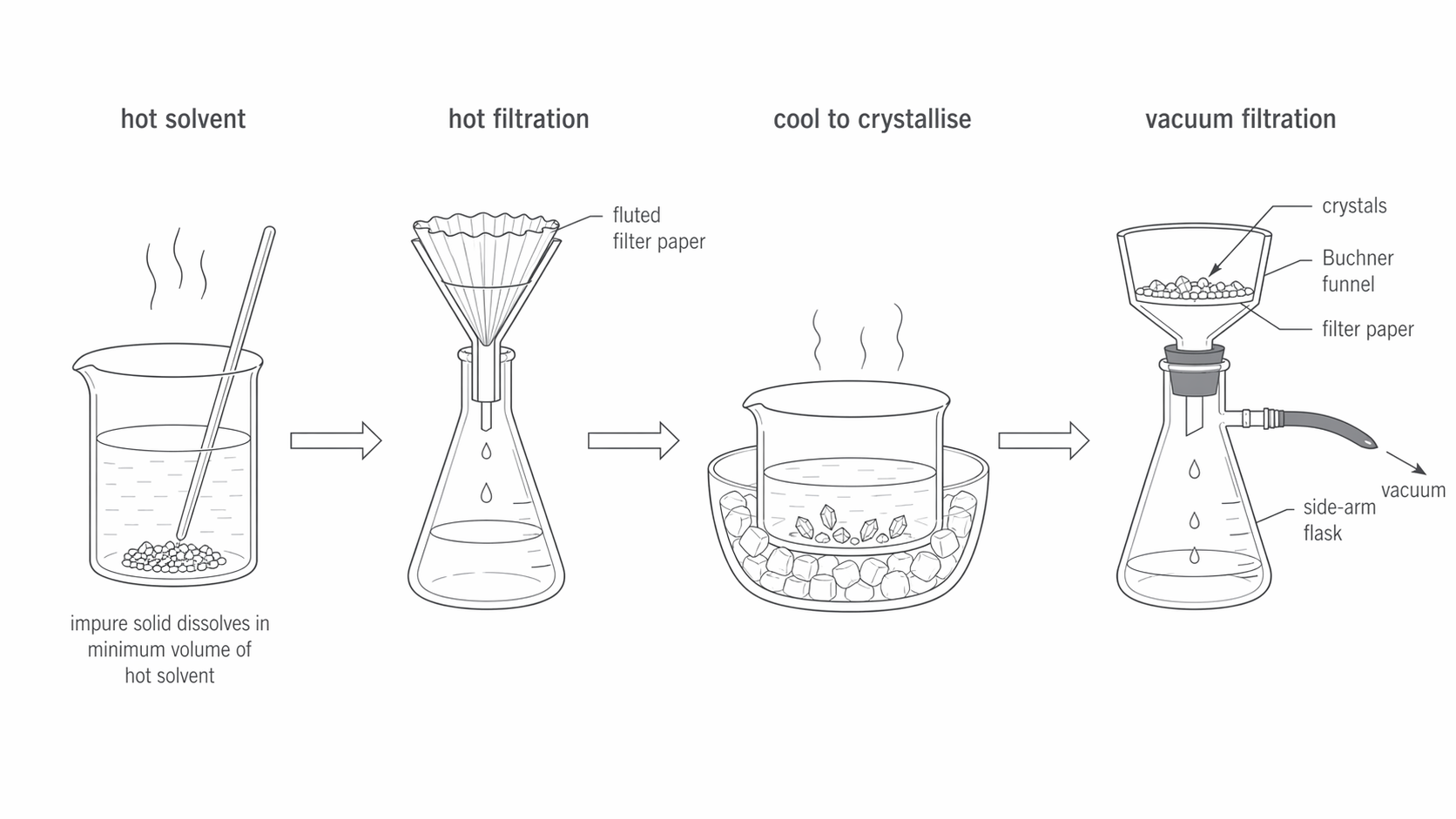
- Dissolve the impure solid in the minimum volume of hot solvent.
- Hot-filter the solution, often through fluted filter paper, to remove insoluble impurities.
- Allow the filtrate to cool slowly, then cool further in ice if needed.
- Collect the crystals by filtration, often vacuum filtration using a Buchner funnel and flask.
- Wash the crystals with a small amount of cold solvent or cold distilled water.
- Dry the crystals before measuring melting point or calculating yield.
Each step has a reason. The minimum volume of hot solvent keeps the solution close to saturation, so more product crystallises out on cooling. Hot filtration is done quickly so crystals do not form in the funnel. Slow cooling usually gives better-formed crystals; an ice bath can then increase yield further once crystallisation has begun. Washing must be cold so impurities are removed without dissolving too much product.
The diagram below summarises the main recrystallisation sequence from dissolving the crude sample to collecting purified crystals by vacuum filtration.
[DIAGRAM: asset_name: RP 10 - Preparation of a Pure Organic Solid and Test of Its Purity - a Pure Organic Liquid - Diagram 2; asset_slug: RP 10 - Preparation of a Pure Organic Solid and Test of Its Purity - a Pure Organic Liquid - Diagram 2; recommended_method: retained_png; description: Four-stage recrystallisation sequence showing the impure organic solid dissolved in the minimum volume of hot solvent, hot filtration through fluted filter paper, cooling of the filtrate to form crystals, and final vacuum filtration using a Buchner funnel, filter paper, and side-arm flask.]
Purification is never perfect. Some product stays dissolved after recrystallisation, some crystals are lost during transfer or filtration, and a little material may be lost during washing. That means a purer sample often comes with a lower yield, so the chemist is balancing purity against how much product can be recovered.
For vacuum filtration, fit the Büchner funnel with filter paper covering its holes, wet the paper with the chosen solvent to seal it, and use a suitable thick-walled side-arm flask with a trap and suction. Disconnect the suction safely before turning off a water pump to avoid suck-back. Soluble impurities remain in the mother liquor; an insoluble impurity is removed at hot filtration. Dry crystals to constant mass where practical. Record the balance readings, calculate the limiting reagent and theoretical yield from the balanced equation, and report . Wet crystals falsely inflate the apparent yield.
Testing the purity of an organic solid
A purified solid is commonly tested by measuring its melting point.
Pure substance
A pure substance consists of a single element or compound, without other substances mixed with it. A pure compound usually has a sharp melting point or characteristic boiling point under stated conditions; these measurements provide evidence of purity.
A pure organic solid melts sharply at, or very close to, the data-book value. An impure sample usually melts at a lower temperature and over a wider range. That happens because impurities disrupt the regular crystal lattice, so less energy is needed to start melting. Residual solvent left after recrystallisation counts as an impurity too.
Continue this lesson.
You’re previewing NovaLearn without an account. Create a free account to read the rest.
Create free account