3.1.12.6 - Buffer Action
Buffers matter because many chemical and biological systems only work well over a narrow pH range. In this lesson, you will see what an acidic buffer and a basic buffer are, why they resist sudden pH change, and how to calculate the pH of an acidic buffer. The key idea is that a buffer contains both a species that can remove added acid and a species that can remove added base.
What a buffer contains
A buffer does not keep pH perfectly fixed. Instead, it keeps the pH approximately constant when the solution is diluted or when small amounts of acid or base are added.
Buffer solution
A buffer solution is a solution that resists large changes in pH when small amounts of acid or base are added, and whose pH changes only very slightly on dilution.
An acidic buffer contains a weak acid together with a salt of that weak acid. A common example is ethanoic acid, , mixed with sodium ethanoate, which supplies . The weak acid is important because most of it stays undissociated, so it can react with added base. The salt is important because it provides a high concentration of the conjugate base, which can react with added acid.
A basic buffer works in the same overall way, but with a weak base and the salt of that weak base. A common example is aqueous ammonia, , with ammonium chloride, which supplies .
One important vocabulary point is that weak does not mean dilute. A weak acid only partially dissociates. A concentrated solution of a weak acid can still be used to make a buffer.
How an acidic buffer resists pH change
Consider the weak acid equilibrium:
In an acidic buffer, the weak acid HA and the salt providing are both present in useful amounts.
Acidic buffer
An acidic buffer has a pH below 7 and contains a weak acid together with a salt supplying its conjugate base. The acid strength and the ratio of the two components determine the pH.
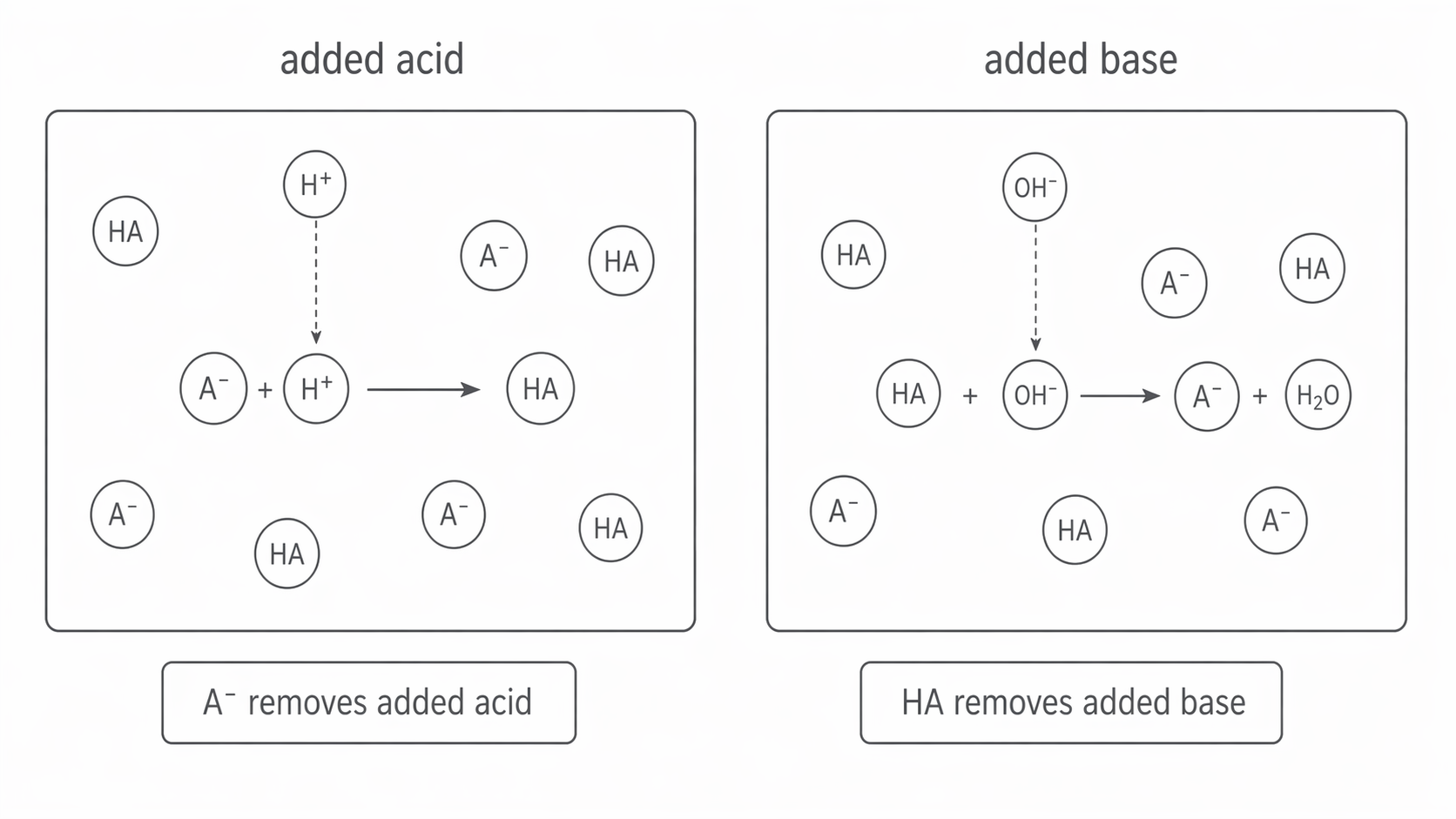
If a small amount of acid is added, the extra is removed by the conjugate base from the salt:
If a small amount of base is added, the is removed by the weak acid:
So the buffer works because it contains both members of the pair. The acid component deals with added base, and the salt component deals with added acid.
The diagram below shows the two linked particle-level reactions in an acidic buffer: removes added acid, while HA removes added base.
[DIAGRAM: asset_name: 1.12.6 - Buffer Action - Diagram 1; asset_slug: 1.12.6 - Buffer Action - Diagram 1; recommended_method: retained_png; description: Two side-by-side particle-level panels for an acidic buffer, each showing that the buffer already contains both HA and A^- particles. Left panel labelled added acid: show an incoming H+ reacting with A^- to form HA, with a clear reaction arrow A^- + H+ -> HA and a caption stating A^- removes added acid. Right panel labelled added base: show an incoming OH^- reacting with HA to form A^- and H2O, with a clear reaction arrow HA + OH^- -> A^- + H2O and a caption stating HA removes added base.]
This also explains dilution. When the buffer is diluted, both and fall by roughly the same factor, so their ratio changes very little. Because buffer pH depends mainly on that ratio, the pH changes only slightly. That is why a buffer resists dilution as well as small additions of acid or base.
Buffers are not unlimited. If enough acid is added to use up most of the , or enough base is added to use up most of the HA, the buffer stops working well and the pH then changes much more sharply.
How a basic buffer works and where buffers are used
A basic buffer has a pH above 7 and contains a weak base and a salt supplying its conjugate acid. A familiar example is ammonia with ammonium ions in comparable amounts; the component ratio matters as well as the identity of the base.
If acid is added, the weak base removes it:
If base is added, the ammonium ion removes it:
The logic is the same as for an acidic buffer. One component removes added acid. The other removes added base. The only difference is that this pair maintains a pH on the alkaline side of 7.
Buffers are vital in living systems. Blood is kept close to pH 7.4 by buffer systems, because even a small pH change can disrupt enzyme-controlled reactions and normal physiology. Buffer solutions are also used in products such as shampoos so they do not become too acidic or too alkaline.
Continue this lesson.
You’re previewing NovaLearn without an account. Create a free account to read the rest.
Create free account