3.3.3.2 - Elimination (Halogenoalkanes)
When 2-bromopropane reacts with potassium hydroxide, the chemistry is not locked into just one pathway. The same hydroxide ion can either attack a carbon atom and replace bromine, or remove a proton and help form a carbon-carbon double bond. This lesson is about seeing exactly why both routes are possible, what conditions favour each one, and how to outline both mechanisms clearly.
One reagent, two possible outcomes
Potassium hydroxide provides hydroxide ions, . With a halogenoalkane such as , those hydroxide ions can behave in two different ways.
In a substitution reaction, bromine is replaced by , so 2-bromopropane becomes propan-2-ol.
In an elimination reaction, a hydrogen atom and the bromine atom are removed from neighbouring carbon atoms, producing the alkene propene.
Because 2-bromopropane is a secondary halogenoalkane, both reactions are realistic competitors. That is what the specification means by concurrent substitution and elimination: the same substrate and the same reagent can lead to different organic products depending on how the hydroxide ion behaves.
Nucleophile
A nucleophile is a species that donates a lone pair of electrons to form a new covalent bond.
In substitution, acts as a nucleophile because it donates a lone pair to the carbon atom bonded to bromine.
In elimination, the same acts as a base. Here, it does not attack that carbon. Instead, it removes a proton from a neighbouring carbon atom.
The reaction conditions help decide which role is more important:
| Conditions | More favoured pathway | Main organic product from 2-bromopropane |
|---|---|---|
| Aqueous potassium hydroxide, lower temperature | Substitution | Propan-2-ol |
| Hot ethanolic potassium hydroxide | Elimination | Propene |
For a secondary halogenoalkane such as 2-bromopropane, it is best to think in terms of "favoured", not "exclusive". Both routes can occur, but the solvent and temperature shift the balance.
The substitution mechanism
In the substitution pathway, the important bond is the carbon-bromine bond. Bromine is more electronegative than carbon, so this bond is polar. The carbon atom attached to bromine is slightly positive, written , and that makes it the site that the nucleophile attacks.
Hydroxide has a lone pair on oxygen, so it can donate that electron pair to the carbon. As the new carbon-oxygen bond forms, the carbon-bromine bond breaks and both electrons from that bond go to bromine. Bromide ion, , is the leaving group.
The overall ionic equation is:
The diagram below shows the substitution mechanism for 2-bromopropane, with hydroxide using a lone pair to attack the carbon as bromide leaves.
[DIAGRAM: asset_name: 3.3.2 - Elimination (Halogenoalkanes) - Diagram 1; asset_slug: 3.3.2 - Elimination (Halogenoalkanes) - Diagram 1; recommended_method: retained_png; description: Substitution mechanism for 2-bromopropane, shown as CH3-CH(Br)-CH3, with δ+ on the middle carbon and δ- on Br; show :OH- donating a lone pair to the middle carbon and a second curly arrow from the C-Br bond to Br, forming propan-2-ol and Br-.]
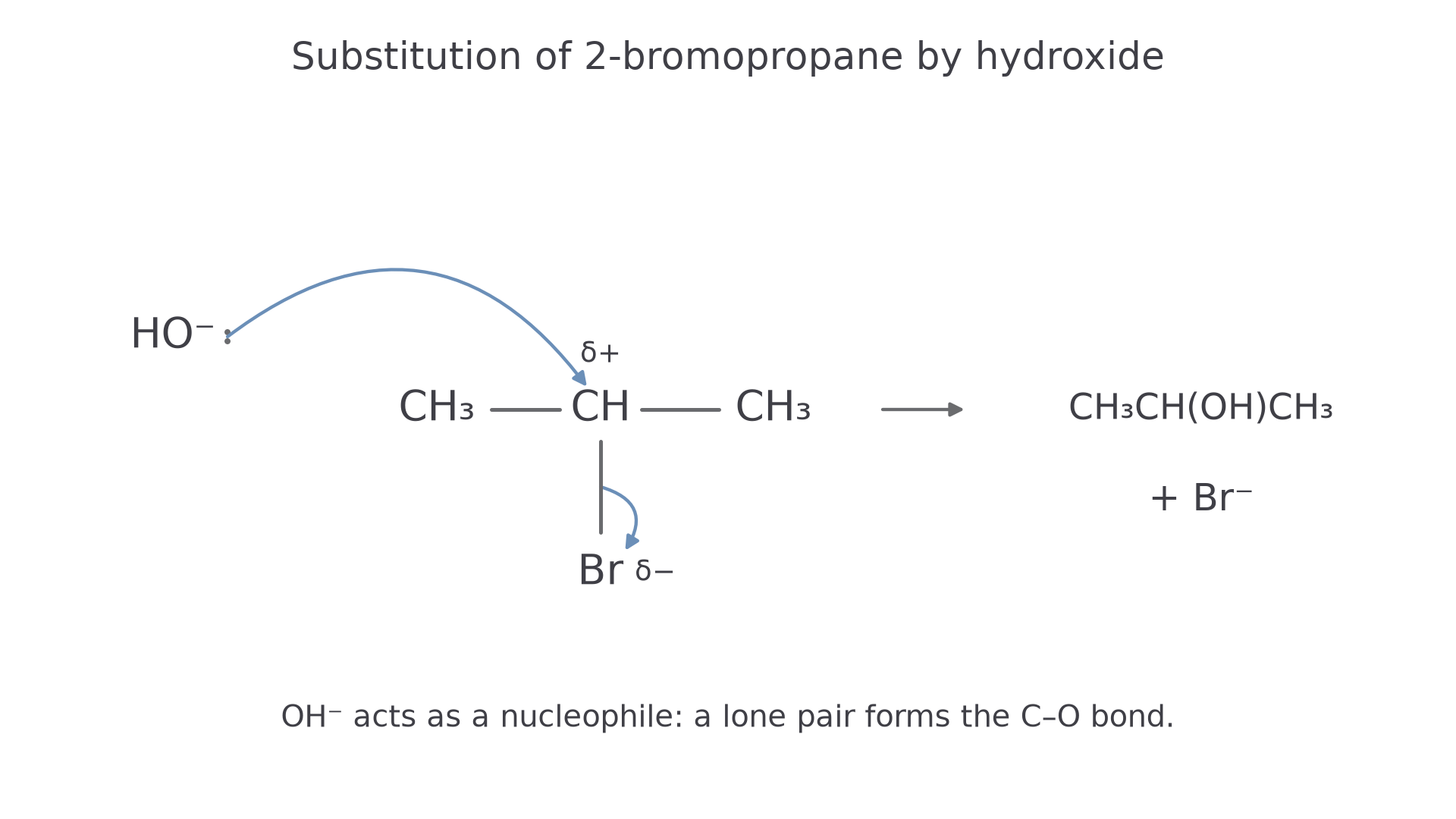
The key idea is not just that hydroxide reacts. You need to say what the hydroxide ion is doing. In substitution it attacks an electron-deficient carbon and forms a new bond to that carbon, so its role is nucleophile.
A common mistake is to say the hydroxide ion attacks bromine. It does not. The bromine atom leaves because the bond breaks heterolytically, but the new bond forms to carbon.
The elimination mechanism
The elimination pathway is where the second role of hydroxide becomes most obvious.
Base
A base is a proton acceptor.
In the elimination pathway, hydroxide is acting in exactly that way. It uses a lone pair to remove a proton from a carbon atom next to the carbon bonded to bromine.
This matters because once that proton is removed, the electrons from the bond can be used to form a carbon-carbon double bond. At the same time, the bond breaks and bromide ion leaves. So three electron movements happen together in the outline mechanism:
Continue this lesson.
You’re previewing NovaLearn without an account. Create a free account to read the rest.
Create free account