3.2.5.4 - Formation of Coloured Ions
Explain colour through absorption of visible light, calculate the energy gap, and use a calibration graph to measure the concentration of a coloured solution.
Seeing colour in transition metal ions
Transition metal ions are often present as complex ions in solution, and their colour is a useful identification clue. The key idea is selective absorption: white light contains all visible wavelengths, but a coloured ion absorbs some of them more strongly than others.
What reaches your eye is the light that is not absorbed. In a solution, that remaining light is transmitted through the solution; in a solid, it is mainly reflected. So if a solution looks blue, it is not because it absorbs blue light. It looks blue because other wavelengths, especially those in the complementary orange-red region, have been absorbed more strongly.
The diagram below links the absorbed part of the visible spectrum to the colour you actually see when white light passes through a blue transition-metal solution.
[DIAGRAM: asset_name: 2.5.4 - Formation of Coloured Ions - Diagram 1; asset_slug: 2.5.4 - Formation of Coloured Ions - Diagram 1; recommended_method: retained_png; description: Clean exam-style left-to-right schematic of a rectangular cuvette containing a blue transition-metal ion solution. Label the incoming beam white light (all visible wavelengths). Inside the cuvette, show orange-red wavelengths being absorbed more strongly. Show an outgoing beam labelled transmitted blue light. Add a clear note that solution appears blue because orange-red light is absorbed.]
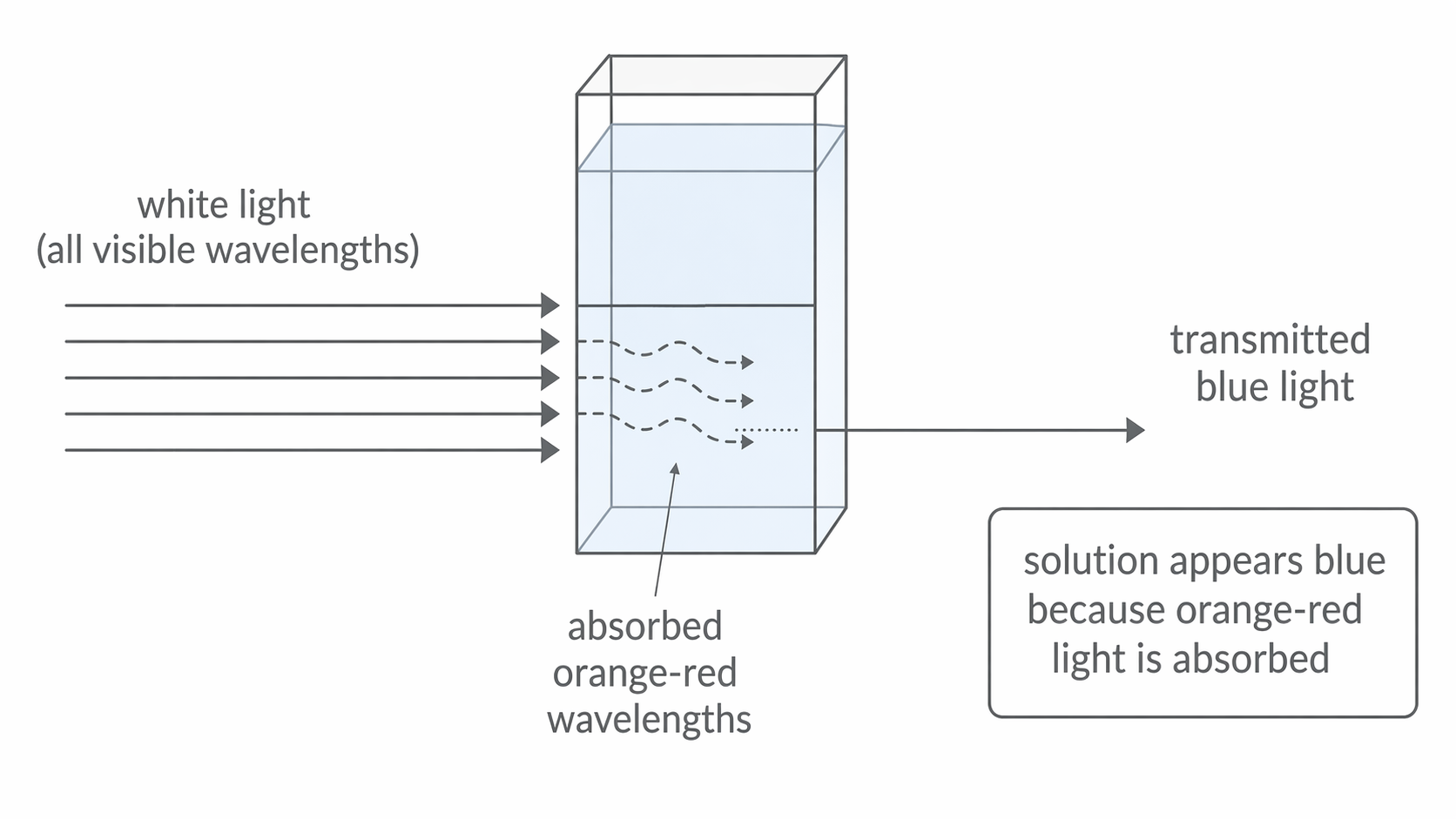
This is why colour is linked to absorption rather than just "what colour the substance contains". When you describe a coloured ion, be clear about which wavelengths are absorbed and which are transmitted or reflected.
For a complementary-colour example, absorption mainly in the violet-blue region leaves a yellow-orange appearance. Absorbing orange-red leaves a blue appearance.
Why d electrons absorb light
The absorption happens because the d electrons in a transition metal ion can move between two different energy levels. In a complex ion, the ligands around the metal ion split the d orbitals into groups with different energies. The ground state is the lowest-energy arrangement of the electrons in the available orbitals. If light with exactly the right energy is absorbed, an electron is promoted to the higher-energy level, which is an excited state.
Only photons with energy matching that gap are absorbed, so each complex tends to remove a particular region of the visible spectrum. The size of the gap is written as:
Energy absorbed by a d electron
Here, is Planck's constant, is frequency, is the speed of light, and is wavelength. A shorter wavelength means a higher frequency, so it also means a larger energy change. So if one complex absorbs green light and another absorbs red light, the one absorbing green light has the larger .
Worked example: a photon of wavelength has wavelength . Substituting into gives . The crucial housekeeping step is converting nm to m before substituting.
The diagram below shows the simplified energy-level picture behind that absorption: an electron moves from the lower-energy ground state to a higher-energy excited state when it absorbs light with energy .
[DIAGRAM: asset_name: 2.5.4 - Formation of Coloured Ions - Diagram 2; asset_slug: 2.5.4 - Formation of Coloured Ions - Diagram 2; recommended_method: retained_png; description: Simplified split d-orbital energy diagram in a single clean panel. Draw two lower horizontal lines labelled lower-energy d orbitals and three upper horizontal lines labelled higher-energy d orbitals. Show one electron being promoted from a lower level to an upper level by an upward arrow labelled absorbed visible light and Delta E. Label the lower arrangement ground state and the upper arrangement excited state.]
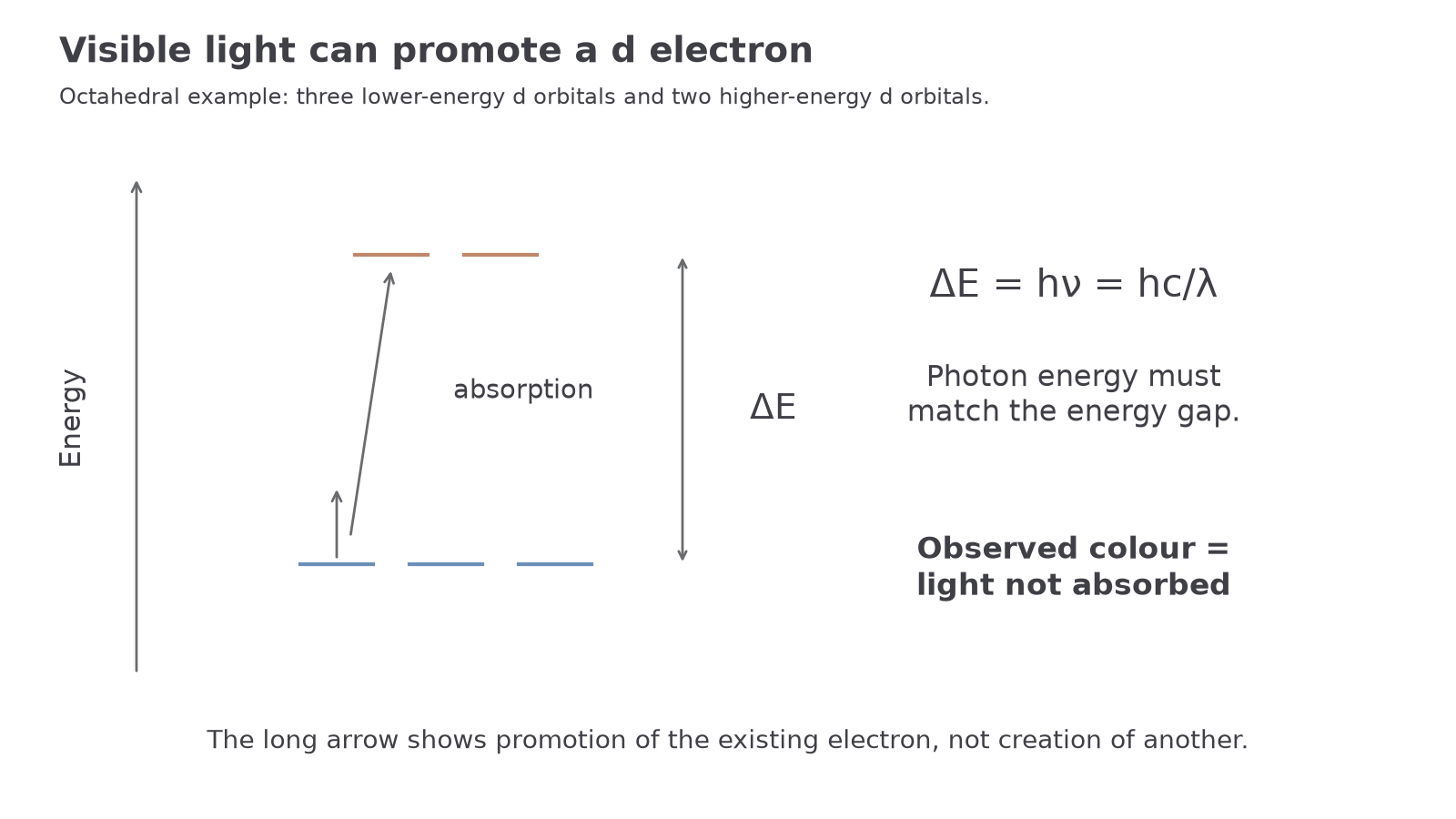
For the octahedral example in the diagram, three d orbitals are lower in energy and two are higher. The ground-state electrons occupy the available orbitals according to the filling rules; a suitable occupied lower orbital and an unoccupied higher state permit absorption. An electron absorbs a photon with energy equal to the gap and is promoted. The colour observed is the transmitted or reflected light that remains, not light emitted by this excitation. A d⁰ or d¹⁰ configuration cannot give this d–d transition explanation.
Why the same metal can have different colours
The colour is not fixed just by the identity of the metal. Anything that changes the size of changes the wavelength absorbed, so it changes the colour seen. Here there are three main causes to focus on: oxidation state, co-ordination number, and ligand.
Continue this lesson.
You’re previewing NovaLearn without an account. Create a free account to read the rest.
Create free account