3.2.5.6 - Catalysts (Transition Metals)
Explain surface catalysis and catalytic cycles, then use reaction equations and concentration–time graphs to analyse homogeneous catalysis and autocatalysis.
Why transition metals are useful catalysts
A catalyst increases the rate of a reaction by providing an alternative pathway with a lower activation energy. It does not change the position of equilibrium; it only helps equilibrium be reached faster.
Transition metals are especially good catalysts because many of them show variable oxidation states. That means they can gain electrons in one step and lose them again in another, or do the reverse, while ending up chemically unchanged overall. This is exactly what a catalyst needs to do in a redox mechanism.
For this specification point, there are two big catalytic patterns to recognise. In heterogeneous catalysis, the catalyst is in a different phase from the reactants and the reaction happens at the catalyst surface. In homogeneous catalysis, the catalyst is in the same phase as the reactants and the reaction goes through intermediate species.
That distinction matters because the explanation changes with it. Surface catalysis is about adsorption at active sites, whereas homogeneous catalysis is about a new reaction pathway made of easier solution-phase steps.
Heterogeneous catalysis on a surface
A heterogeneous catalyst is usually a solid used with gaseous or liquid reactants. The reaction happens at active sites on the catalyst surface, where reactant particles adsorb. Adsorption means the particles stick to the surface; they do not pass into the bulk of the solid.
Heterogeneous catalyst
A heterogeneous catalyst is a catalyst in a different phase from the reactants, with the reaction occurring at active sites on its surface.
At an active site, reactant particles are held close together and their bonds can be weakened. That makes successful collisions more likely. Iron, , in the Haber process and vanadium(V) oxide, , in the Contact process are both standard examples of heterogeneous catalysts. In the Haber process, nitrogen and hydrogen adsorb onto the iron surface and react at those active sites.
The surface area of a solid catalyst matters a lot. If the catalyst is spread over a porous support medium, more of the catalyst is exposed to the reactants. That increases the number of available active sites and means less of an expensive catalyst is needed. The support itself is there to hold the catalyst in a thin, high-surface-area layer rather than to act as the catalyst.
The diagram below shows how a support medium exposes a thin catalyst coating over a large surface so that many active sites are available.
[DIAGRAM: asset_name: 2.5.6 - Catalysts (A-level only) - Diagram 1; asset_slug: 2.5.6 - Catalysts (A-level only) - Diagram 1; recommended_method: retained_png; description: Cross-section of a porous support pellet or honeycomb coated with a thin catalyst layer on the internal and external surfaces; label support medium, thin catalyst layer, large surface area, active sites, and reactant molecules adsorbed at the surface.]
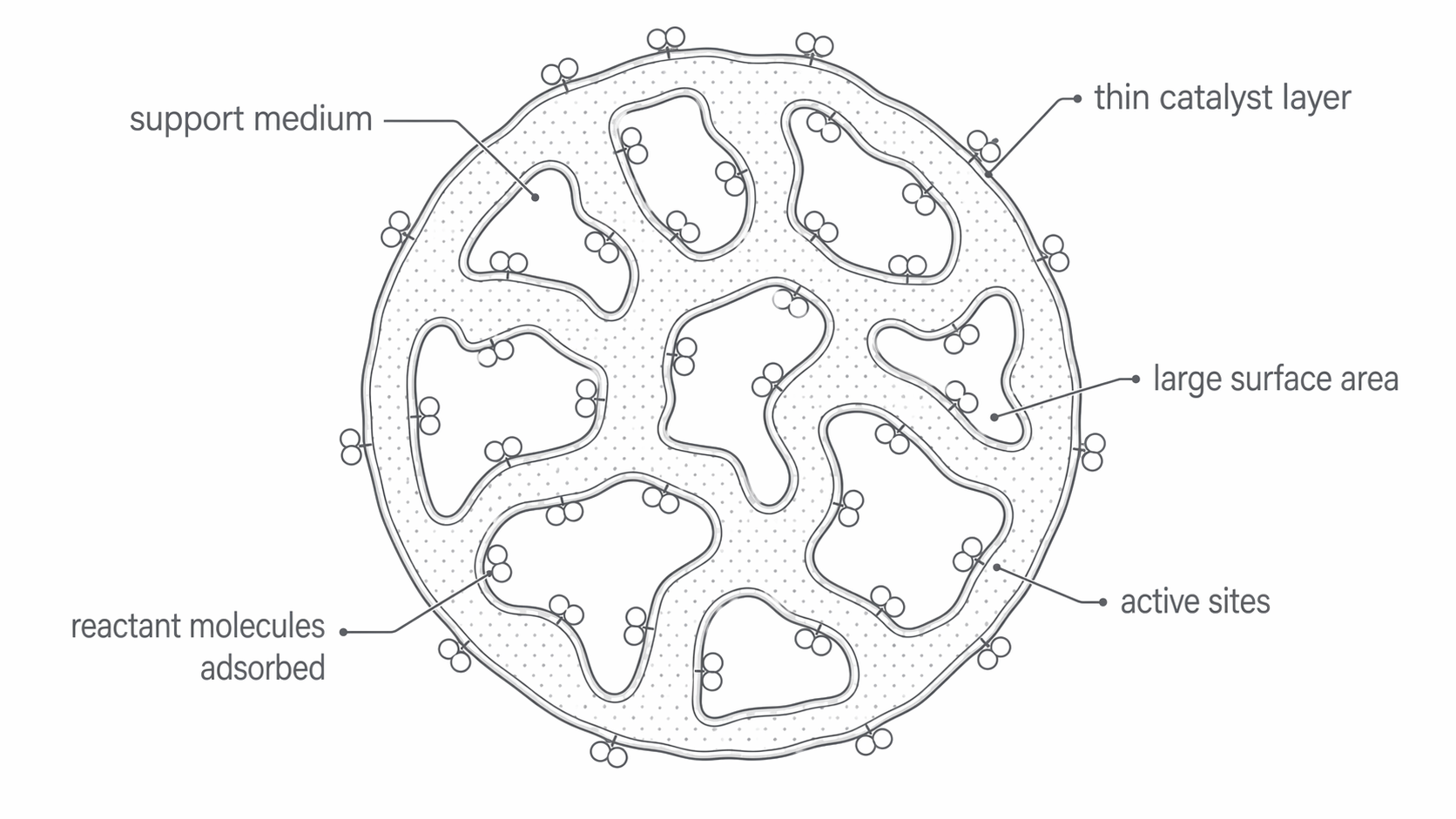
Heterogeneous catalysts can also become poisoned. An impurity blocks active sites, so fewer reactant particles can adsorb and react. This reduces efficiency and has a direct cost implication because industrial production slows and the catalyst may need to be replaced or cleaned. Sulfur compounds poisoning the iron catalyst in the Haber process is a classic example.
Keep that surface model in mind: the catalyst works because its surface is available, so anything that exposes more surface helps, and anything that blocks the surface harms performance.
After surface reaction, the products must desorb to free the active sites for new reactants. Strong adsorption can block sites; weak adsorption may not hold reactants long enough to react. A poison lowers rate by occupying active sites, requiring catalyst replacement or regeneration and increasing cost.
How V2O5 catalyses the Contact process
The key step in the Contact process is the oxidation of sulfur dioxide to sulfur trioxide:
Vanadium(V) oxide acts as the catalyst. The important idea is that vanadium can move between oxidation states +5 and +4, then return to +5 by the end of the cycle. This is why variable oxidation states are so important in catalysis: they let the catalyst take electrons from one species in one step and pass the effect on in a later step.
The catalytic cycle is:
In the first step, vanadium is reduced from +5 in to +4 in . In the second step, it is oxidised back to +5. The catalyst is therefore regenerated.
If you double the first equation and then add the second equation, the vanadium-containing species cancel out, leaving only the overall reaction. In the final overall equation, neither nor appears, because the catalyst is regenerated and any intermediate species cancel during the addition.
The diagram below summarises the Contact process cycle and shows how vanadium returns to oxidation state by the end.
[DIAGRAM: asset_name: 2.5.6 - Catalysts (A-level only) - Diagram 2; asset_slug: 2.5.6 - Catalysts (A-level only) - Diagram 2; recommended_method: retained_png; description: Catalytic cycle for the Contact process showing SO2 oxidised to SO3 by V2O5, vanadium changing from +5 in V2O5 to +4 in V2O4, then O2 reoxidising V2O4 back to V2O5 so the catalyst is regenerated.]
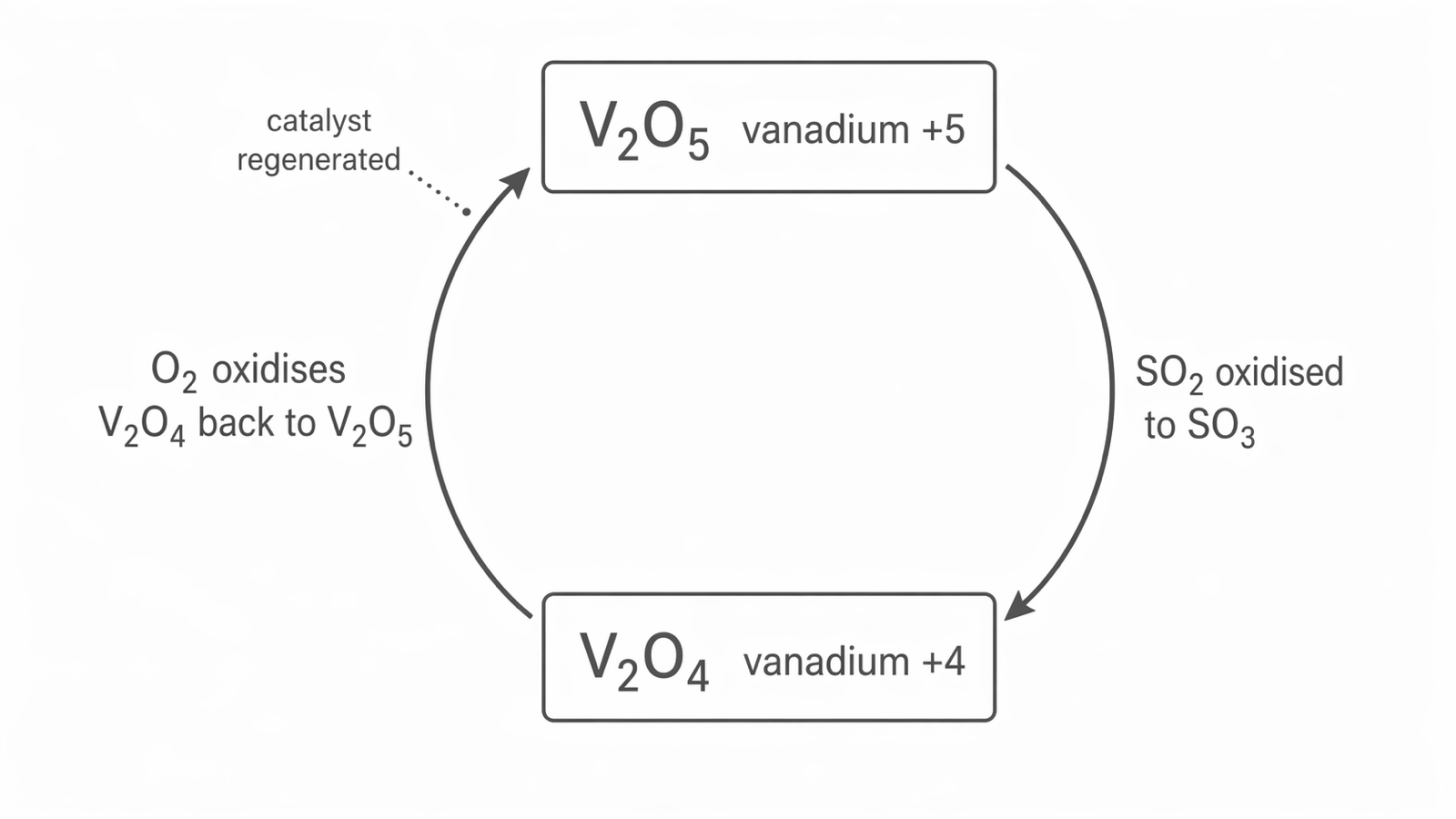
This example also links surface catalysis to redox chemistry. is a heterogeneous catalyst because it is a solid surface, but it works because vanadium can change oxidation state during the reaction pathway.
Homogeneous catalysis through intermediate species
When the catalyst and reactants are in the same phase, the mechanism is different. Instead of reacting on a solid surface, the reaction proceeds through intermediate species in solution.
Continue this lesson.
You’re previewing NovaLearn without an account. Create a free account to read the rest.
Create free account