3.2.3.1 - Trends in Properties (Halogens)
Connect halogen electronegativity, boiling points and displacement reactions to electron attraction, then identify halide ions using precipitation and ammonia tests.
Electronegativity and Boiling Point
Group 7 contains the halogens, which exist as simple molecular substances made of diatomic molecules such as and . That matters because two different ideas control two different trends here. Electronegativity depends on how strongly a halogen atom attracts bonding electrons, while boiling point depends on the strength of intermolecular forces between halogen molecules.
Electronegativity
The ability of an atom to attract the bonding pair of electrons in a covalent bond towards itself.
Electronegativity decreases down Group 7. Each halogen down the group has an extra electron shell, so the bonding electrons are further from the nucleus and are more shielded by inner electrons. Nuclear charge does increase down the group, but the increase in distance and shielding has the bigger effect, so the attraction for the bonding pair becomes weaker.
Boiling point shows the opposite trend: it increases down Group 7. The halogens are simple molecular substances, so boiling does not break the covalent bond inside molecules. It only overcomes the intermolecular forces between molecules. As the molecules get larger, they contain more electrons and have more easily distorted electron clouds, so the London forces between molecules become stronger. More energy is therefore needed to separate the molecules, giving a higher boiling point.
This is why chlorine is a gas at room temperature, bromine is a liquid, and iodine is a solid. It can be tempting to explain iodine's higher boiling point by saying that the bond is stronger than the bond, but that is not the reason. The boiling point trend is about stronger intermolecular forces, not stronger covalent bonds.
The diagram below puts those linked trends side by side so you can compare the physical and bonding ideas without mixing them up.
[DIAGRAM: asset_name: 2.3.1 - Trends in Properties (Halogens) - Diagram 1; asset_slug: 2.3.1 - Trends in Properties (Halogens) - Diagram 1; recommended_method: retained_png; description: Four diatomic molecules F2, Cl2, Br2 and I2 increasing in size from left to right, with labels showing 18, 34, 70 and 106 total electrons respectively; arrows indicate stronger London forces and higher boiling point down the group, while lower electronegativity is explained by bonding electrons being further from the nucleus and more shielded.]
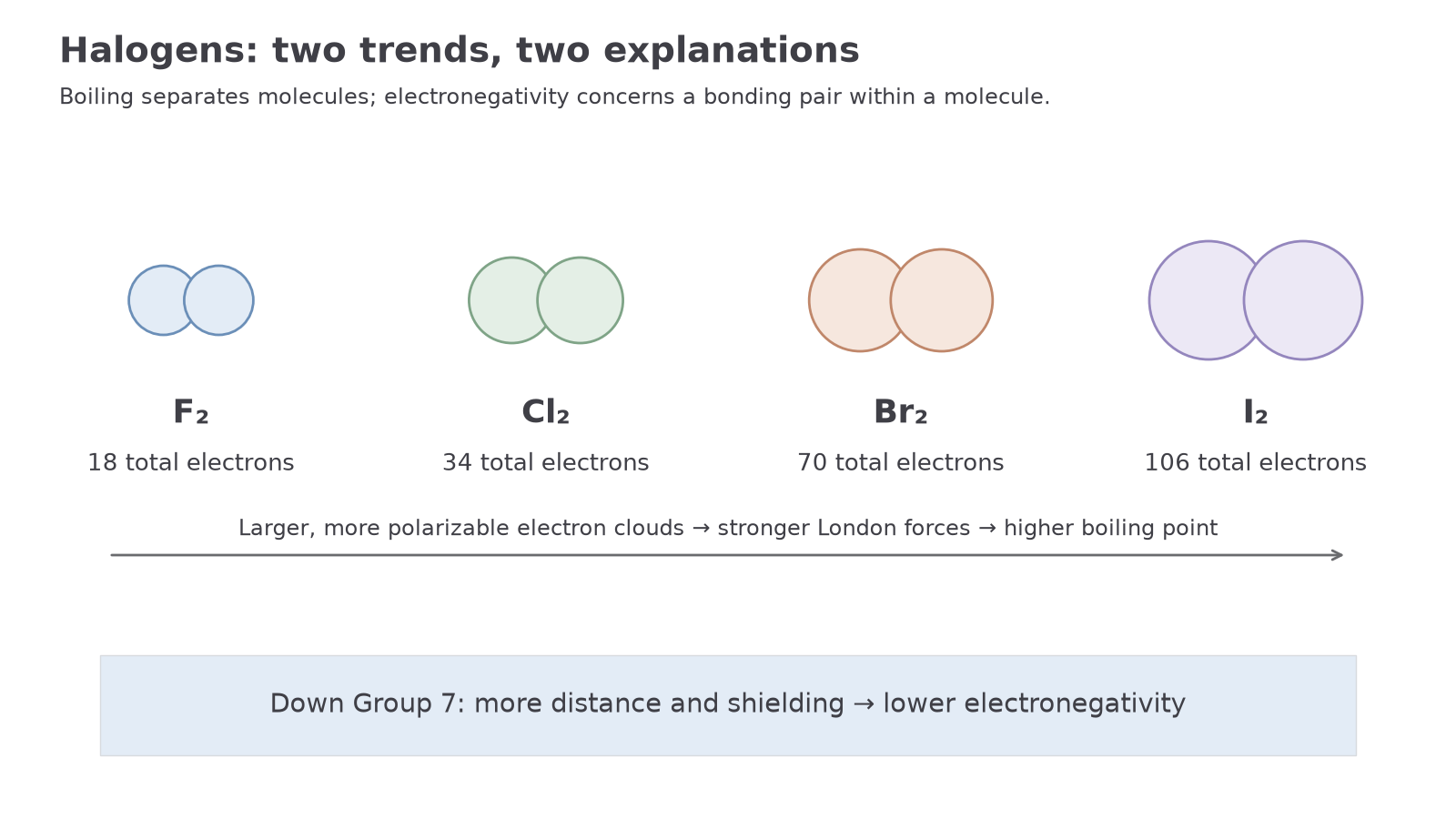
Once you separate those two ideas, the trend becomes much easier to remember: larger molecules mean stronger intermolecular forces, but larger atoms mean weaker attraction for a bonding pair.
The electron totals in the diagram count all electrons: has , although only 14 are valence electrons. Use the same kind of count for every molecule when comparing polarizability.
Oxidising Ability and Displacement
Halogens react by gaining electrons to form halide ions, so the halogen molecule is reduced.
Oxidising Agent
A species that oxidises another species by accepting electrons. The oxidising agent is itself reduced.
The halogens are oxidising agents, but their oxidising ability decreases down Group 7:
The reason is similar to the electronegativity trend. A halogen atom lower down the group has more shells, a larger radius, and more shielding. That makes it less able to attract an incoming electron. So gains electrons more readily than , and gains electrons more readily than .
This trend shows up in displacement reactions in aqueous solution. A more powerful halogen oxidises the halide ion of a less powerful halogen. In practice, chlorine can displace bromide and iodide ions, bromine can displace iodide ions, and iodine displaces none.
For example:
Here, bromide ions lose electrons to form bromine, so bromide is oxidised. Chlorine gains electrons overall and is reduced to chloride ions, so chlorine is acting as the oxidising agent.
The summary table below shows the aqueous displacement pattern for chlorine, bromine, and iodine.
[DIAGRAM: asset_name: 2.3.1 - Trends in Properties (Halogens) - Diagram 2; asset_slug: 2.3.1 - Trends in Properties (Halogens) - Diagram 2; recommended_method: retained_png; description: A displacement table with Cl2, Br2 and I2 down the left side and Cl-, Br- and I- across the top; cells show chlorine reacts with bromide and iodide, bromine reacts with iodide only, and iodine shows no reaction. Add a note that fluorine is not normally tested in aqueous solution because it reacts with water.]
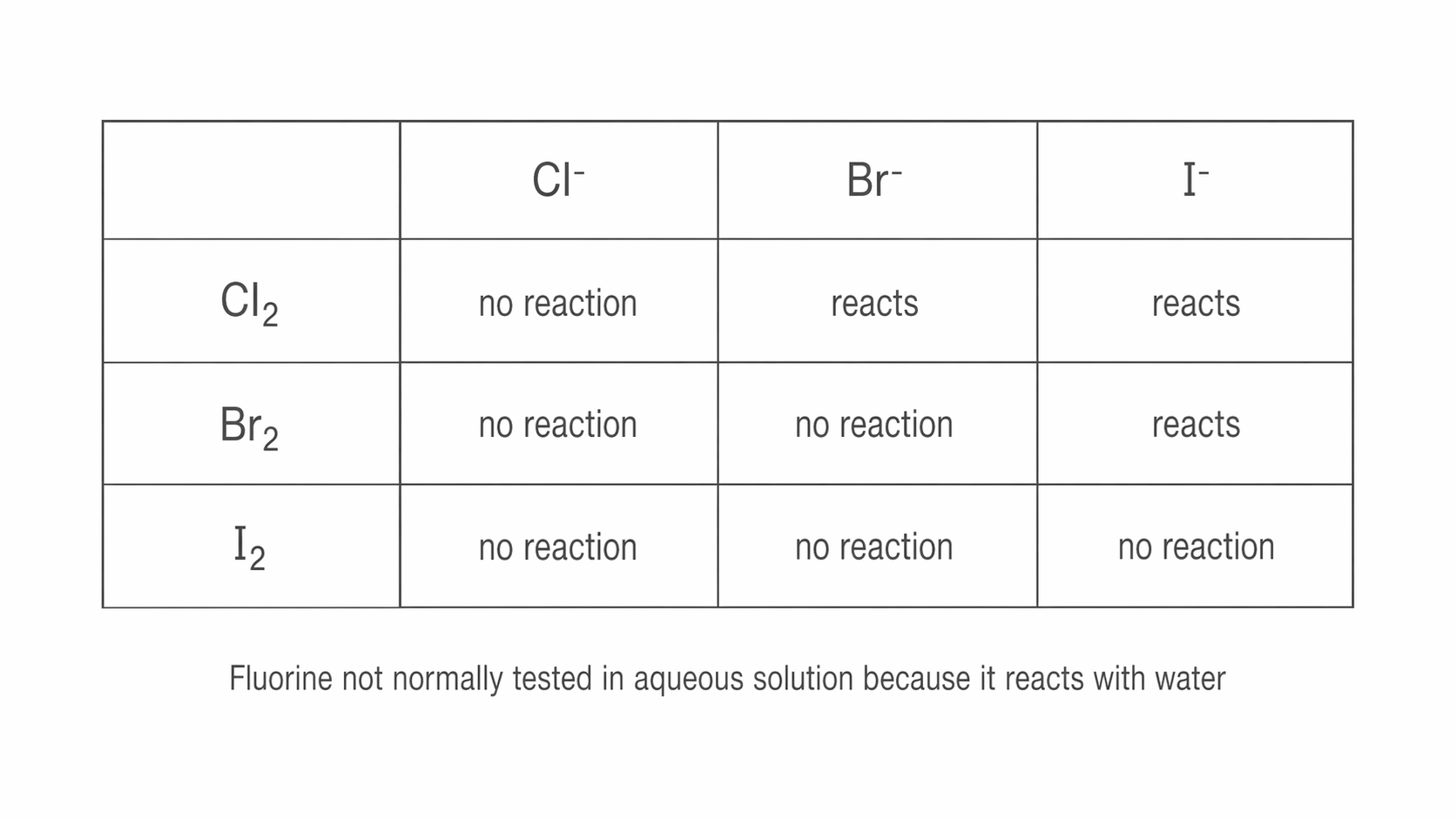
Once the redox idea is clear, the observations make sense too. If chlorine water is added to potassium bromide solution, an orange-brown colour appears because is formed. If bromine water is added to potassium chloride solution, there is no redox reaction because bromine is not a strong enough oxidising agent to oxidise chloride ions.
The pattern is simple: a halogen only displaces the halide ion of a halogen below it in Group 7.
Use fresh small portions of halide solutions and equal drops of dilute halogen water; compare with a halogen-water control against a white background. Chlorine water is pale green, bromine water orange and iodine in water brown. A colour from added reagent alone is not proof of displacement: look for the product colour and check whether the halogen is above the displaced halide in the group.
Reducing Ability of Halide Ions
Now reverse the viewpoint. Instead of looking at halogen molecules gaining electrons, look at halide ions losing electrons.
Reducing Agent
A species that reduces another species by donating electrons. The reducing agent is itself oxidised.
Halide ions are reducing agents, and their reducing ability increases down Group 7:
Continue this lesson.
You’re previewing NovaLearn without an account. Create a free account to read the rest.
Create free account