3.1.12.4 - Weak Acids, Bases and Ka
Weak acids and weak bases do not react completely with water, so their solutions contain an equilibrium mixture rather than a single set of products. In this lesson, the main focus is weak acids: how to describe their partial dissociation, how to build the expression for , and how to calculate pH from and concentration. By the end, you should be able to move confidently between chemical equations, equilibrium expressions, and pH calculations.
Weak acids, weak bases and partial dissociation
A strong acid ionises almost completely in water, but a weak acid ionises only slightly. That means most of the acid particles stay as molecules, and only a small fraction produces ions. Weak bases behave in the same general way: they react only slightly with water, so the equilibrium lies mainly to the left.
Weak acid
A weak acid is an acid that only partially dissociates in aqueous solution, so an equilibrium is established between undissociated acid molecules and the ions formed.
This is why a weak acid can still have a fairly high concentration but a much lower than a strong acid of the same concentration. "Weak" tells you about the extent of dissociation, not how much acid was dissolved. Do not confuse weak with dilute, or strong with concentrated.
For a generic weak acid :
A particle diagram is useful here because it makes the equilibrium mixture visible: many undissociated HA molecules remain, while only a few ions are present.
[DIAGRAM: asset_name: 1.12.4 - Weak Acids and Bases Ka for Weak Acids - Diagram 1; asset_slug: 1.12.4 - Weak Acids and Bases Ka for Weak Acids - Diagram 1; recommended_method: retained_png; description: Boxed equilibrium equation HA(aq) ⇌ H+(aq) + A-(aq) on the left, linked by a double-headed arrow labelled "partial dissociation" to a particle box on the right showing many HA molecules and only a few separated H+ and A- ions.]
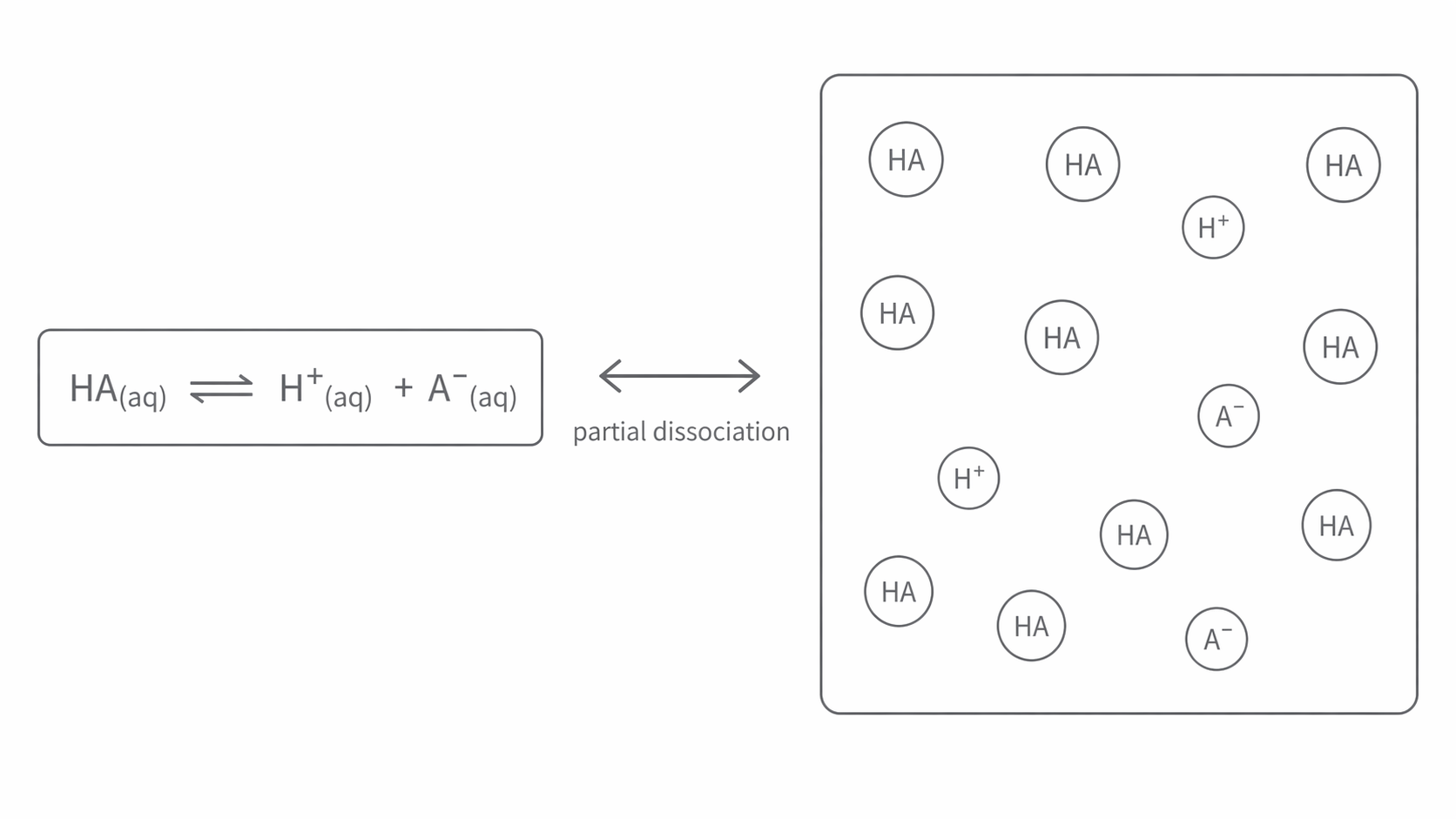
Only a small proportion of dissociates, so at equilibrium there is still much more than or .
Constructing and interpreting Ka
Because weak acid dissociation is an equilibrium, we can describe it using an equilibrium constant. For the reaction
the acid dissociation constant is:
Acid dissociation constant
Acid dissociation constant, Ka
is the equilibrium constant for the dissociation of a weak acid in aqueous solution.
When you construct this expression, each concentration is an equilibrium concentration in . Water is not included because it is the solvent and its concentration is treated as constant. A larger means the acid dissociates more and is therefore stronger. A smaller means less dissociation and a weaker acid.
This helps you link the equation to real chemistry. If an acid has a relatively large , the equilibrium lies further to the right, so more is produced. If is very small, the equilibrium lies mainly to the left and most acid molecules remain undissociated.
With concentrations expressed in , the units used for here are : the two numerator concentrations divided by one denominator concentration leave one concentration unit. , like pH, has no units. Compare acid strengths at the same temperature.
One easy trap is using the equation correctly but forgetting what it means. is not just a formula to memorise; it is a measure of the position of equilibrium for weak-acid dissociation.
Calculating pH from Ka and concentration
To calculate the pH of a weak acid, start from the equilibrium expression and use the fact that the acid dissociates only slightly. Suppose the initial concentration of is . If dissociates, then at equilibrium:
The approximation is the key step. Use this approximation only when is small relative to , with no added acid or conjugate-base salt and a negligible contribution from water. Check after calculating. If dissociation is appreciable, retain and use .
The diagram below summarises the ICE table setup for a weak acid before you substitute into the expression for .
[DIAGRAM: asset_name: 1.12.4 - Weak Acids and Bases Ka for Weak Acids - Diagram 2; asset_slug: 1.12.4 - Weak Acids and Bases Ka for Weak Acids - Diagram 2; recommended_method: retained_png; description: ICE table for HA(aq) ⇌ H+(aq) + A-(aq), with columns labelled species, HA(aq), H+(aq), A-(aq) and rows labelled Initial, Change, Equilibrium containing c, 0, 0 then -x, +x, +x then c-x, x, x.]
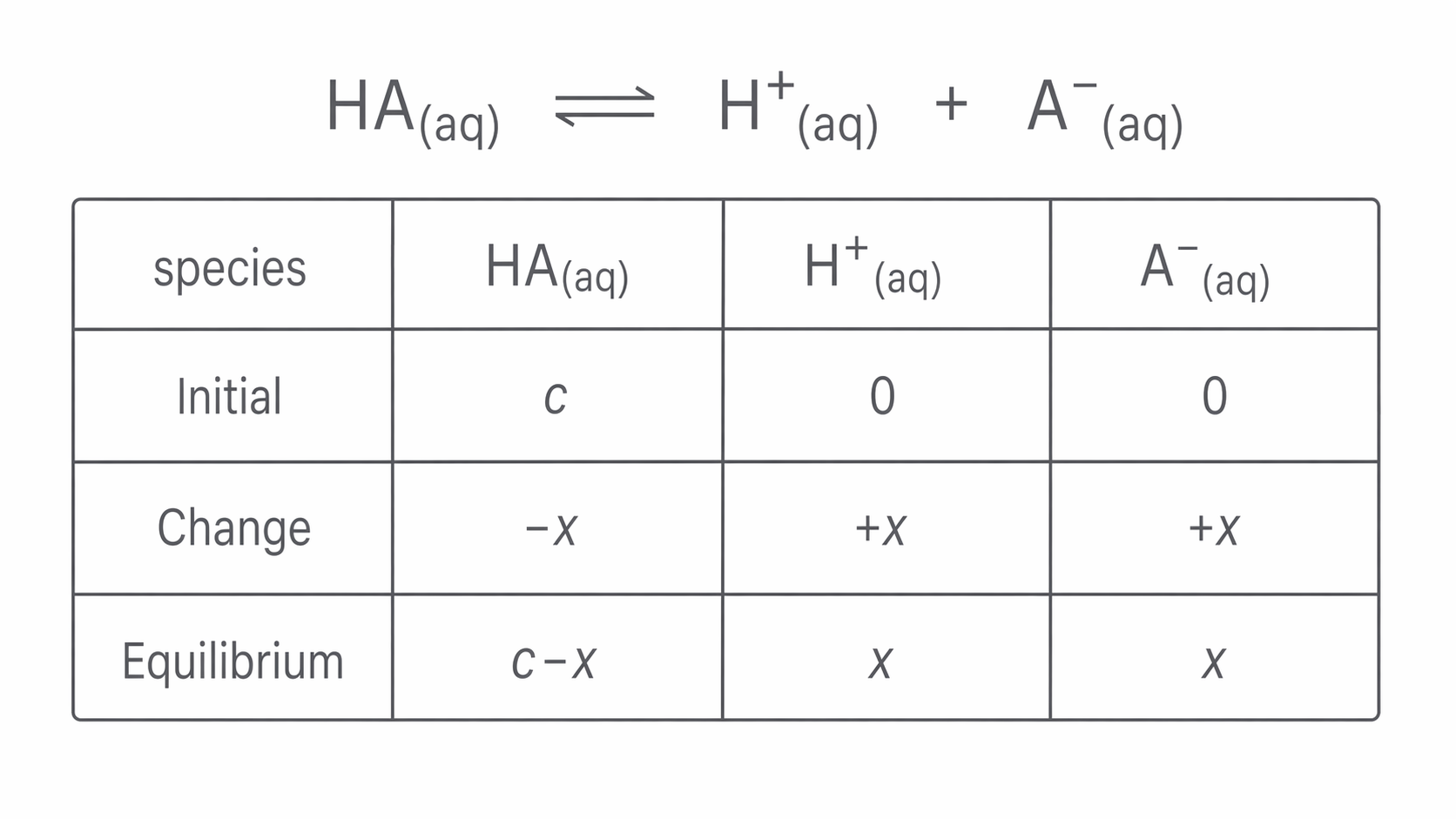
Substituting into the expression gives:
Continue this lesson.
You’re previewing NovaLearn without an account. Create a free account to read the rest.
Create free account