3.1.5.4 - Effect of Concentration and Pressure
This lesson is about one simple but powerful idea: reactions go faster when reacting particles collide more often. We will follow that idea in two different settings, changing concentration and changing gas pressure. The key is to connect what changes in the container to what happens to collision frequency.
Concentration and collision frequency
Collision theory says that reacting particles must collide before a reaction can happen. If collisions happen more often each second, there are more opportunities for successful collisions, so the rate of reaction increases.
Collision frequency
Collision frequency is the number of collisions between reacting particles in a given time.
In a solution, increasing concentration means there are more reacting particles in the same volume. That could mean more acid particles, more ions, or more dissolved molecules packed into the same space. Because the particles are closer together on average, they collide more frequently.
The diagram below compares the same volume at low and high concentration and shows why the more concentrated mixture gives more collisions each second.
[DIAGRAM: asset_name: 1.5.4 - Effect of Concentration and Pressure - Diagram 1; asset_slug: 1.5.4 - Effect of Concentration and Pressure - Diagram 1; recommended_method: retained_png; description: At fixed volume and temperature, a higher concentration provides more particles and more frequent collisions.]
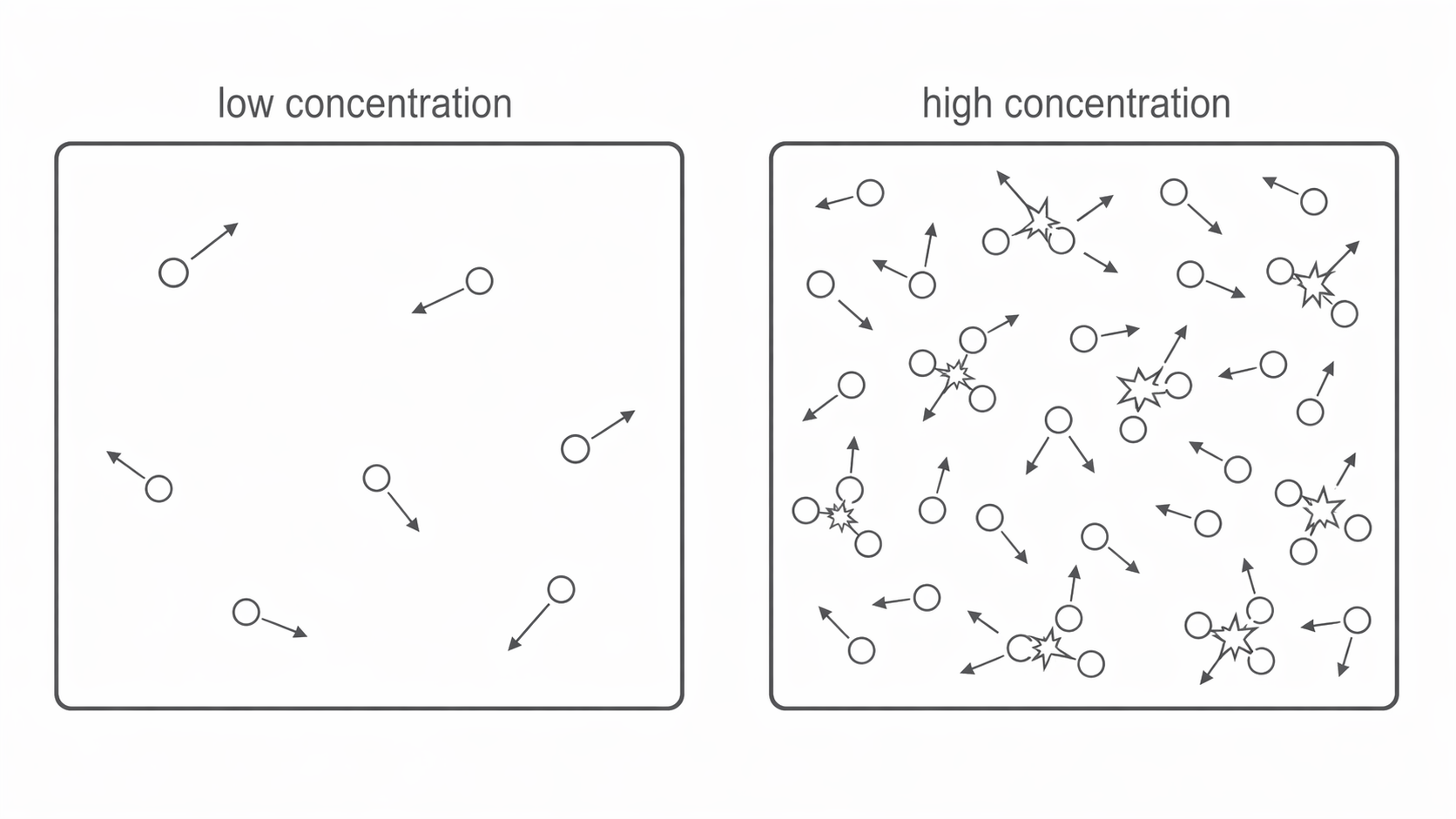
That increase in collision frequency is the reason the rate increases. This does not mean the particles are moving faster. At the same temperature, their average energy has not increased. The change is that there are simply more encounters per second.
You can use the same logic for many common reactions. If magnesium reacts with dilute hydrochloric acid, increasing the acid concentration puts more particles into each of solution. More particles reach the metal surface each second, so the reaction happens faster.
Measuring a continuous rate
For magnesium reacting with excess hydrochloric acid, connect a conical flask through an airtight bung and delivery tube to a freely moving gas syringe. Add equal lengths of freshly cleaned magnesium ribbon to equal total volumes of acid at different concentrations. Start timing on mixing and record hydrogen volume at regular intervals. Keep temperature, magnesium surface area and total volume constant; use a water bath if needed. The gas must be able to move the syringe plunger freely rather than build pressure in a sealed rigid vessel.
Plot hydrogen volume against time. The gradient is a rate in ; use a tangent to estimate the initial rate. A tangent rising from 0 to in 20 s gives . A more concentrated acid should give a steeper initial gradient. If the same mass of magnesium is limiting and acid remains in excess, the final gas volume should be the same. A leaking bung lowers the collected volume; a delay in fitting the bung particularly distorts the initial rate.
To investigate concentration, prepare several dilutions of one reactant while keeping the other reactant's amount, the total mixture volume and temperature fixed. For example, mixing 10.0 cm³ of 1.00 mol dm⁻³ stock with 10.0 cm³ water makes 20.0 cm³ at 0.500 mol dm⁻³; the amount of solute is unchanged during dilution. Use equal lengths and surface condition of magnesium if comparing acid reactions, and measure the same gas volume or the initial slope in each run. A shorter time to consume a smaller amount of reactant would not by itself show a higher rate.
Continue this lesson.
You’re previewing NovaLearn without an account. Create a free account to read the rest.
Create free account