3.2.3.2 - Uses of Chlorine and Chlorate(I)
Use oxidation states and balanced equations to explain chlorination, the effect of sunlight, and the manufacture of bleach with cold dilute alkali.
Chlorine in water forms chlorate(I) and chloride
When chlorine dissolves in water, it does not just sit there unchanged. It reacts reversibly with water to produce chloride ions and chlorate(I) ions:
Some books write the same chemistry as . That is consistent with the ionic equation above, because chloric(I) acid, , can donate a proton to form .
Disproportionation
A redox reaction in which atoms of the same element are simultaneously oxidised and reduced.
This reaction is a disproportionation reaction. Chlorine starts at oxidation state 0 in . In the products, one chlorine atom ends up at -1 in , so it has been reduced. The other ends up at +1 in , so it has been oxidised. The important step is to follow each chlorine atom separately rather than just noticing that chlorine appears on both sides.
The +1 chlorine species is the useful one in water treatment. It is an oxidising agent, so it can damage the cells of bacteria and other microorganisms, killing them before they can cause disease.
Oxidising Agent
A species that causes another substance to be oxidised by accepting electrons.
The diagram below tracks the two chlorine atoms through the reversible reaction with water and shows why the +1 chlorine species is the useful disinfectant.
[DIAGRAM: asset_name: 2.3.2 - Uses of Chlorine and Chlorate(I) - Diagram 1; asset_slug: 2.3.2 - Uses of Chlorine and Chlorate(I) - Diagram 1; recommended_method: retained_png; description: Monochrome reaction-flow diagram for chlorine in water. Show Cl2 + H2O entering a reversible step, then two product branches: one chlorine atom reduced 0 -> -1 to Cl^-, and the other chlorine atom oxidised 0 -> +1 to ClO^- / HClO. Label the ClO^- / HClO branch as the disinfecting system that kills microorganisms.]
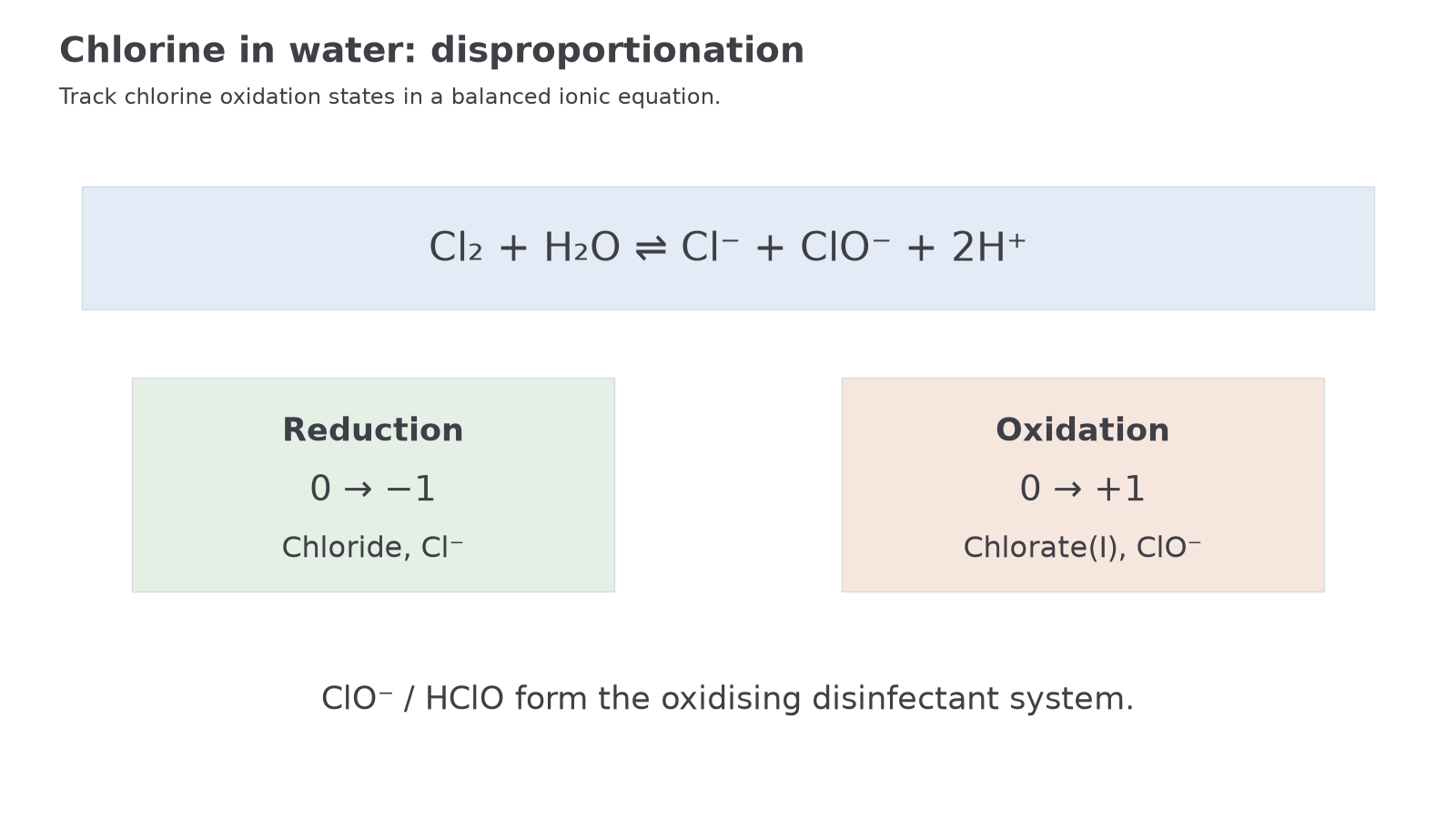
That is why chlorination works: the water is not being "poisoned" in the everyday sense, but treated with a low concentration of a strong enough oxidising agent to destroy harmful microbes.
Why chlorine is added to water supplies
The use of chlorine in water treatment is one of those cases where society has to weigh risk against benefit. Chlorine gas is toxic, and high concentrations of chlorine-containing species would be unsafe. However, untreated water can spread dangerous infections. So the real question is not "Is chlorine harmless?" but "Does careful chlorination make the water supply safer overall?"
In drinking-water treatment, chlorine or chlorine-releasing compounds are added in small, controlled amounts so there is still some disinfectant present as the water travels through pipes. That residual disinfectant helps stop harmful microorganisms multiplying between the treatment plant and the tap.
Continue this lesson.
You’re previewing NovaLearn without an account. Create a free account to read the rest.
Create free account