3.1.6.1 - Chemical Equilibria and Le Chatelier's Principle
Many important chemical reactions are reversible, so the key question is not just whether products can form, but what mixture is left once the system settles. In this lesson, you will build the particle picture of dynamic equilibrium, then use Le Chatelier's principle to predict how concentration, pressure, temperature, and catalysts affect the equilibrium position. You will also see why industry often chooses compromise conditions rather than the conditions that give the absolute highest yield.
Reversible Reactions And Dynamic Equilibrium
In a reversible reaction, products can react to reform the original reactants. If we write a simple equilibrium as
the forward reaction changes reactants into products, while the reverse reaction changes products back into reactants. The double arrow matters because it shows that both directions are possible.
At the start, if only reactants are present, the forward reaction is fastest because there are many reactant particles available to collide. As products build up, the reverse reaction starts and its rate increases. In a closed system, no reactant or product escapes, so both reactions continue until their rates become equal.
Dynamic equilibrium
A dynamic equilibrium is reached in a closed system when the forward and reverse reactions continue at equal rates, so the concentrations of reactants and products remain constant.
Constant does not mean equal. An equilibrium mixture may contain mostly reactants, mostly products, or any proportion in between. The important point is that the amounts stop changing with time because the two opposing reactions are balancing each other exactly.
The diagram below brings together the two standard equilibrium graphs: concentrations level off at fixed values, while the forward and reverse rates become equal at equilibrium.
[DIAGRAM: asset_name: 1.6.1 - Chemical Equilibria and Le Chatelier's Principle - Diagram 1; asset_slug: 1.6.1 - Chemical Equilibria and Le Chatelier's Principle - Diagram 1; recommended_method: retained_png; description: At dynamic equilibrium, concentrations become constant but need not be equal, while forward and reverse rates become equal and remain nonzero.]
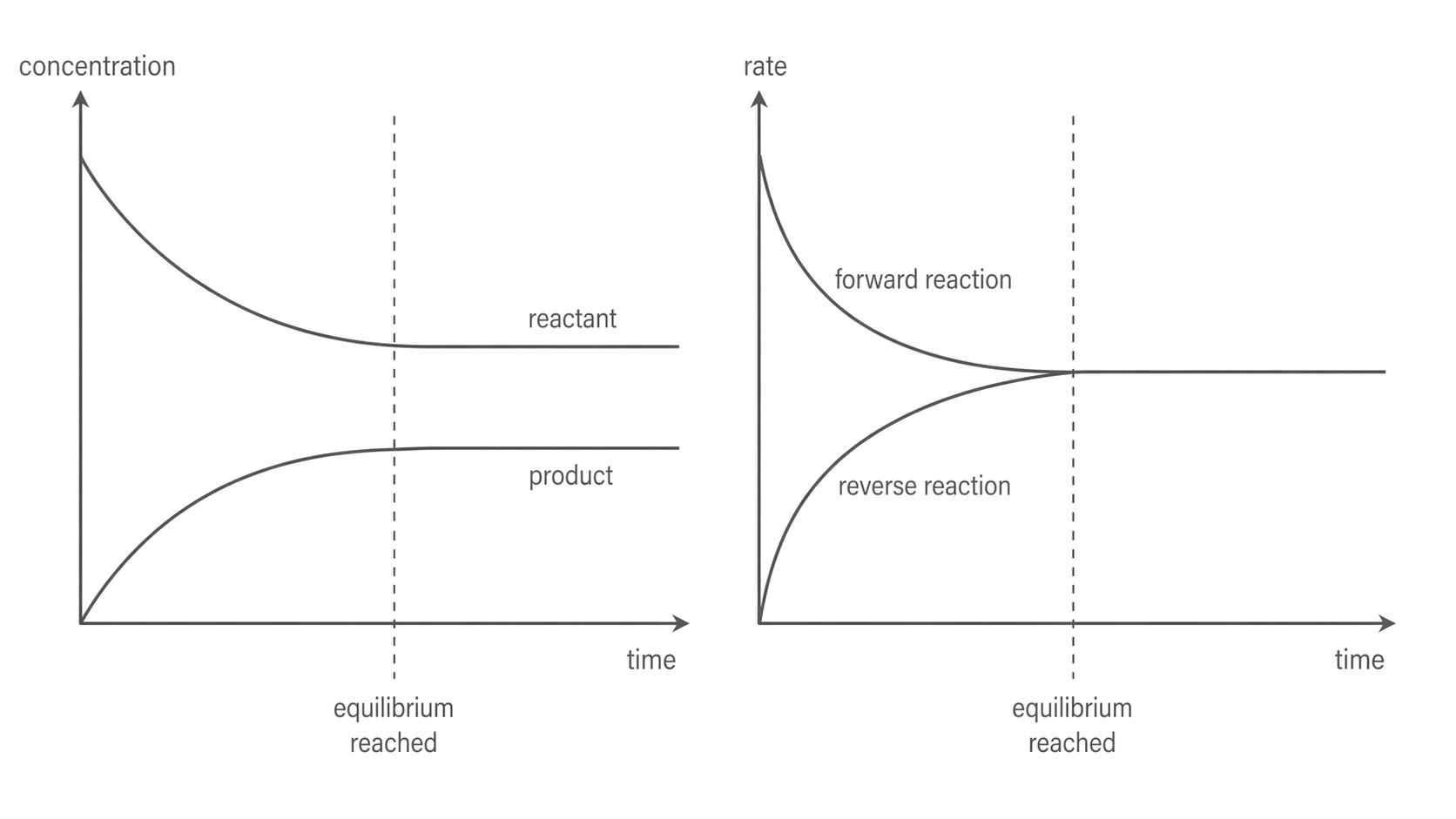
A useful way to think about equilibrium is to separate what you can see from what is happening at particle level. Macroscopically, colour, concentration, or pressure stop changing. Microscopically, particles are still reacting in both directions all the time.
Using Le Chatelier's Principle
Le Chatelier's principle gives a quick way to predict the direction of shift when an equilibrium mixture is disturbed. Use it qualitatively: it tells you which side is favoured, not how far the equilibrium moves.
Le Chatelier's Principle
If a system at equilibrium is disturbed, the equilibrium position moves in the direction that tends to reduce the effect of the disturbance.
In this section we apply it to homogeneous equilibria, where all reacting species are in the same phase. In practice, concentration changes can apply to solutions or gases, but pressure changes only matter for equilibria involving gases.
For concentration changes, think in terms of "using up what was added" or "replacing what was removed". If extra reactant is added, the system shifts in the direction that removes some of that reactant, so the forward reaction is favoured. If a product is removed, the system shifts to replace it, again favouring the forward reaction.
Adding a reactant first produces an immediate increase in that reactant's concentration. The subsequent equilibrium shift uses up only part of the added material; it does not usually restore the original concentration. On a concentration–time graph, distinguish this sudden jump from the gradual changes as forward and reverse rates become equal again.
A visible solution equilibrium can test the prediction. In , the product is red. Adding a small amount of iron(III) or thiocyanate solution makes the mixture redder as more product forms. Compare equal samples against an untreated control, using the same viewing depth and background; excessive dilution would change concentration as well as the intended reagent addition. This is evidence for a change in composition, not proof that reactions have stopped.
For example, in
adding more shifts the equilibrium to the right because the system responds by using some of the added hydrogen to make more ammonia. Removing also shifts the equilibrium to the right because the system tries to replace the ammonia that was taken away.
Pressure changes need more care. They only affect equilibria involving gases, and only when the total number of moles of gas is different on the two sides. Increasing pressure by compression at constant temperature favours the side with fewer moles of gas because that reduces the pressure change. Decreasing pressure favours the side with more moles of gas.
In the ammonia equilibrium above, the left-hand side has 4 moles of gas and the right-hand side has 2 moles of gas. So increasing pressure shifts the equilibrium to the right and increases the equilibrium yield of ammonia. But in
there are 2 moles of gas on each side, so changing pressure does not change the equilibrium position.
Adding an inert gas at constant volume does not change the reacting gases’ concentrations, so it does not shift their equilibrium even though total pressure rises.
This mole-count rule is only about equilibrium position. It is not the same as saying that the reaction is faster or that there are more collisions. Those are rate ideas, so keep rate and position of equilibrium separate.
Continue this lesson.
You’re previewing NovaLearn without an account. Create a free account to read the rest.
Create free account