3.3.2.2 - Modification of Alkanes by Cracking
Crude oil does not naturally contain hydrocarbons in the same proportions that industry wants to use them. Refineries therefore need a way to turn less useful long-chain molecules into shorter, more valuable ones. Cracking does exactly that, and this lesson will help you compare thermal and catalytic cracking and explain why cracking makes economic sense.
What cracking does
Cracking changes the molecules themselves by breaking carbon–carbon bonds.
Cracking
Cracking is the breaking of bonds in alkanes to form smaller hydrocarbons.
Long-chain alkanes are not always the most useful products from crude oil. Industry often needs more short-chain hydrocarbons for fuels and more reactive molecules for making other chemicals. Cracking solves that problem by splitting large alkane molecules into smaller ones.
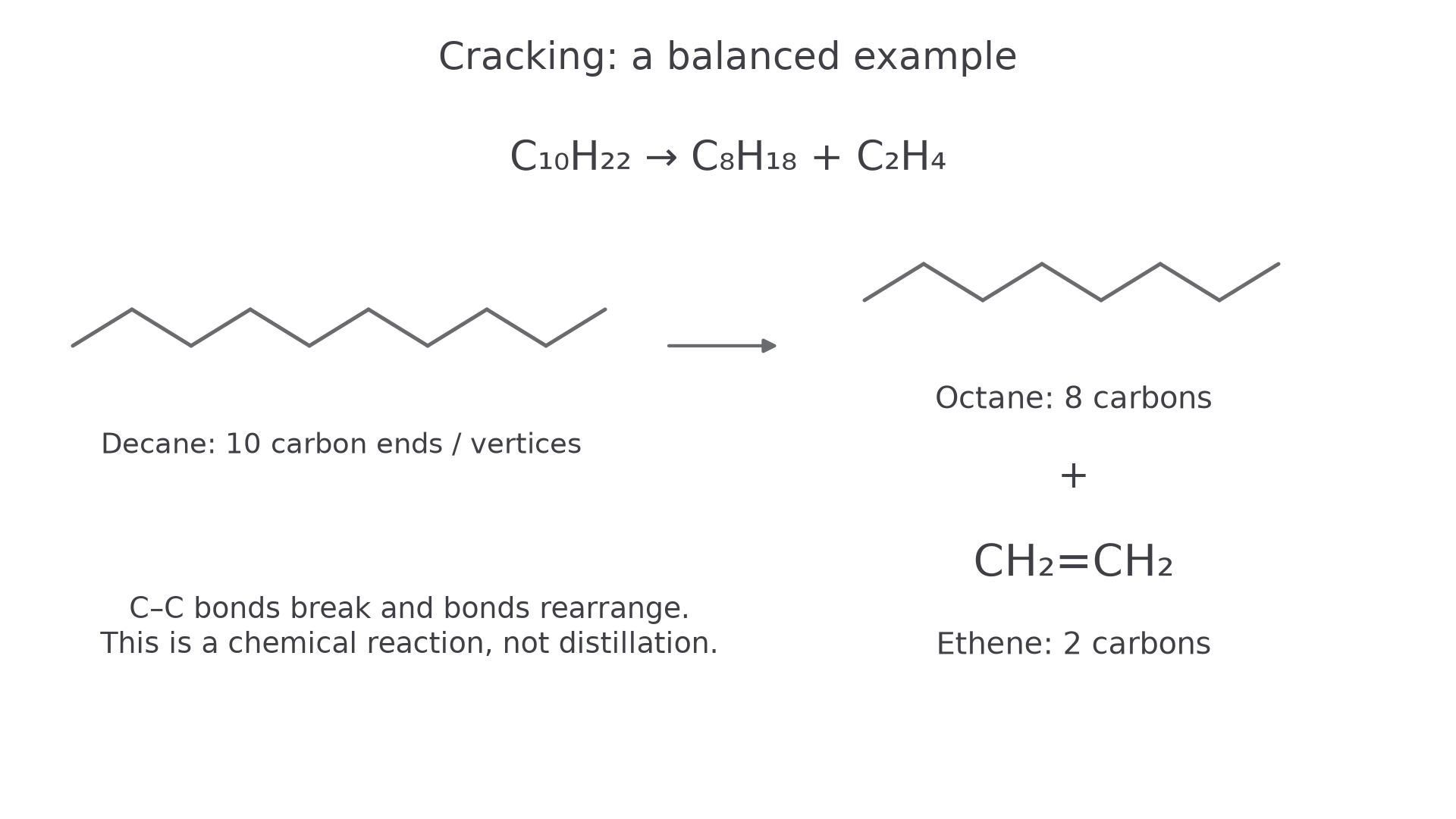
One possible cracking reaction is:
→ +
In this example, decane forms octane and ethene. The exact products can vary because the carbon chain can break in different places, but the key idea is always the same: a larger alkane is turned into smaller hydrocarbons.
Very often, one of the products is an alkene. That is useful because alkenes are much more reactive than alkanes and can be used as feedstock for making polymers and many other organic compounds.
The diagram below shows one possible cracking reaction in which decane splits at a bond to give octane, a saturated alkane, and ethene, an unsaturated alkene.
[DIAGRAM: asset_name: 3.2.2 - Modification of Alkanes by Cracking - Diagram 1; asset_slug: 3.2.2 - Modification of Alkanes by Cracking - Diagram 1; recommended_method: retained_png; description: Exam-clean monochrome reaction diagram for one possible cracking of decane. Show a long zig-zag decane chain labelled decane, with the C-C bond near one end clearly highlighted as the bond broken. Draw an arrow to the products: octane as a shorter zig-zag chain labelled saturated alkane, and ethene shown explicitly as CH2=CH2 with the C=C double bond and labelled unsaturated alkene.]
Thermal cracking
Thermal cracking uses very high temperature and high pressure. Those harsher conditions are part of what makes it different from catalytic cracking.
The products from thermal cracking contain a high percentage of alkenes. That makes thermal cracking especially useful when industry wants starting materials for making new organic chemicals. The mechanism is not required here, so the important thing is the link between the conditions and the type of products formed.
A clear summary is:
- thermal cracking: high temperature, high pressure
- main outcome: a high percentage of alkenes
This is why thermal cracking is often linked with demand for alkene feedstocks. If a refinery or chemical plant wants more ethene or propene, thermal cracking is a good route because it produces plenty of unsaturated molecules.
Thermal cracking is the harsher process and is the one to link with producing a high percentage of alkenes.
Catalytic cracking
Catalytic cracking also uses a high temperature, but it happens at a slight pressure and in the presence of a zeolite catalyst. The catalyst is what makes this process different from thermal cracking.
Continue this lesson.
You’re previewing NovaLearn without an account. Create a free account to read the rest.
Create free account