3.3.8 - Aldehydes and Ketones
Aldehydes and ketones both contain the carbonyl group, but one small structural difference changes how they behave in oxidation reactions and in nucleophilic addition. That difference explains the classic aldehyde tests, the reduction of carbonyl compounds with , and the formation of hydroxynitriles with cyanide. Throughout the topic, structure controls reactivity right down to the electron movement.
Oxidation and Chemical Tests
Aldehydes have a carbonyl carbon bonded to at least one hydrogen atom. Ketones have a carbonyl carbon bonded to two carbon-containing groups. That difference matters immediately in oxidation.
An aldehyde can be oxidised to a carboxylic acid without breaking a carbon-carbon bond. In a ketone, further oxidation would need a carbon-carbon bond to be broken, so ketones are not readily oxidised under the mild conditions used in standard qualitative tests.
The general oxidation equation for an aldehyde is:
This is why aldehydes are described as being readily oxidised to carboxylic acids.
In alkaline Tollens’ and Fehling’s solutions the organic oxidation product is a carboxylate ion; acidification gives the carboxylic acid shown in the general equation. Use fresh reagents, a warm water bath and separate clean samples. Record a colour/solid observation separately from the conclusion. Tollens’ reagent must be prepared freshly and disposed of promptly following the laboratory instructions, never stored or allowed to dry.
Two named tests exploit this difference.
With Fehling's solution, an aldehyde is warmed with the reagent and gives a brick-red precipitate of copper(I) oxide. The reagent starts blue because it contains copper((II)) ions. A ketone gives no visible change.
With Tollens' reagent, an aldehyde is warmed with the reagent and gives a silver mirror on the inside of the test tube as silver ions are reduced to silver metal. A ketone again gives no reaction.
The chemistry behind both tests is the same idea: the aldehyde is oxidised, while the oxidising agent in the reagent is reduced.
Aldehydes can be oxidised under mild conditions, but ketones are resistant because oxidation would require carbon-carbon bond cleavage.
Reduction with sodium borohydride
Reduction does the reverse job. Aldehydes are reduced to primary alcohols, and ketones are reduced to secondary alcohols, using sodium borohydride in aqueous solution.
The overall equations are:
For example:
Nucleophilic addition
A reaction in which a nucleophile attacks an electron-poor carbon atom and adds across a double bond, so two new single bonds are formed.
These reductions are examples of nucleophilic addition because the carbonyl bond is polar. Oxygen is more electronegative than carbon, so the carbonyl carbon is and is the site attacked by the nucleophile.
In the mechanism, is treated as a source of . The mechanism has two essential steps.
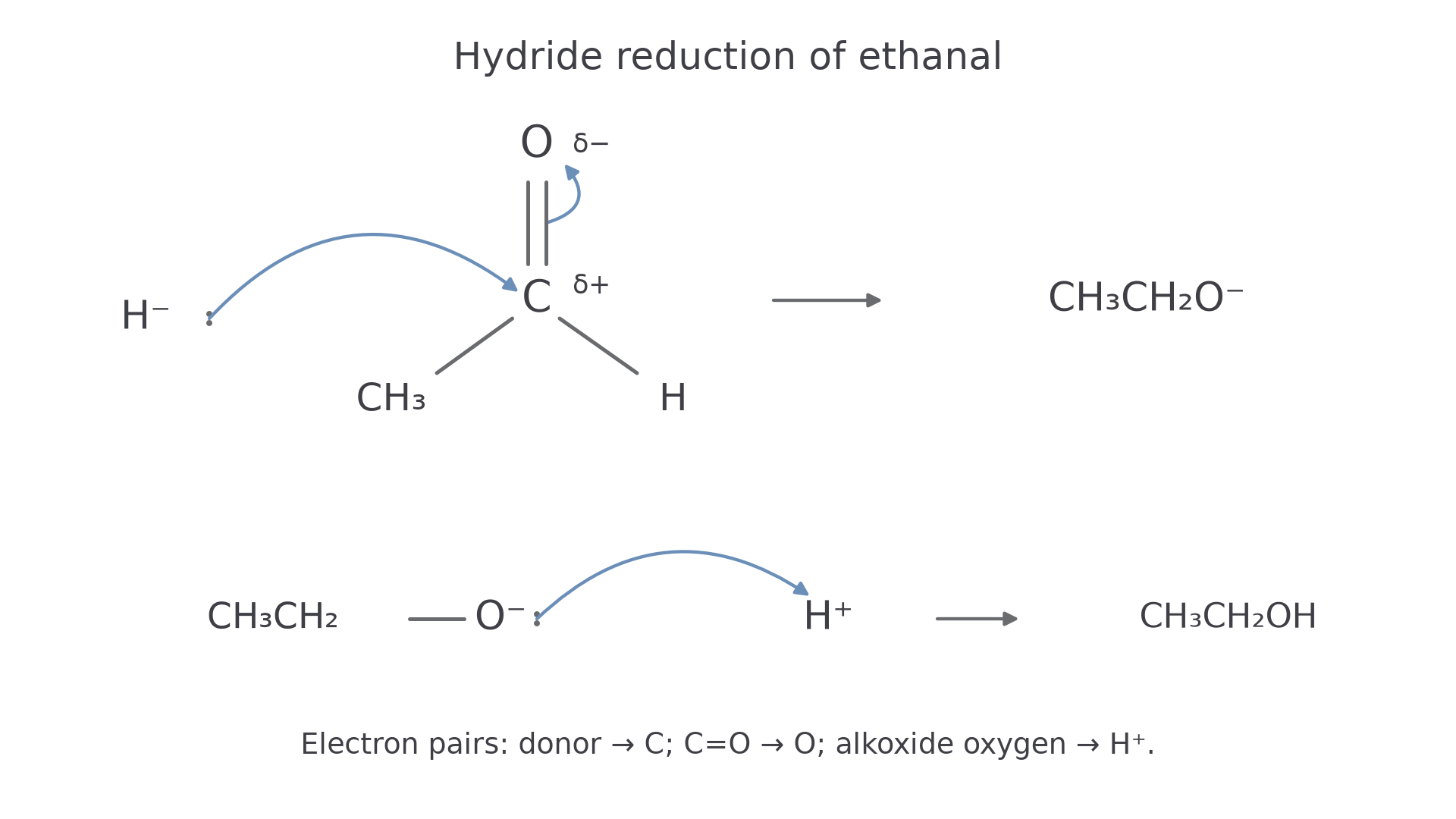
First, the hydride ion attacks the carbonyl carbon. The pi bond breaks and the electron pair moves onto oxygen, producing an alkoxide ion.
Second, the oxygen is protonated by from the aqueous medium, forming the alcohol.
The diagram below shows the two-step hydride-addition mechanism for ethanal, from nucleophilic attack by to protonation of the alkoxide.
[DIAGRAM: asset_name: 3.8 - Aldehydes and Ketones (A-level only) - Diagram 1; asset_slug: 3.8 - Aldehydes and Ketones (A-level only) - Diagram 1; recommended_method: retained_png; description: Three-step horizontal mechanism for reducing ethanal. Step 1: CH3CHO with delta+ on the carbonyl carbon and delta- on oxygen, a curly arrow from H^- to the carbonyl carbon, and a second curly arrow from the C=O bond to oxygen. Step 2: the alkoxide intermediate CH3CH2O^-. Step 3: protonation by H+ to give CH3CH2OH.]
Sodium borohydride selectively reduces the polar carbonyl in these examples. The carbonyl carbon is electron-poor and attracts hydride; an ordinary non-polar, electron-rich bond does not provide the same nucleophilic attack site. In the cyanide mechanism, draw the donor pair on carbon in , not nitrogen, because a new C–C bond is formed.
This reduction is not just "adding hydrogen somewhere". The first added species is a nucleophile, , and the oxygen is protonated afterwards.
Continue this lesson.
You’re previewing NovaLearn without an account. Create a free account to read the rest.
Create free account