3.1.6.2 - Equilibrium Constant Kc
gives chemists a numerical way to describe the position of equilibrium. In this lesson, you will build expressions, calculate from equilibrium data, use in further calculations, and predict how temperature changes affect it. The central idea is simple: is a ratio of equilibrium concentrations, and that ratio only changes when the temperature changes.
Building the Kc expression
For this topic, we deal with homogeneous equilibria, where all the reacting species are in the same phase.
Homogeneous system
A homogeneous system is an equilibrium mixture in which all reactants and products are in the same phase.
That means the substances can all be described using concentrations in , shown by square brackets such as .
If the balanced equation is:
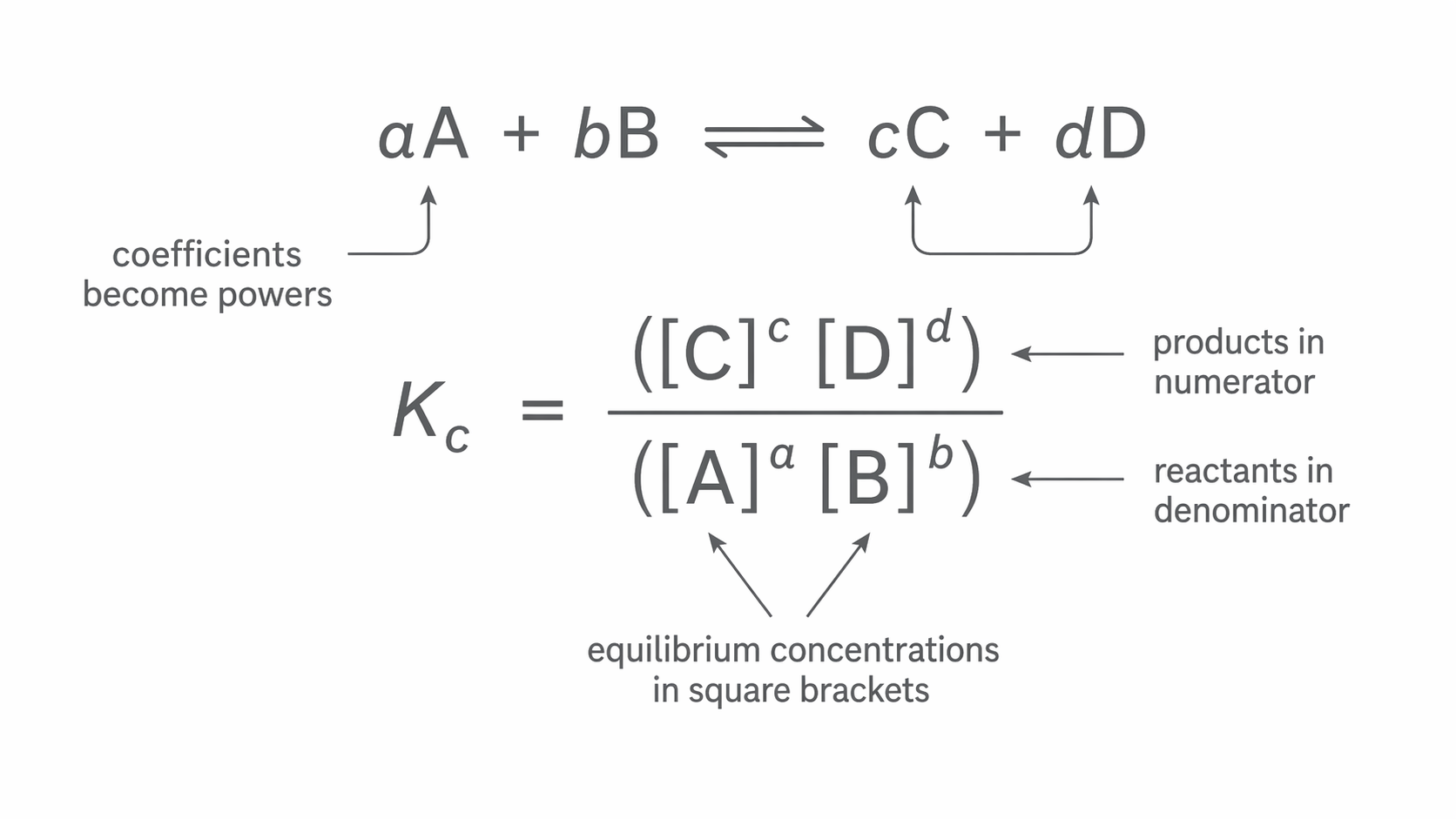
then the equilibrium constant is:
General Kc Expression
There are three details that matter every time:
- use the balanced equation
- use equilibrium concentrations, not starting concentrations
- turn the stoichiometric coefficients into powers
So if a substance has coefficient 2 in the equation, its concentration is squared in the expression. If the coefficient is 1, we usually do not write the power.
The diagram below shows the structure of a expression: products go in the numerator, reactants go in the denominator, and coefficients become powers.
[DIAGRAM: asset_name: 1.6.2 - Equilibrium Constant Kc for Homogeneous Systems - Diagram 1; asset_slug: 1.6.2 - Equilibrium Constant Kc for Homogeneous Systems - Diagram 1; recommended_method: retained_png; description: Constructing Kc with product concentrations above reactant concentrations, each raised to its stoichiometric coefficient.]^c[D]^d)/([A]^a[B]^b). Add callout arrows and labels showing products in numerator, reactants in denominator, coefficients become powers, and equilibrium concentrations in square brackets.]
What Kc tells you about equilibrium
is not just a formula to calculate. It also tells you where the equilibrium lies.
Equilibrium constant
The equilibrium constant, , is the constant value of the ratio of equilibrium concentrations of products to reactants for a reversible reaction at a fixed temperature.
For a simple equilibrium A ⇌ B, Kc = [B]/[A], so:
- if is much greater than 1, products predominate and the equilibrium lies to the right
- if is much less than 1, reactants predominate and the equilibrium lies to the left
- if is around 1, appreciable amounts of both reactants and products are present
For more complicated equations, Kc compares products of concentrations raised to powers, not the total amounts on each side. Its units depend on those powers. Interpret its magnitude using the specified equation and concentration units rather than comparing numerical Kc values for unrelated reactions.
This does not tell you how fast equilibrium is reached. A large means the equilibrium position favours products, but a slow reaction can still take a long time to get there.
At constant temperature, changing concentration does not change the value of . Instead, the equilibrium position shifts until the ratio returns to the same value. Adding a catalyst also does not change ; it speeds up the forward and reverse reactions by the same proportion, so equilibrium is reached faster but the final ratio is unchanged.
In ester manufacture, removing water as it forms can improve the equilibrium yield of ester. The system shifts right to replace some of the removed water, but the value of at that temperature stays the same.
Calculating Kc from equilibrium concentrations
In calculations like these, the hardest step is often not the substitution. It is finding the equilibrium concentrations correctly before you substitute them.
Worked example:
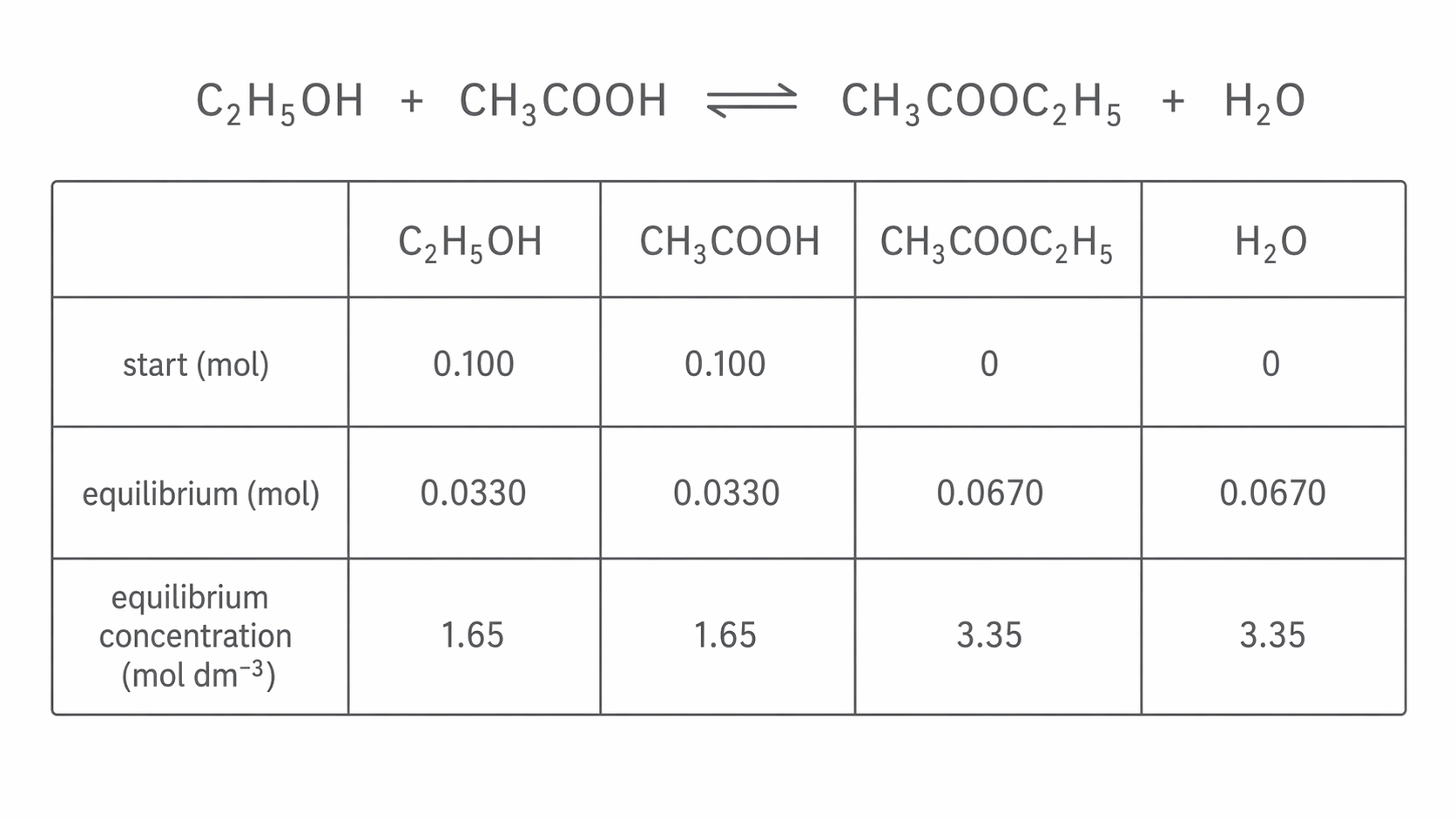
Initially, of ethanol and of ethanoic acid are mixed. The total volume is . At equilibrium, analysis shows that of ethanoic acid remains.
Step 1: use the stoichiometry.
Because the equation is 1 : 1 : 1 : 1:
- ethanol remaining =
- ethanoic acid used =
- ester formed =
- water formed =
Step 2: convert equilibrium amounts to equilibrium concentrations.
Step 3: substitute into the expression.
So to 3 significant figures. Keep extra digits during the calculation and round only the final result.
The diagram below organises the worked example into an equilibrium table so you can see the route from starting amounts to equilibrium concentrations clearly.
[DIAGRAM: asset_name: 1.6.2 - Equilibrium Constant Kc for Homogeneous Systems - Diagram 2; asset_slug: 1.6.2 - Equilibrium Constant Kc for Homogeneous Systems - Diagram 2; recommended_method: retained_png; description: An esterification equilibrium table distinguishes initial amounts, changes and equilibrium amounts before conversion to concentrations.]
The units of depend on the equation. You find them by substituting into the expression and cancelling. In this esterification example, the units cancel completely, so has no units.
Continue this lesson.
You’re previewing NovaLearn without an account. Create a free account to read the rest.
Create free account