3.3.2.1 - Fractional Distillation of Crude Oil
Petroleum, usually called crude oil before refining, is one of the main raw materials of organic chemistry. This lesson focuses on two linked ideas: what alkanes are, and why a refinery can separate a complicated mixture of them into useful fractions. If you can explain why different hydrocarbons condense at different heights in a column, you understand the core of the process.
Alkanes and petroleum
Crude oil matters here because most of it is made of alkanes. Before separation makes sense, we need to be precise about what that means.
Alkane
An alkane is a hydrocarbon containing only carbon-carbon and carbon-hydrogen single bonds. Alkanes are saturated hydrocarbons.
A hydrocarbon contains carbon and hydrogen only. The word saturated tells you there are no carbon-carbon double bonds or triple bonds present. In an alkane, every carbon atom is joined by single covalent bonds only, so the molecules are relatively unreactive compared with many other organic compounds.
For an acyclic alkane the general formula is . Thus six carbons give . A saturated carbon ring has two fewer hydrogens because closing the ring uses two bonding positions: cyclohexane is . Do not classify a formula without considering whether rings or multiple bonds are present.
Petroleum is not one pure substance. It is a mixture of many hydrocarbons, mainly alkanes, with different molecular sizes. That word mixture matters because the components are physically combined, not chemically bonded into one giant compound. Because the molecules are different, they do not all boil at the same temperature.
Why the mixture can be separated
Fractional distillation works because different hydrocarbons in crude oil have different boiling points. In general, shorter-chain alkanes have lower boiling points, while longer-chain alkanes have higher boiling points.
Fractional distillation
Fractional distillation is the separation of a mixture into fractions by repeated vaporisation and condensation, using differences in boiling point.
That boiling-point trend comes from intermolecular forces, not from stronger covalent bonds inside the molecules. Larger alkane molecules have more electrons and usually a greater surface area, so the London forces between their molecules are stronger. More energy is needed to separate those molecules, so their boiling points are higher.
Each fraction collected from the column is still a mixture, but it contains hydrocarbons with similar boiling-point ranges. That is why a petrol fraction contains many similar hydrocarbons rather than one pure compound.
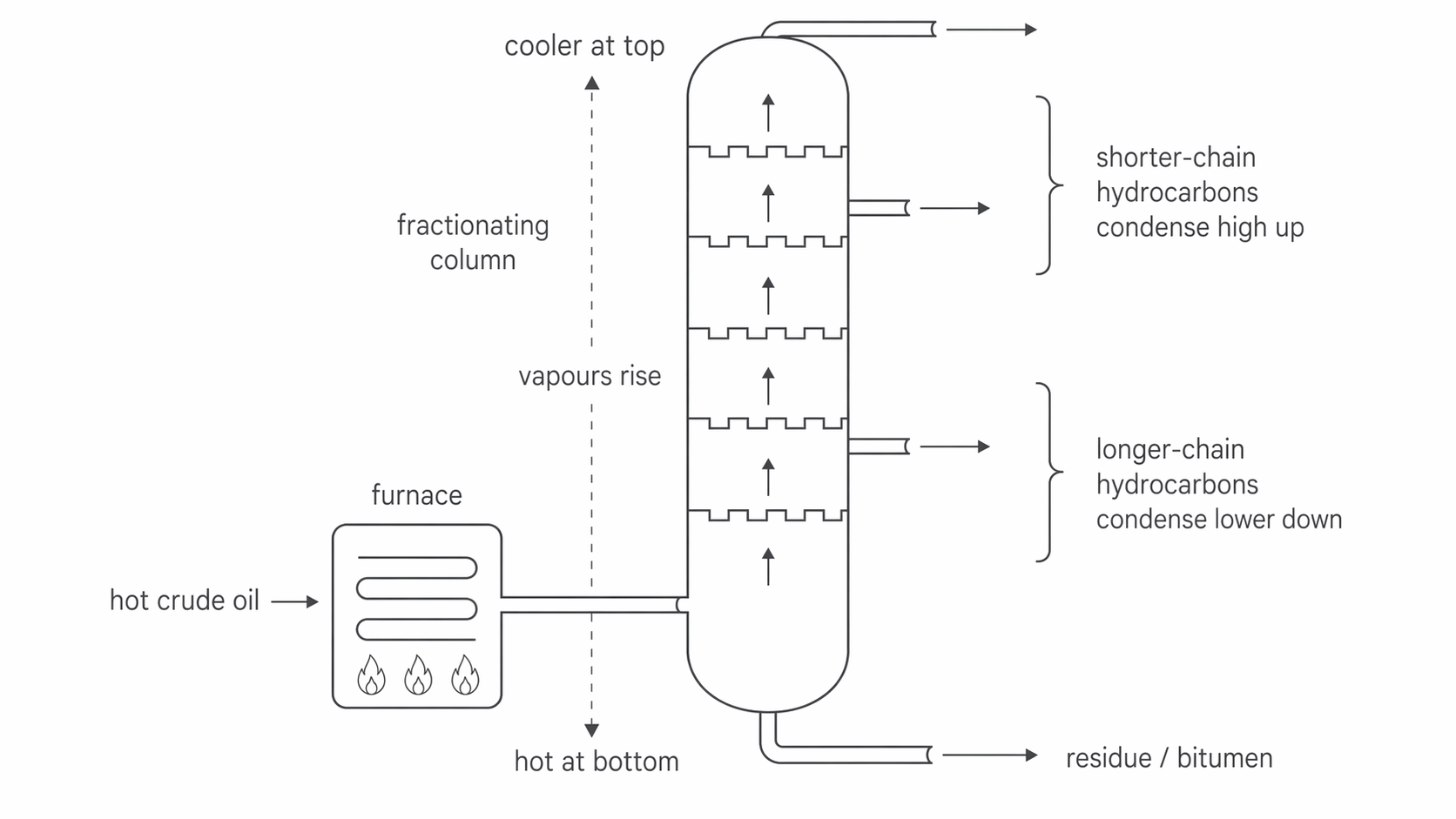
The diagram below shows the basic layout of a fractionating column and why different hydrocarbons are collected at different heights.
[DIAGRAM: asset_name: 3.2.1 - Fractional Distillation of Crude Oil - Diagram 1; asset_slug: 3.2.1 - Fractional Distillation of Crude Oil - Diagram 1; recommended_method: retained_png; description: Exam-clean monochrome fractionating column for crude oil. Show a furnace heating crude oil and the hot feed entering near the base of a tall column containing trays. Label a clear temperature gradient, hot at the bottom and cooler at the top, with vapours rising upward through the column. Add side outlets at different heights, showing shorter-chain hydrocarbons condensing high up, longer-chain hydrocarbons condensing lower down, and residue or bitumen leaving from the bottom.]
Continue this lesson.
You’re previewing NovaLearn without an account. Create a free account to read the rest.
Create free account