3.2.5.2 - Substitution Reactions
Follow ligand substitution by counting donor atoms, tracking complex charge and comparing observations; then explain chelation and oxygen transport by haemoglobin.
Simple ligand substitution with water and ammonia
A ligand substitution reaction happens when one ligand in a complex ion is replaced by another ligand.
Ligand substitution reaction
A ligand substitution reaction is a reaction in which one ligand attached to a central metal ion is replaced by a different ligand.
For this topic, the first ligands to know are , , and . Water and ammonia are both monodentate ligands, meaning each ligand forms one co-ordinate bond to the metal ion. They are also similar in size and both uncharged, so replacing with usually happens without changing the coordination number.
For example, an octahedral cobalt(II) aqua complex can be converted into an octahedral cobalt(II) ammine complex:
The metal ion still has six co-ordinate bonds before and after the substitution, so the coordination number stays at 6.
Copper(II) is an important A-level exception because the substitution by ammonia is often incomplete. Instead of all six water ligands being replaced, the common product in excess ammonia is:
This is still a ligand substitution reaction, but copper(II) shows that you cannot assume every water ligand is replaced.
The diagram below compares the aqua and ammine copper(II) complexes and shows that all six ligand positions are still occupied after substitution.
[DIAGRAM: asset_name: 2.5.2 - Substitution Reactions - Diagram 1; asset_slug: 2.5.2 - Substitution Reactions - Diagram 1; recommended_method: retained_png; description: Two octahedral copper(II) complexes side by side. Left complex labelled [Cu(H2O)6]2+ with six H2O ligands occupying six positions around Cu2+. Right complex labelled [Cu(NH3)4(H2O)2]2+ with four NH3 ligands replacing four water ligands while two H2O ligands remain. Add an arrow labelled substitution by NH3 and label coordination number = 6 beneath both complexes.]
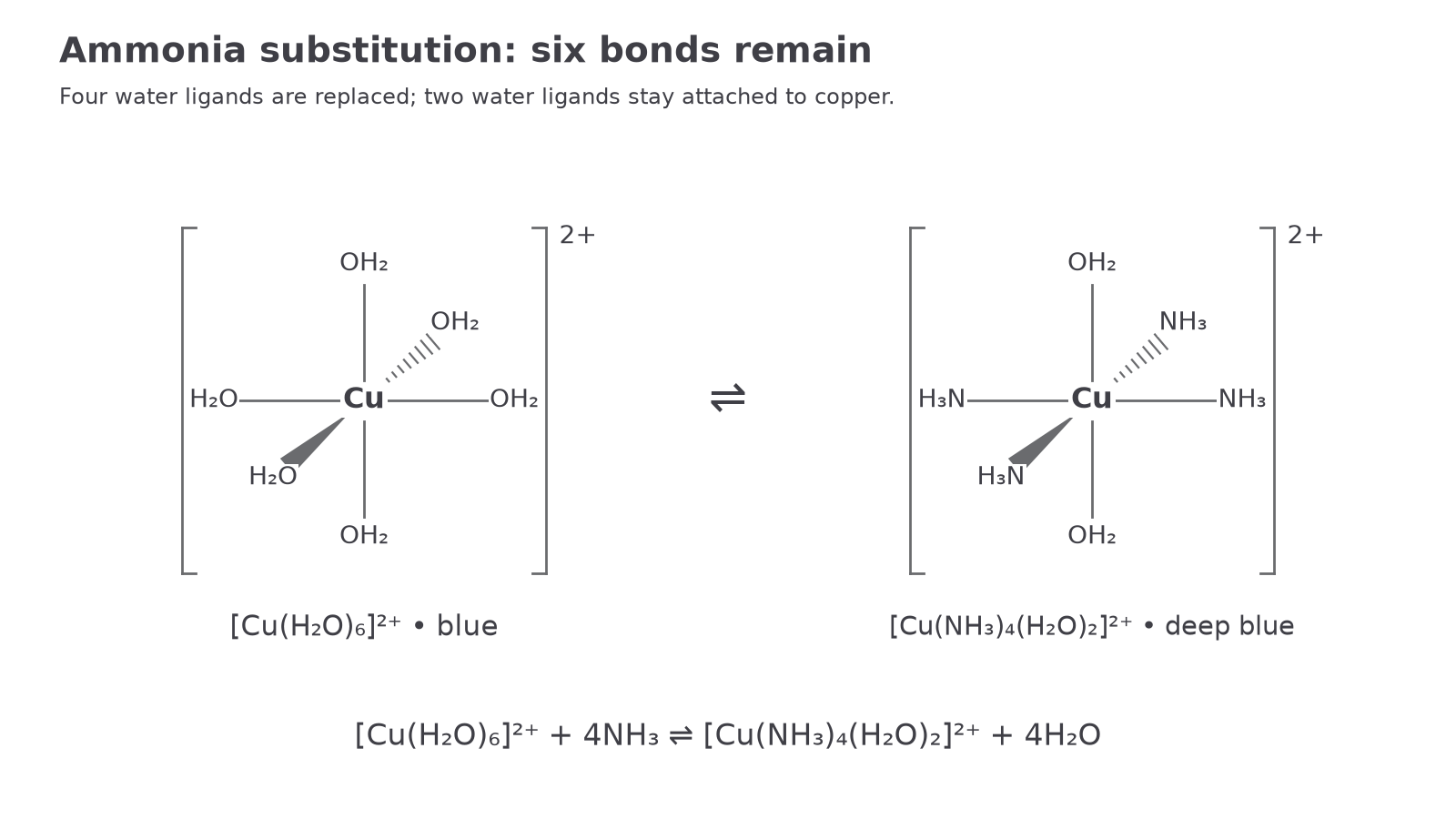
The important pattern is this: when the incoming ligand is similar in size to the outgoing ligand, substitution can happen without changing the number of ligands around the metal ion.
With copper(II), add ammonia dropwise and record the pale blue hydroxide precipitate first; in excess ammonia it dissolves to give the deep blue complex. The initial precipitation is an acid–base reaction; the final dissolved complex is explained by ligand substitution. Count six donor atoms in both aqua and tetraamminediaqua complexes: four ammonia N donors and two water O donors remain around copper.
Why chloride can change the coordination number
Chloride behaves differently. It is a monodentate ligand, but it is larger than and , so fewer chloride ligands can fit around the metal ion.
That is why replacing water ligands with chloride ligands can change the coordination number from 6 to 4. In the copper(II) example below, the octahedral aqua complex becomes a tetrahedral chloride complex:
The same idea applies to cobalt(II) and iron(III) as well. Record the colour changes as well as the geometry: larger chloride ligands can reduce the coordination number because six chloride ions cannot pack around the metal ion in the same way that six smaller water molecules can.
Coordination number
The coordination number is the number of co-ordinate bonds formed to the central metal ion.
Notice that coordination number counts co-ordinate bonds, not the charge on the complex and not the number of atoms in each ligand. This is why a chloride substitution can change the coordination number even though both the old and new ligands are still monodentate.
The diagram below contrasts an octahedral aqua complex with a tetrahedral chloride complex, making the drop in coordination number easy to see.
[DIAGRAM: asset_name: 2.5.2 - Substitution Reactions - Diagram 2; asset_slug: 2.5.2 - Substitution Reactions - Diagram 2; recommended_method: retained_png; description: Compare two copper(II) complexes side by side. Left: octahedral [Cu(H2O)6]2+ with six H2O ligands around Cu2+, labelled coordination number = 6. Right: tetrahedral [CuCl4]2- with four larger Cl- ligands around Cu2+, labelled coordination number = 4. Add an arrow labelled excess Cl- and a short note that larger chloride ligands mean fewer ligands fit around the metal ion.]
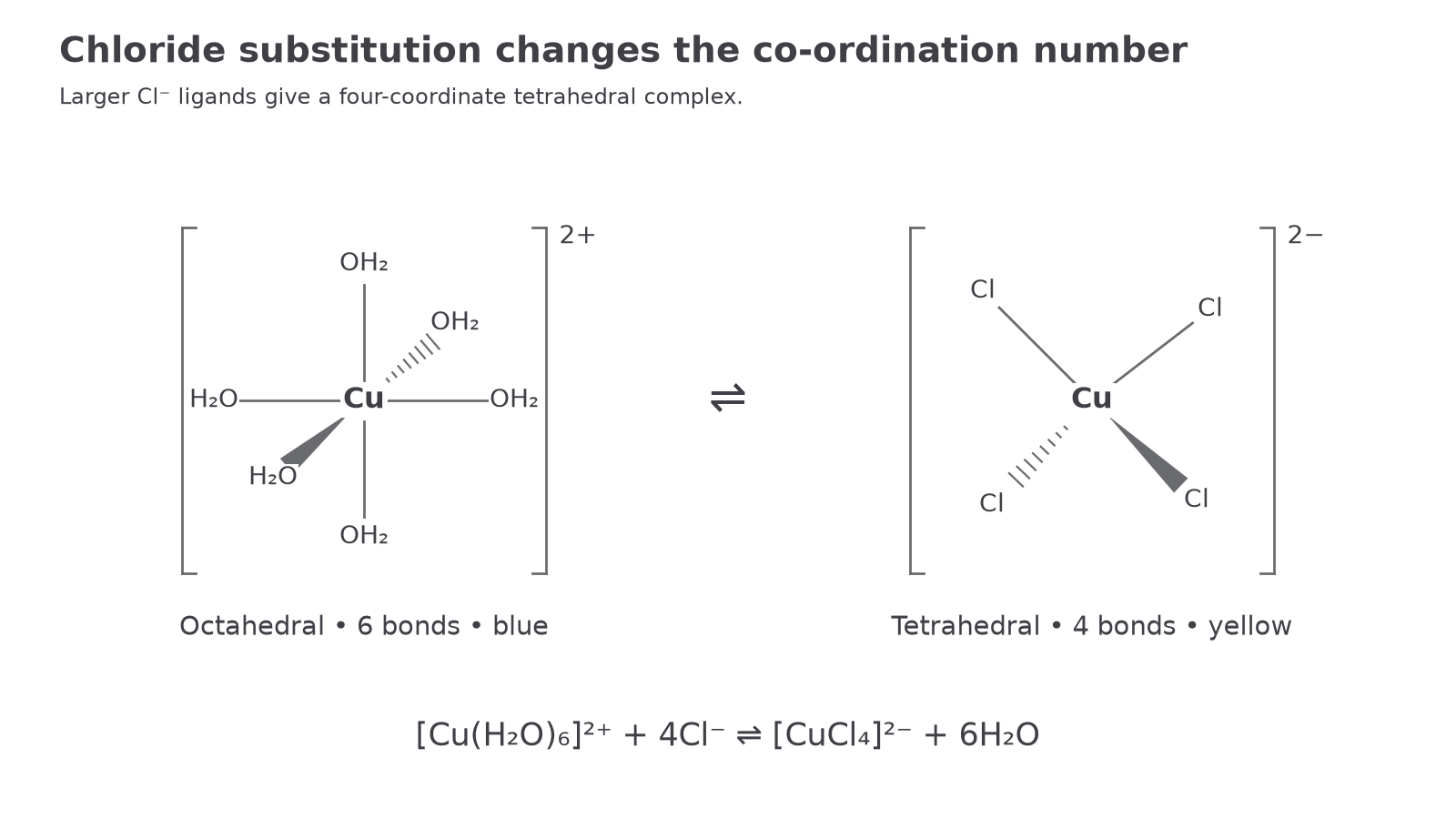
The chemistry comes down to size and packing: chloride is larger, so fewer ligands fit around the metal ion, so the coordination number falls.
Useful comparisons with concentrated hydrochloric acid are pink to blue , and blue to yellow . A copper mixture can look green while both complexes are present. For iron(III), chloride substitution forms yellow , often deepening the original yellow solution. For example, . Add water to shift the equilibrium back towards the aqua complex. Use small fresh portions in a fume cupboard with eye protection; concentrated acid is corrosive.
Bidentate and multidentate ligands
Some ligands can attach to the metal ion more than once. This is where counting carefully becomes essential.
Bidentate ligand
A bidentate ligand is a ligand that forms two co-ordinate bonds to a central metal ion.
The two named bidentate ligands in this topic are ethane-1,2-diamine, (often abbreviated to en), and the ethanedioate ion, . Each one has two lone pairs available to bond to the metal ion, so each ligand uses two attachment points.
Continue this lesson.
You’re previewing NovaLearn without an account. Create a free account to read the rest.
Create free account