Required practical 6 - Organic Functional-Group Tests
Organic molecules can look similar, so chemists often identify them by how they react with carefully chosen reagents. In this required practical, the aim is not to measure an amount but to link a visible observation to a functional group. By the end of the lesson, you should be able to choose suitable test-tube reactions, predict the observations, and explain how to distinguish an alcohol, an aldehyde, an alkene, and a carboxylic acid safely.
The unknowns in this practical are simple aliphatic compounds with one of the four listed functional groups. A negative Fehling's test excludes the simple aliphatic aldehydes in this candidate set; it does not exclude every aromatic aldehyde.
Planning the identification
When you are distinguishing organic compounds, a good test must give a clear observation and must be carried out in a way that makes that observation trustworthy. That means using separate fresh samples, clean apparatus, and controlled heating where needed.
Qualitative test
A qualitative test identifies the presence of a substance or functional group from an observation such as a colour change, precipitate, or gas, rather than measuring an amount.
In this practical, small volumes are enough. Use test tubes, droppers or pipettes for measured additions, and a water bath or electric heater when warming is needed. That keeps the tests small-scale and controlled, while letting you heat safely and handle reactive, corrosive, irritant, and flammable substances with care.
The main safety ideas are straightforward but important. Sodium metal is very reactive, bromine water is irritant, Fehling's solution contains alkali, and many organic liquids are flammable. Wear eye protection, keep test-tube mouths pointed away from people, and avoid naked flames when heating organic samples.
The diagram below lays out a sensible sequence for identifying the unknown with separate fresh samples and clear positive observations at each stage.
[DIAGRAM: asset_name: RP 06 - Tests for Alcohol, Aldehyde, Alkene and Carboxylic Acid - Diagram 1; asset_slug: RP 06 - Tests for Alcohol, Aldehyde, Alkene and Carboxylic Acid - Diagram 1; recommended_method: retained_png; description: Flow chart for identifying an unknown organic liquid using separate fresh samples. Start with "Unknown organic liquid" and show a clear sequence where each negative result leads to the next fresh-sample test. Step 1: add sodium carbonate; effervescence and limewater turning cloudy identifies a carboxylic acid. If negative, Step 2: warm a fresh sample with Fehling's solution; a brick-red precipitate identifies an aldehyde. If negative, Step 3: add bromine water to another fresh sample; orange to colourless identifies an alkene. If the sample is still unidentified, Step 4: add a tiny piece of sodium to a dry fresh sample; hydrogen with a squeaky pop identifies an alcohol. Add a small side note that acidified K2Cr2O7 can then be used as a follow-up to classify a primary or secondary alcohol because it changes from orange to green.]
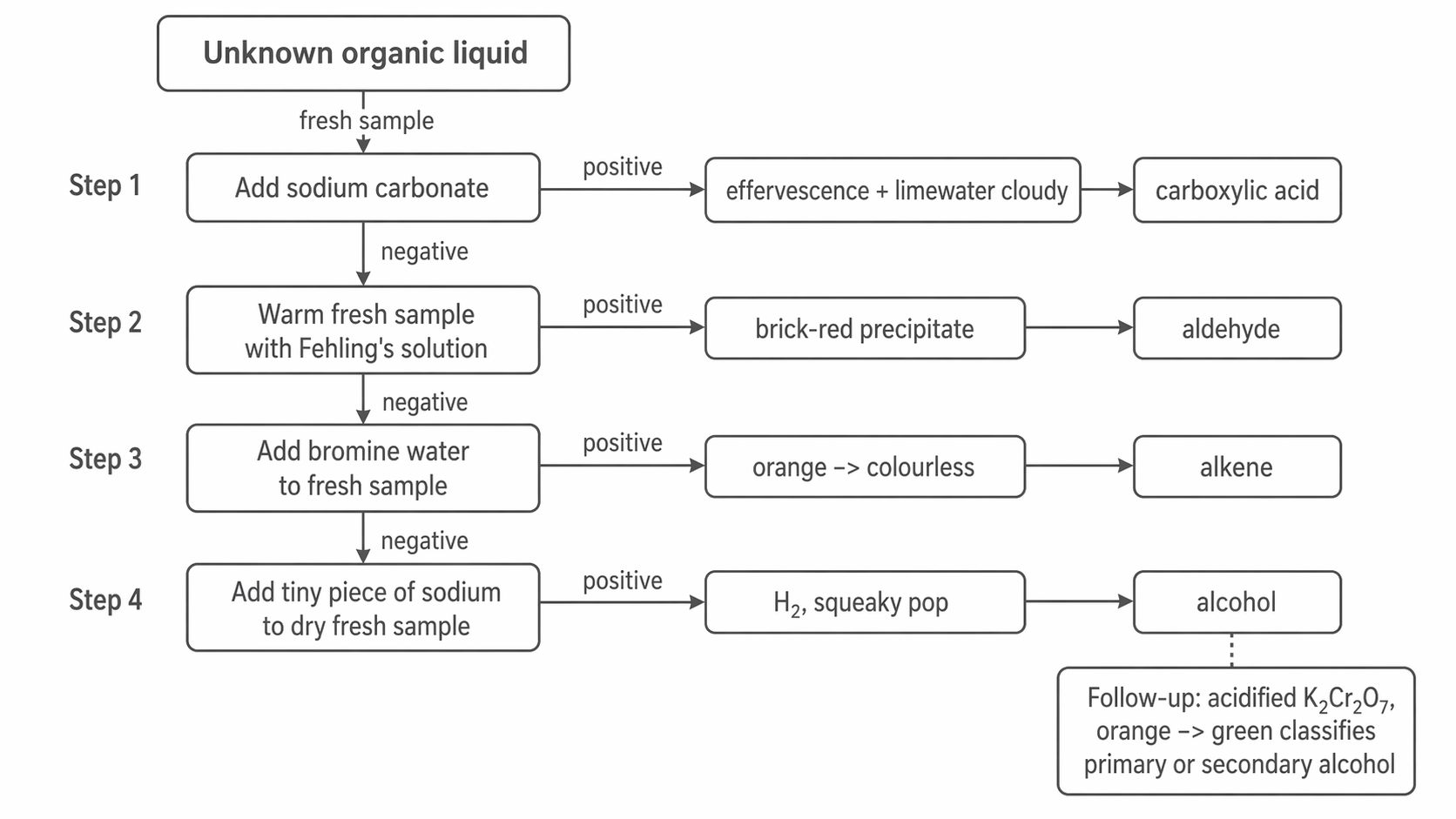
That order is helpful because it keeps the evidence easy to interpret. If you identify an aldehyde early with Fehling's solution, you are less likely to misread another reagent later.
Testing for alcohols and aldehydes
Alcohols contain an group attached to a saturated carbon atom. A dry alcohol reacts with sodium metal because the hydrogen in the bond can be displaced. Add a very small piece of sodium to a dry sample. If a gas is produced and gives a squeaky pop with a lit splint, that gas is hydrogen.
The sodium test is a supervised small-scale test, with sodium handled by the instructed technique. If testing the evolved gas with a splint, separate the gas sample from the flammable organic liquid and remaining sodium; never bring a flame to the reaction vessel.
The word dry matters. Sodium also reacts with water, so a wet test tube could produce hydrogen even if the organic liquid were not an alcohol. That is why the sodium test must be done on a fresh, dry sample and with only a tiny piece of sodium.
Here, the sodium test works best after the carbonate test has ruled out a carboxylic acid, because carboxylic acids also react with reactive metals.
Acidified potassium dichromate(VI) can be used as a follow-up test with alcohols. Warm the sample with acidified dichromate in a water bath. Primary and secondary alcohols reduce dichromate(VI) ions to chromium(III) ions, so the reagent changes from orange to green. Tertiary alcohols do not give this colour change under these conditions, so this test is useful for classifying an alcohol rather than proving that every alcohol will respond.
Aldehydes are tested in a different way. Mix equal volumes of Fehling's solution A and Fehling's solution B to make a deep blue reagent, then warm it with the sample in a water bath. If an aldehyde is present, the blue copper(II) ions are reduced and a brick-red precipitate of copper(I) oxide forms. Use controlled water-bath warming; vigorous boiling is unnecessary.
Oxidising agent
An oxidising agent causes oxidation by accepting electrons and is itself reduced.
The chemistry behind both tests is related. Aldehydes and many alcohols can be oxidised, so oxidising reagents help chemists tell them apart from less reactive functional groups. The positive observations are different: Fehling's solution gives a precipitate with an aldehyde, whereas acidified dichromate gives a colour change with primary and secondary alcohols.
Continue this lesson.
You’re previewing NovaLearn without an account. Create a free account to read the rest.
Create free account