3.3.13.3 - Enzymes
Enzymes matter because they let living systems run essential reactions quickly and selectively under mild conditions. In this lesson, you will see why enzymes are proteins, how an active site helps catalysis happen, why some enzymes only bind one enantiomer, and how a drug can block an enzyme by occupying its active site.
Enzymes are protein catalysts
Enzymes are proteins, usually folded into compact globular shapes. Their precise three-dimensional structure matters because it creates a small region with the right shape and chemical groups to interact with a particular substrate.
Enzyme
A protein that acts as a biological catalyst, increasing the rate of a reaction by lowering activation energy without being used up.
Because an enzyme is a catalyst, it is regenerated at the end of the reaction and can be used again. The key point is not just that enzymes speed reactions up, but that they do so selectively: one enzyme is usually adapted for one particular substrate, or a very small group of closely related substrates.
Active site
The small region of an enzyme with a specific three-dimensional shape and chemical environment where the substrate binds and the reaction is catalysed.
That specificity comes from both shape and bonding. A substrate must be able to fit the active site and also make temporary intermolecular interactions with it. If either requirement is wrong, binding is weak or impossible, so the reaction does not proceed efficiently.
How the active site helps catalysis
When a suitable substrate enters the active site, an enzyme-substrate complex forms. The substrate is held in the correct position by temporary interactions such as hydrogen bonding and other intermolecular forces. This matters because the enzyme is not simply a container: it holds the reacting molecule in the exact orientation needed for reaction.
While the substrate is bound, the arrangement of bonding and electron density within the substrate is made easier to change. In other words, the enzyme provides a lower-activation-energy pathway. Once the reaction has happened, the products no longer fit the active site as well, so they leave and the enzyme can catalyse another reaction.
The diagram below shows the sequence clearly: the substrate approaches a complementary active site, temporary intermolecular attractions hold it in place in the enzyme-substrate complex, and the products then leave while the enzyme itself is unchanged.
[DIAGRAM: asset_name: 3.13.3 - Enzymes - Diagram 1; asset_slug: 3.13.3 - Enzymes - Diagram 1; recommended_method: retained_png; description: Three-stage enzyme action sequence from left to right: a folded globular enzyme labelled enzyme with a clearly labelled active-site pocket; a complementary substrate approaching; the central enzyme-substrate complex showing dotted temporary intermolecular attractions holding the substrate in the correct orientation; final stage with two products leaving while the enzyme and active site remain unchanged.]
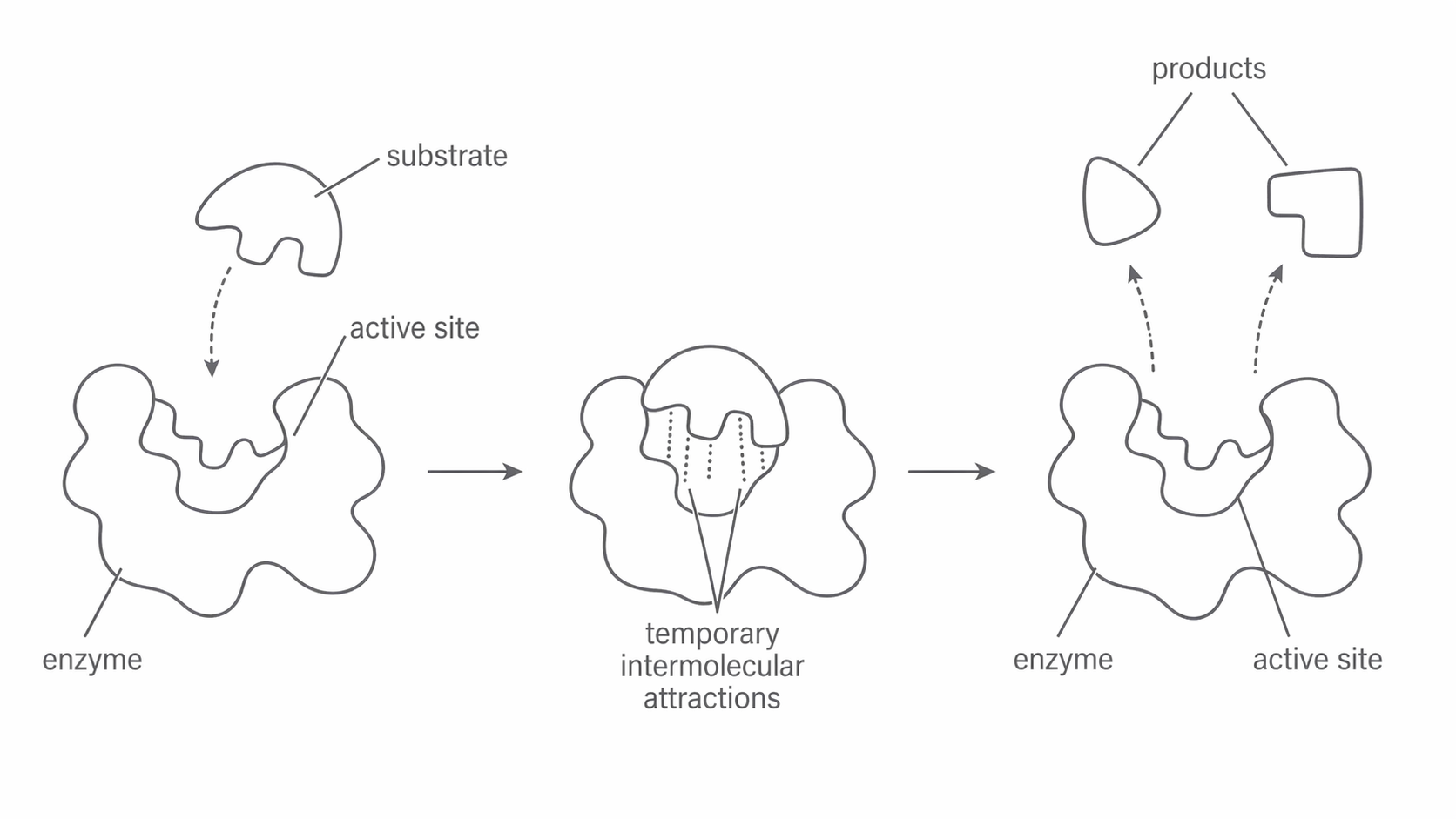
This is why the active site is so central to enzyme action: it brings together selectivity and catalysis in the same place. The active site chooses the right substrate, holds it correctly, and makes the reaction pathway easier.
The next idea is even more selective: sometimes the active site can distinguish between two molecules that are mirror images of each other.
Why enzymes are stereospecific
An enantiomer is one of a pair of optical isomers that are non-superimposable mirror images. They have the same structural formula, but their atoms are arranged differently in three dimensions.
Stereospecific
An enzyme is stereospecific if its active site binds and catalyses reaction of only one enantiomer of a substrate or drug.
The reason lies in three-dimensional fit. An enzyme is itself a three-dimensional protein, so the active site has groups arranged in fixed positions. One enantiomer may line up perfectly with those groups, allowing all the needed interactions to form at once. Its mirror image has the same atoms, but they point in different directions in space, so it cannot make the same set of contacts in the same active site.
Continue this lesson.
You’re previewing NovaLearn without an account. Create a free account to read the rest.
Create free account