3.3.5.1 - Alcohol Production
Industrial alcohol production is really a choice between two very different routes. One starts with alkenes and adds water across a double bond; the other starts with glucose from plant material and uses yeast enzymes to make ethanol. In this lesson, you will compare those routes, justify the conditions used in fermentation, outline the acid-catalysed hydration mechanism, and weigh up why ethanol as a biofuel is useful but controversial.
Two industrial routes to ethanol
Alcohols can be made industrially by hydration of alkenes. In the simplest example, ethene reacts with steam to form ethanol:
This route is usually linked to petrochemical feedstocks because the ethene is commonly produced from crude oil fractions by cracking.
Ethanol can also be made by fermentation of glucose:
That means the same alcohol can come either from a non-renewable starting material or from plant-derived sugars.
Biofuel
A biofuel is a fuel made from renewable biological material, such as plants or biological waste.
This definition matters because ethanol from fermentation can be used as a biofuel, while ethanol made from petrochemical ethene uses a finite fossil feedstock. Ethene itself can also be made from biomass, so identify the stated feedstock before judging renewability.
The diagram below compares the two main industrial routes used to make ethanol.
[DIAGRAM: asset_name: 3.5.1 - Alcohol Production - Diagram 1; asset_slug: 3.5.1 - Alcohol Production - Diagram 1; recommended_method: retained_png; description: Split process-flow comparison of the two main industrial routes to ethanol, drawn as two balanced vertical branches. Left branch: crude oil fractions -> cracking -> ethene -> hydration with steam, with phosphoric acid catalyst shown beside the hydration step -> ethanol, labelled non-renewable feedstock and fast continuous process. Right branch: sugar cane or sugar beet -> glucose solution -> yeast fermentation -> aqueous ethanol -> fractional distillation -> fuel ethanol, labelled renewable feedstock, slower batch process, and separation needed.]
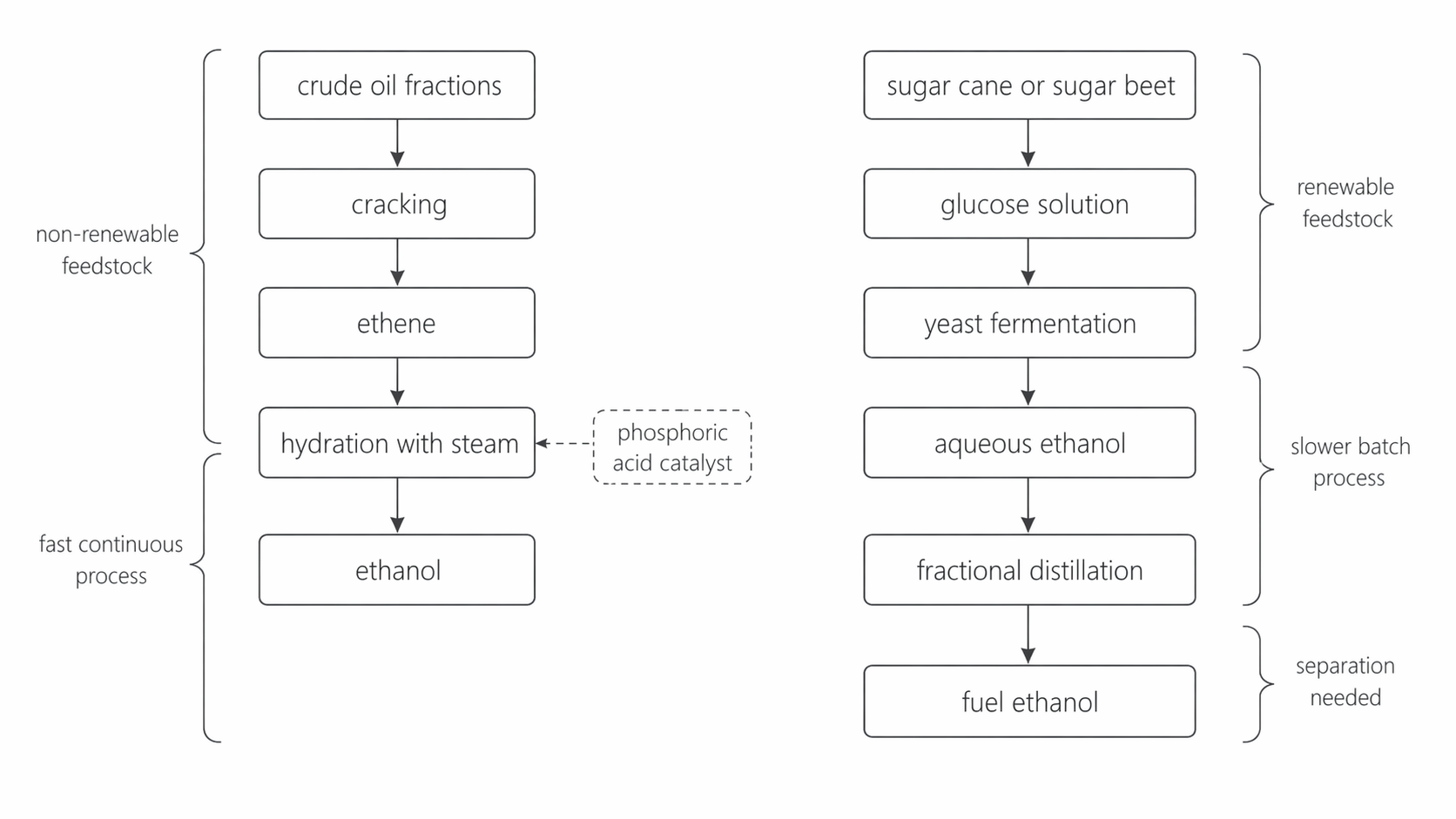
Hydration is usually the faster, more continuous industrial route. Fermentation is slower and produces ethanol in aqueous solution, so it needs a separation stage afterwards. However, fermentation uses renewable feedstocks, so it remains important although its dilute product requires energy-intensive separation.
Set the two methods side by side rather than calling one simply "better" overall.
Why fermentation uses these conditions
Fermentation only works well when the conditions suit the enzymes in yeast. The yeast catalyses the breakdown of glucose to ethanol and carbon dioxide, but enzymes are temperature-sensitive.
A temperature of about , often quoted as about , is a compromise:
- if the temperature is too low, the reaction is slow because the molecules and enzyme-substrate collisions have less kinetic energy
- if the temperature is too high, the enzymes denature and lose the shape of their active sites
Oxygen is kept out so that the yeast ferments rather than respires aerobically. Excluding air also reduces further oxidation of ethanol to ethanoic acid. The process is usually run as a batch process because, once the ethanol concentration rises to about 15%, the yeast can no longer function effectively.
For a laboratory fermentation, measure glucose solution and yeast into a flask, maintain a water bath near 35 °C and fit an airlock that releases carbon dioxide while excluding air. Never seal a gas-producing fermentation completely. Record temperature and gas evolution over time. Once fermentation has finished, remove solid yeast and fractionally distil the mixture using electrical heat, a packed column and a thermometer at the sidearm. Feed cooling water into the lower condenser connection and out of the upper one. Collect the ethanol-rich fraction over the specified temperature range; ordinary distillation does not give absolutely pure ethanol because ethanol and water form a constant-boiling mixture.
The fermentation mixture is not pure ethanol. It is mostly water with dissolved ethanol and other impurities.
Fractional distillation
Fractional distillation separates a mixture of miscible liquids by repeated evaporation and condensation, using differences in boiling point.
This is why it is used after fermentation. Ethanol boils at about , lower than water at , so the vapour becomes richer in ethanol and can be collected separately.
The diagram below shows how the fermentation conditions and the later separation stage fit together in ethanol production.
[DIAGRAM: asset_name: 3.5.1 - Alcohol Production - Diagram 2; asset_slug: 3.5.1 - Alcohol Production - Diagram 2; recommended_method: retained_png; description: Left-to-right process-and-apparatus diagram for ethanol fermentation and separation. Left: fermenter vessel containing glucose solution and yeast, labelled 30-40 C, no oxygen, and batch process. Arrow to the right: fractional distillation setup with a fractionating column and condenser, labelled ethanol-rich distillate collected near 78 C and water remaining richer near 100 C.]
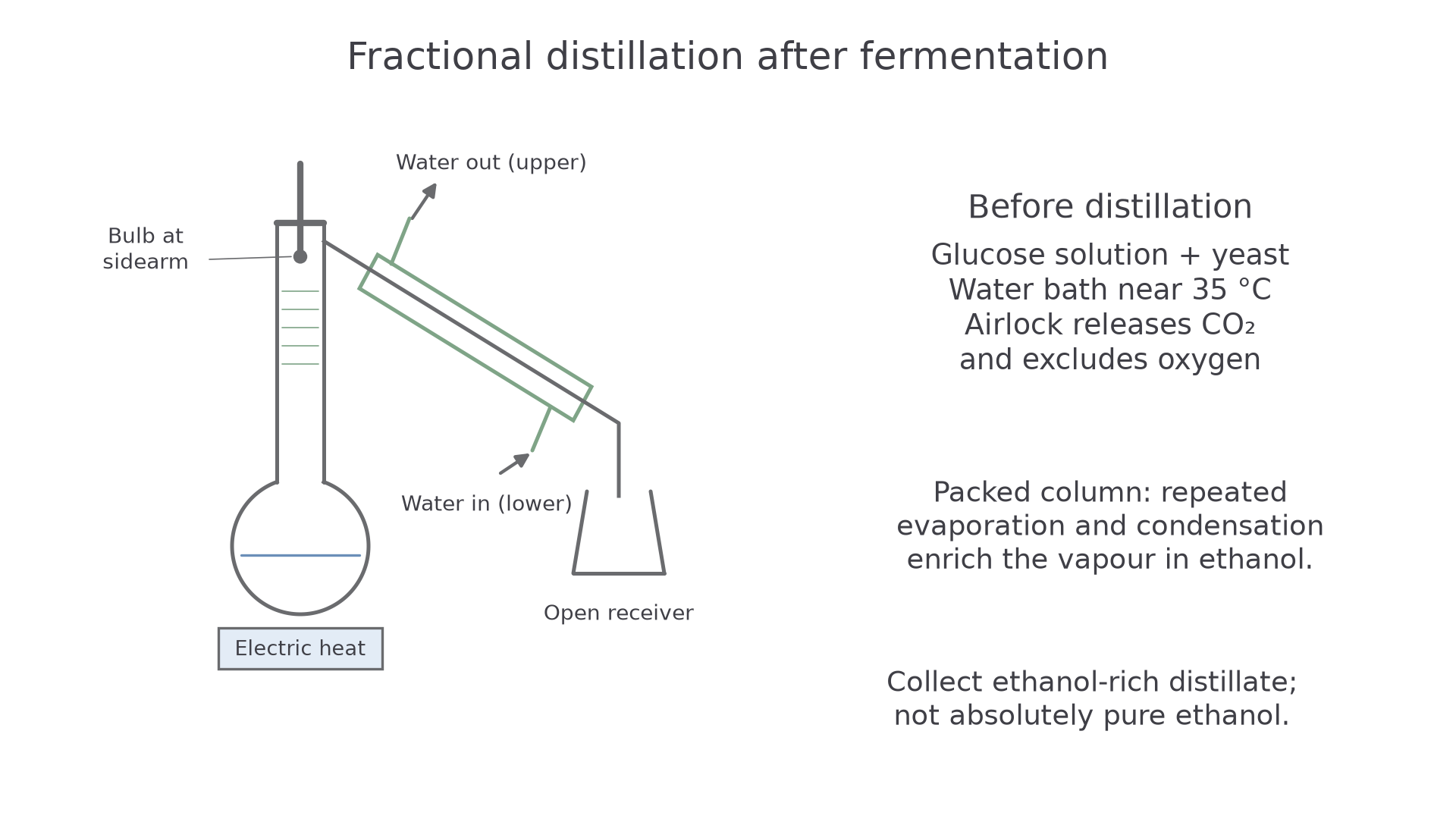
One useful way to think about fermentation is that the chemistry is gentle but the separation is not trivial. Making the ethanol is relatively low-temperature; isolating it from water still costs energy.
Each fermentation condition only makes sense when you link it to what it does for the enzymes or the product.
Continue this lesson.
You’re previewing NovaLearn without an account. Create a free account to read the rest.
Create free account