3.3.4.2 - Addition Reactions of Alkenes
Alkenes are reactive because the carbon-carbon double bond contains a pi bond that is rich in electrons and easy to attack. That makes alkenes especially good at reacting with electron-poor species, so they often undergo electrophilic addition. In this lesson you will follow that pattern through reactions with , and concentrated , and use carbocation stability to predict major and minor products in unsymmetrical alkenes.
Why alkenes react and how to outline the mechanism
In a double bond, one bond is a strong sigma bond and the other is a weaker pi bond. The pi bond has electron density above and below the plane of the molecule, so it is more exposed than a single bond. When an electrophile approaches, the pi electrons can be donated to it. As a result, the pi bond breaks while the carbon-carbon sigma bond remains, and two new single bonds are formed across the carbons that used to be joined by the bond.
Electrophile
An electrophile is an electron pair acceptor. It is attracted to regions of high electron density and forms a bond by accepting a pair of electrons.
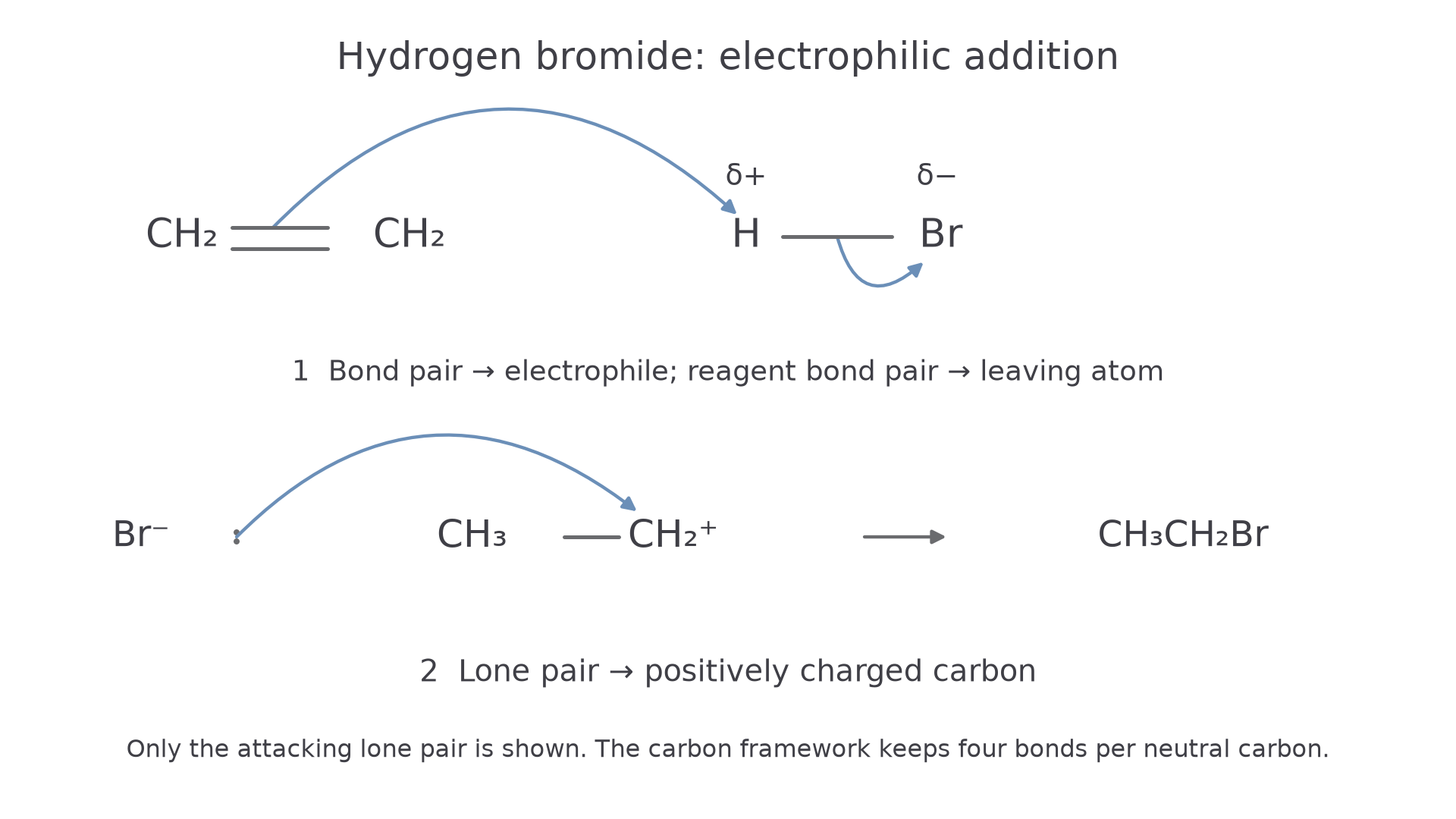
Electrophilic addition follows a common pattern. First, show the electrophile with the correct partial charges. Then draw a curly arrow from the pi bond to the electrophile, because the electrons in the double bond are moving. At the same time, draw a second curly arrow from the bond that breaks to the atom that takes that electron pair. This forms a carbocation intermediate. Finally, draw a curly arrow from a lone pair on the negative ion to the positively charged carbon.
That sequence is the same idea in all three reactions in this lesson, but the electrophile changes:
- in , the electrophile is H
- in , the electrophile is the atom made electron-poor by an induced dipole
- in concentrated , the electrophile is the H in the bond
When you draw the mechanism, curly arrows must start from an electron pair, so they begin at the pi bond or at a lone pair. They do not start from an atom on its own.
The diagram below summarises that shared pattern for electrophilic addition in alkenes.
[DIAGRAM: asset_name: 3.4.2 - Addition Reactions of Alkenes - Diagram 1; asset_slug: 3.4.2 - Addition Reactions of Alkenes - Diagram 1; recommended_method: deterministic_code; description: Full ethene/HBr electrophilic addition, exact C=C and H–Br arrow origins, dipoles, ethyl carbocation and bromide lone-pair attack giving bromoethane.]
Addition of HBr and major and minor products
Hydrogen bromide is polar, so the H atom is slightly positive and can act as the electrophile. The pi bond attacks that H atom, the bond breaks heterolytically, and a bromide ion is formed. The carbocation produced in the first step is then attacked by , giving a bromoalkane.
Carbocation
A carbocation is an organic ion in which a carbon atom carries a positive charge. In these mechanisms it is an intermediate with only six electrons around the positively charged carbon.
For ethene there is only one possible carbocation, so there is only one organic product. For an unsymmetrical alkene such as propene, however, protonation can happen in two ways. One route gives a primary carbocation and the other gives a secondary carbocation. The secondary carbocation is more stable, so it forms more often and leads to the major product.
Count the carbon groups bonded directly to the positively charged carbon: one means primary, two secondary, and three tertiary. Count groups at the charged carbon, not the total carbons in the molecule.
The stability order is:
tertiary carbocation > secondary carbocation > primary carbocation
The traditional AQA model describes alkyl groups as releasing electron density towards the positive carbon, stabilising it. AQA’s February 2025 guidance retains credit for this model for this specification, while also accepting valid explanations informed by research that questions the simple inductive account. The required prediction remains tertiary > secondary > primary for these examples. The more stable the carbocation, the lower the energy of that route, so the more likely it is to form.
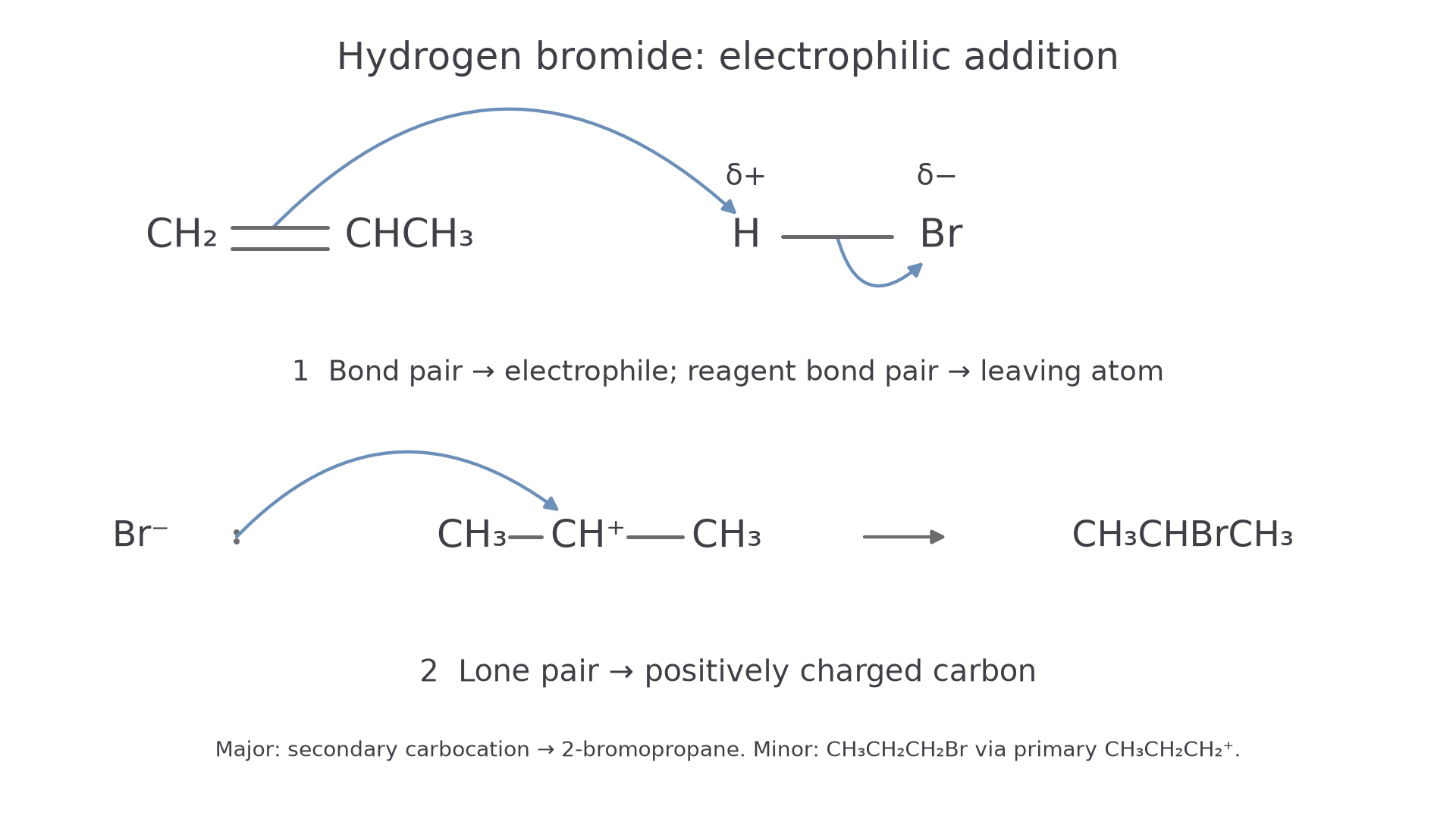
Worked mechanism model: propene reacts with .
- Write the reagent as H-\ce{Br}$$\delta^{-}.
- Draw a curly arrow from the bond in propene to H.
- Draw a second curly arrow from the bond to to form .
- Show the carbocation intermediate. The major route has the positive charge on the middle carbon, so it is a secondary carbocation.
- Draw a curly arrow from a lone pair on to the positively charged carbon.
Worked example: propene reacts with .
- If H adds to the terminal carbon, the positive charge is left on the middle carbon. That carbocation is secondary.
- If H adds to the middle carbon, the positive charge is left on the terminal carbon. That carbocation is primary.
- The secondary carbocation route is favoured, so the major product is 2-bromopropane.
- A smaller amount of 1-bromopropane is still formed as the minor product.
The diagram below follows both carbocation routes for propene reacting with and makes the major and minor products explicit.
[DIAGRAM: asset_name: 3.4.2 - Addition Reactions of Alkenes - Diagram 2; asset_slug: 3.4.2 - Addition Reactions of Alkenes - Diagram 2; recommended_method: retained_png; description: Mechanism summary for propene reacting with HBr. Left panel: show CH3CH=CH2 with polarised Hδ+-Brδ−, a curly arrow from the pi bond to H, and a second curly arrow from the H-Br bond to Br to form Br−. Upper right panel: show the secondary carbocation route, with :Br− attacking CH3-CH+-CH3 to give CH3-CHBr-CH3, labelled major product 2-bromopropane. Lower right panel: show the primary carbocation route, with :Br− attacking CH3-CH2-CH2+ to give CH3-CH2-CH2Br, labelled minor product 1-bromopropane. Label the secondary carbocation as more stable than the primary carbocation.]
This major/minor product idea matters whenever the first step can produce different carbocations. Do not just say "the major product is more stable". Products are neutral molecules. It is the carbocation intermediate that has different stability, and that is what controls which product forms most.
Continue this lesson.
You’re previewing NovaLearn without an account. Create a free account to read the rest.
Create free account