3.1.5.5 - Catalysts
Catalysts matter because they let reactions happen faster without needing harsher conditions. In this lesson, you will pin down what a catalyst actually does, see how it changes the energy pathway of a reaction, and use a Maxwell-Boltzmann distribution to explain why a gas reaction becomes faster when a catalyst is added.
What a catalyst changes
A reaction only happens when particles collide with enough energy to get over the activation energy barrier. If too few particles can do that, the reaction is slow. A catalyst speeds the reaction up by changing that barrier, not by becoming part of the final products.
Catalyst
A catalyst is a substance that increases the rate of a chemical reaction without being changed in chemical composition or amount.
The key phrase is "alternative reaction route". A catalyst provides a different pathway from reactants to products, and that pathway has a lower activation energy than the uncatalysed route. Because the energy barrier is lower, a larger fraction of collisions can lead to reaction.
Activation energy
Activation energy is the minimum energy that colliding particles must have for a reaction to occur.
This does not mean the catalyst gives particles extra energy. The particles in the mixture still have the same range of energies at the same temperature. What changes is the minimum energy needed for success.
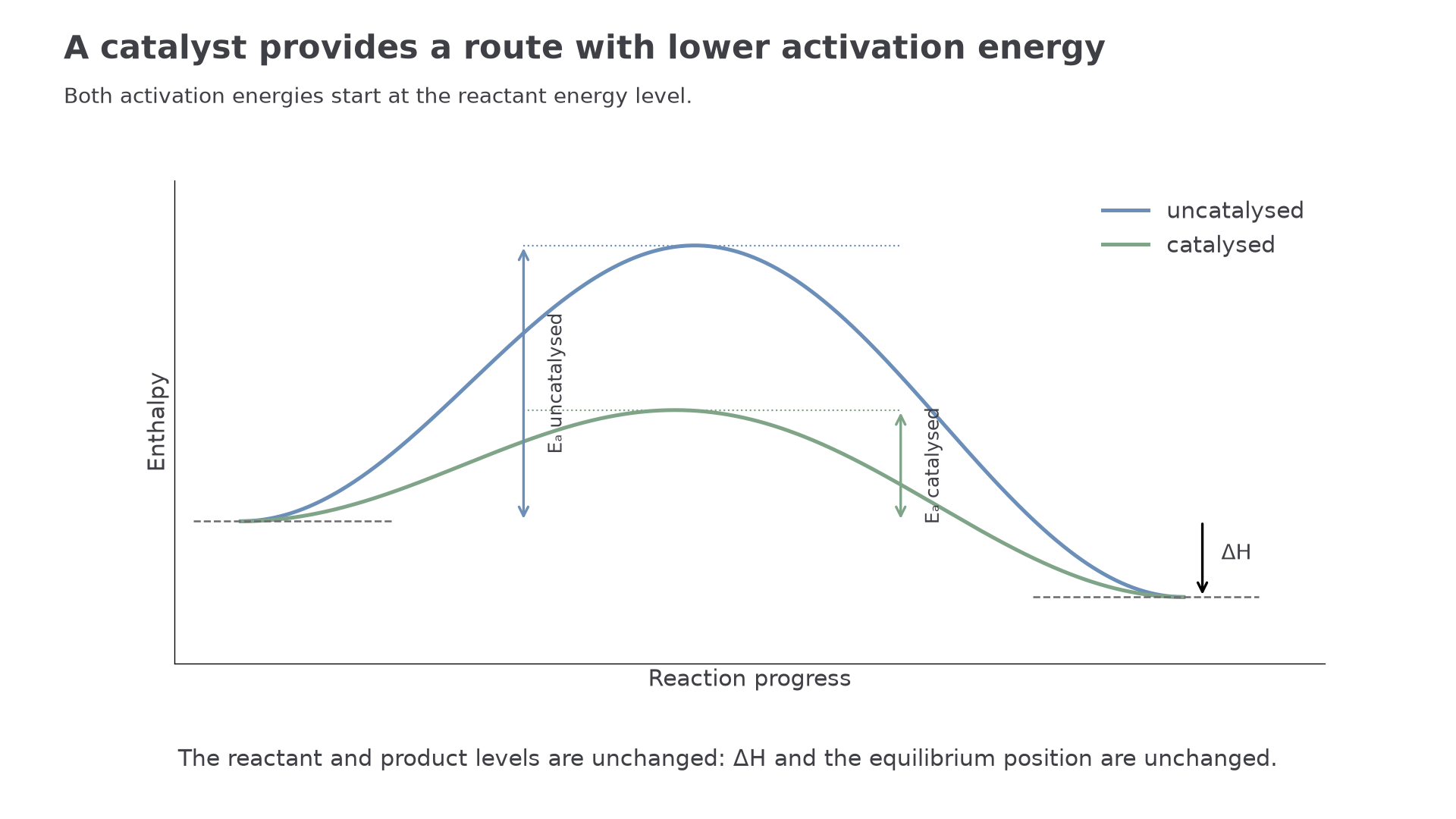
The diagram below compares uncatalysed and catalysed reaction profiles, making it clear that the catalyst lowers the activation energy without changing the overall energy difference between reactants and products.
[DIAGRAM: asset_name: 1.5.5 - Catalysts - Diagram 1; asset_slug: 1.5.5 - Catalysts - Diagram 1; recommended_method: deterministic_code; description: Catalysed and uncatalysed energy profiles have identical endpoints; both activation energies are measured from the reactant level to the relevant peak.]
Using the Maxwell-Boltzmann distribution
For gas reactions, the Maxwell-Boltzmann distribution helps you picture why a catalyst works. The curve shows how many particles have each energy value at a particular temperature. Most particles have middling energies, while only a smaller fraction have very high energies.
The diagram below keeps the Maxwell-Boltzmann curve unchanged but moves the activation energy line to the left, so a larger area lies to the right of .
[DIAGRAM: asset_name: 1.5.5 - Catalysts - Diagram 2; asset_slug: 1.5.5 - Catalysts - Diagram 2; recommended_method: retained_png; description: An unchanged Maxwell–Boltzmann distribution with two activation-energy thresholds shows the additional successful-collision fraction for a catalyst.]
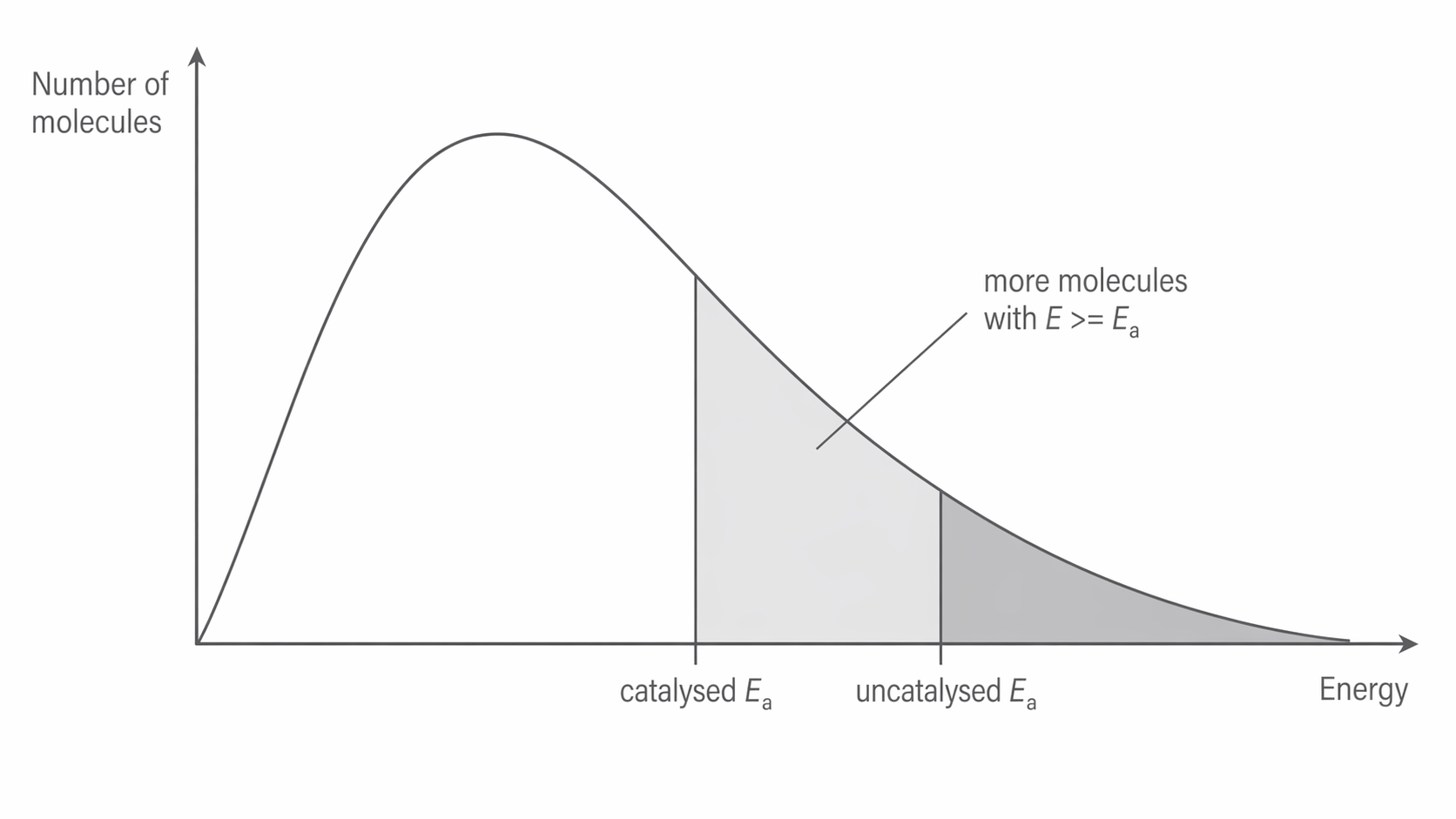
At constant temperature, adding a catalyst does not change the shape of the Maxwell-Boltzmann curve. The particles have not been heated, so their energy distribution is unchanged. Instead, the activation energy line moves to the left because the new route needs less energy.
Continue this lesson.
You’re previewing NovaLearn without an account. Create a free account to read the rest.
Create free account