3.3.4.1 - Structure, Bonding and Reactivity (Alkenes)
Alkenes matter because one small structural change, a carbon-carbon double bond, makes them behave very differently from alkanes. In this lesson, you will pin down exactly what "unsaturated" means, what the double bond is made from, and why that bonding creates a reactive region in the molecule. If you can connect structure → electron density → reactivity, you have the whole story.
What makes an alkene an alkene
Alkenes are hydrocarbons, so they contain carbon and hydrogen only. What makes them a separate homologous series is that they contain at least one carbon-carbon double bond, written as .
Unsaturated hydrocarbon
An unsaturated hydrocarbon is a compound made only of carbon and hydrogen that does not contain the maximum possible number of hydrogen atoms because it has at least one multiple bond.
That definition is worth learning carefully. "Unsaturated" does not just mean "reactive" or "contains a bond". It means the molecule could, in principle, add more atoms because the double bond is present. For example, ethane is , but ethene is . Ethene has two fewer hydrogen atoms because two of the carbon atoms are joined by a double bond instead of a single bond.
An acyclic alkene with one double bond has general formula . A cycloalkane has the same general formula but only single bonds. Thus could be but-1-ene or cyclobutane: the molecular formula alone does not establish unsaturation. An acyclic alkane with four carbons would be .
The diagram below compares a saturated alkane with an unsaturated alkene and highlights the bond that makes the difference.
[DIAGRAM: asset_name: 3.4.1 - Structure, Bonding and Reactivity (Alkenes) - Diagram 1; asset_slug: 3.4.1 - Structure, Bonding and Reactivity (Alkenes) - Diagram 1; recommended_method: retained_png; description: Displayed formulae of ethane and ethene shown side by side in a balanced comparison. Draw ethane as CH3-CH3 with all six hydrogen atoms shown and label it saturated. Draw ethene as CH2=CH2 with all four hydrogen atoms shown and label it unsaturated. Lightly emphasize the C=C double bond in ethene so the structural difference is immediately visible.]
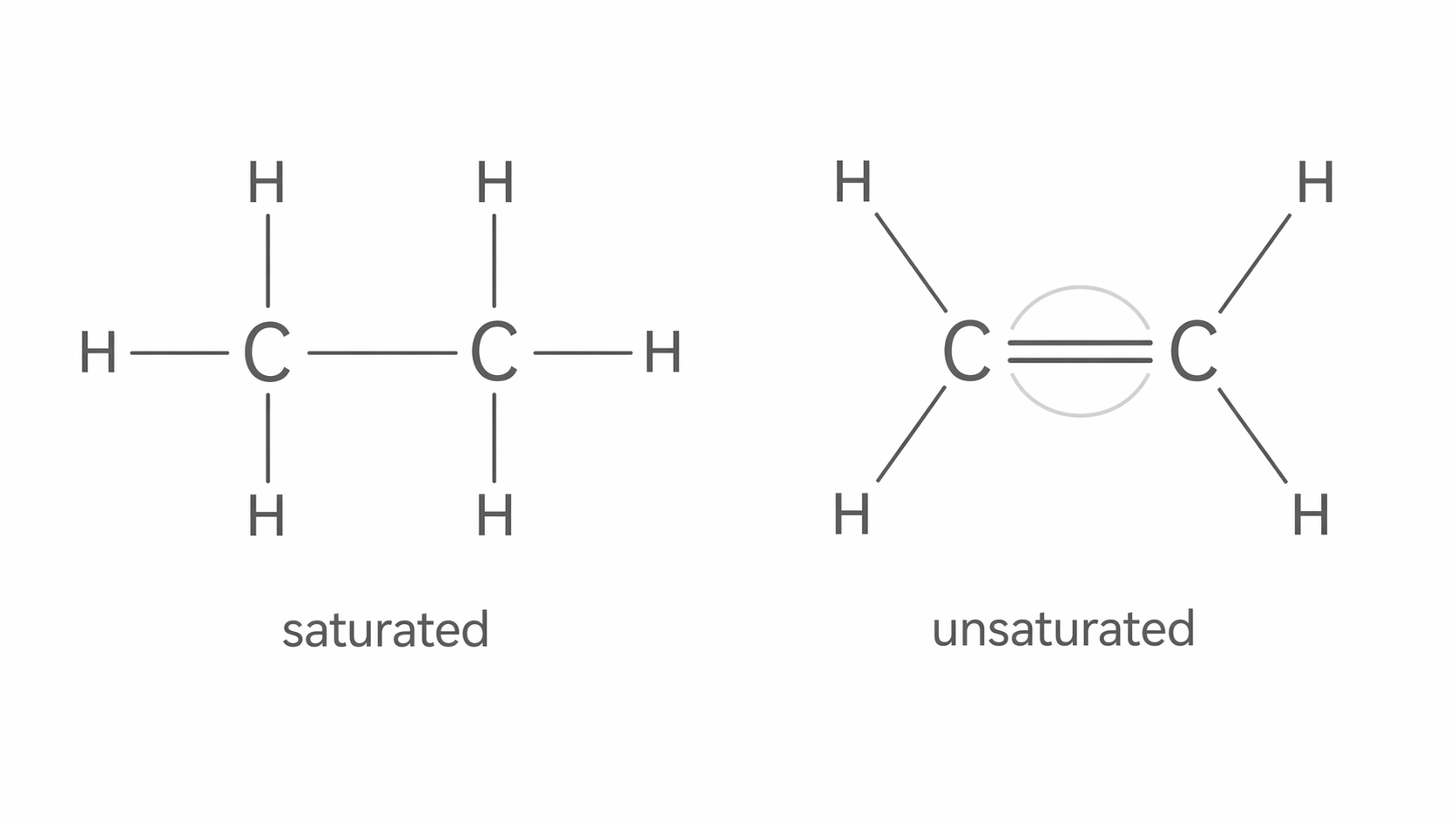
For this topic, the key structural idea is simple: when you see in a hydrocarbon, you should immediately think "alkene", "unsaturated", and "more reactive than an alkane".
That structural feature is not just a naming detail. It is the reason alkenes have a distinctive bonding picture and a distinctive pattern of reactions.
What the double bond contains
A carbon-carbon double bond is still covalent, but it is not a single shared region of electrons. It contains two different parts: one sigma bond and one pi bond.
The sigma bond is formed by end-on overlap of orbitals along the line between the two carbon nuclei. The pi bond is formed by sideways overlap of p orbitals. That sideways overlap puts electron density above and below the plane of the sigma bond.
Pi bond
A pi bond is a covalent bond formed by sideways overlap of adjacent p orbitals, creating electron density above and below the line between the nuclei.
This is why the bond is described as a centre of high electron density. The four bonding electrons associated with the double bond are not spread evenly through the whole molecule. A particularly electron-rich region sits around the double bond, especially in the pi bond.
Continue this lesson.
You’re previewing NovaLearn without an account. Create a free account to read the rest.
Create free account