3.1.11.2 - Commercial Applications of Electrochemical Cells
Commercial cells are electrochemical cells designed to deliver useful electrical energy in everyday devices and larger systems. Different uses need different trade-offs: a watch needs a cell that lasts for a long time, a phone needs a cell that can be recharged many times, and a vehicle may need a system that keeps producing electricity while fuel is supplied. In this lesson, you will compare these cell types, use electrode data to deduce reactions and EMF, and explain how fuel cells turn redox chemistry into a continuous current.
Commercial Cells and Their Uses
An electrochemical cell separates oxidation and reduction so that electrons are forced through an external circuit. That flow of charge is what makes the cell useful as a source of electrical energy.
Electrochemical Cell
A device in which a redox reaction produces electrical energy by transferring electrons through an external circuit and ions through an electrolyte.
Commercial cells fall into three broad groups. A non-rechargeable cell is used once: the discharge reaction is effectively irreversible under normal conditions, so when the reactants are used up the cell is discarded. A rechargeable cell uses chemistry that can be driven in reverse by applying an external voltage, so chemical energy can be stored again after discharge. A fuel cell is different again because the reactants are supplied continuously from outside the cell.
These differences matter socially as well as chemically. Non-rechargeable cells are often convenient and cheap, but they create more waste because each cell is thrown away after use. Rechargeable cells reduce the number of batteries discarded and are essential in portable electronics, but they depend on mined materials and must be used safely during charging. Fuel cells can reduce pollution at the point of use, yet they also depend on how the fuel is produced, stored and transported.
Lithium Cells as Rechargeable Commercial Cells
A simplified lithium cell can be represented by these electrode reactions during discharge:
Negative electrode:
Positive electrode:
At the negative electrode, lithium is oxidised because it loses electrons. At the positive electrode, electrons are accepted, so reduction occurs. Because electrons are released at one electrode and used up at the other, they travel through the external wire from the negative electrode to the positive electrode during discharge. At the same time, ions move through the electrolyte so charge does not build up inside the cell.
Rechargeable Cell
A cell whose discharge reaction can be reversed by applying an external electrical energy supply.
The diagram below shows the discharge direction in a simplified lithium rechargeable cell and the reverse directions during charging.
[DIAGRAM: asset_name: 1.11.2 - Commercial Applications of Electrochemical Cells (A-level only) - Diagram 1; asset_slug: 1.11.2 - Commercial Applications of Electrochemical Cells (A-level only) - Diagram 1; recommended_method: matplotlib_exact_plot; description: Specified simplified lithium-cobalt oxide cell: Li oxidised to Li+ and electron, CoO2 reduced to LiCoO2, discharge electron path and Li+ movement, reversed recharge ion path. Not an assertion that commercial lithium-ion cells contain a pure lithium electrode.]
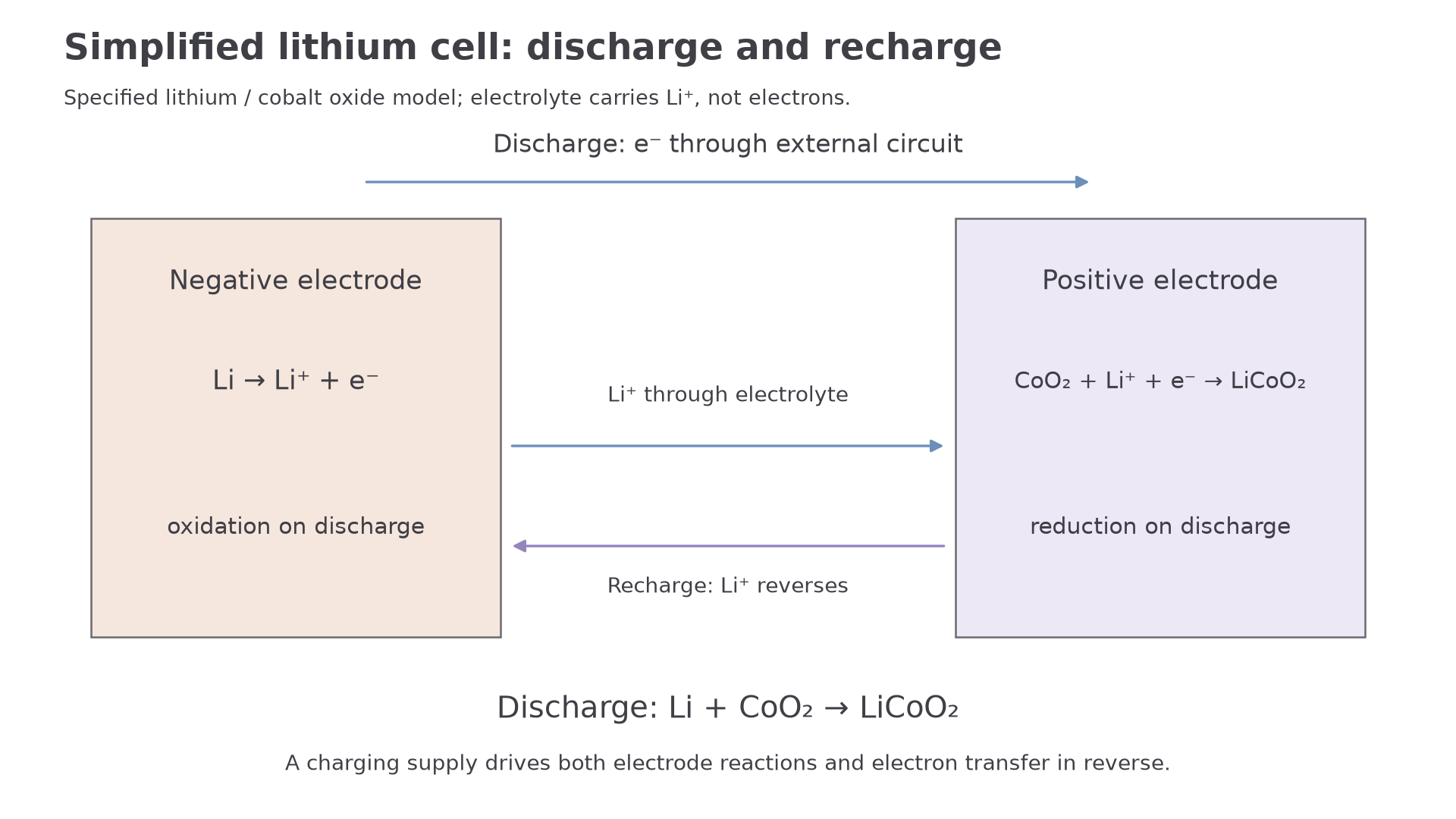
A rechargeable cell works because an external power source can force the reverse changes. During charging, electrons are pushed the opposite way through the circuit, so both half-equations are reversed. That restores the materials needed for a later discharge. This is the key difference from a non-rechargeable battery: the chemistry is not only able to produce current, it can also be reset.
Lithium cells are widely used because they provide a relatively large voltage for a single cell and are light enough for phones, laptops and electric vehicles. That is a major benefit to society because portable devices and battery-powered transport become practical. The risks are also real. The electrolyte can be flammable, damaged cells can overheat, and large-scale use depends on mining metals such as lithium and cobalt, which raises cost and environmental concerns. Rechargeability reduces waste, but it does not remove the need for careful recycling and safe charging.
The clearest description of the current says exactly where electrons are released, where they are accepted, and how ions moving through the electrolyte keep the cell electrically balanced.
Deducing Reactions and EMF from Electrode Data
When you are given electrode data, remember that standard electrode potentials are written as reductions. The half-equation with the more positive electrode potential is the one that stays as a reduction during discharge. The less positive half-equation is reversed so it becomes oxidation at the negative electrode.
EMF
The electromotive force of a cell is the potential difference produced by the cell when no current is drawn from it.
When you deduce EMF from electrode data, the most important step is deciding which reduction stays the same and which one must be reversed.
Calculating Cell EMF
Because the quoted values are reduction potentials, this formula is the same as "more positive reduction potential minus less positive reduction potential". A positive EMF tells you that the discharge reaction is feasible in that direction.
For a rechargeable cell, you still deduce the discharge reaction in exactly this way. Charging is simply the reverse of the discharge reaction, forced by an external power supply. For the lithium cell in Part 2, charging is obtained by reversing both half-equations and the electron and ion flows shown in the diagram.
Here is a worked example using a non-rechargeable commercial cell.
Suppose you are given:
Continue this lesson.
You’re previewing NovaLearn without an account. Create a free account to read the rest.
Create free account