Required practical 5 - Cyclohexene Preparation and Distillation
This required practical uses the preparation of cyclohexene from cyclohexanol to show how a product can be removed from a reaction mixture by distillation. The chemistry is not just about following a method: you need to understand why cyclohexene leaves first, how the apparatus is arranged safely, and why the distillate still needs further purification. By the end, you should be able to explain the reaction, justify the apparatus choices, and see how purification and yield fit into one continuous process.
The reaction and why distillation works
Cyclohexene is made from cyclohexanol by heating the alcohol with concentrated phosphoric acid. The acid helps eliminate water from the alcohol molecule, so the overall reaction is:
The phosphoric acid is not written into the overall equation because it is helping the reaction happen rather than becoming the product you collect.
Dehydration
A dehydration reaction removes the elements of water from a molecule. In this case, cyclohexanol loses and to form the alkene cyclohexene.
The key separation idea is the boiling point difference. Cyclohexene boils at about 83 °C, which is much lower than cyclohexanol at about 161 °C. That means when the reaction mixture is heated gently, cyclohexene vaporises and passes into the condenser before most of the unreacted cyclohexanol does. Water can also be present in the distillate, so the condensed liquid is not pure yet, but distillation still removes the desired product from the reaction flask very effectively.
Distillation
Distillation separates substances by vaporising a more volatile component and then condensing that vapour. In this practical, the lower-boiling cyclohexene is distilled from the hot reaction mixture.
Collecting the fraction that comes over below 100 °C matters. If the temperature rises too far, more water and eventually higher-boiling impurities are likely to come across, so the product becomes less pure.
Setting up the distillation safely
The reaction is usually carried out in a pear-shaped flask connected to a semi-micro distillation setup. Cyclohexanol and concentrated phosphoric acid are placed in the flask, and anti-bumping granules are added before heating starts. The flask is then fitted to a still head, thermometer, condenser, and receiving vessel.
The diagram below shows the semi-micro distillation setup used to remove cyclohexene from the reaction mixture as it forms.
[DIAGRAM: asset_name: RP 05 - Distillation of a Product from a Reaction - Diagram 1; asset_slug: RP 05 - Distillation of a Product from a Reaction - Diagram 1; recommended_method: retained_png; description: Semi-micro distillation apparatus for preparing cyclohexene from cyclohexanol. Label a pear-shaped flask heated in a water bath or electric heater and containing cyclohexanol, concentrated phosphoric acid, and anti-bumping granules; a still head; a thermometer with the bulb level with the side-arm leading to the condenser; a slightly downward-sloping Liebig condenser; water entering at the lower inlet and leaving at the upper outlet; and an open receiving flask collecting the distillate.]
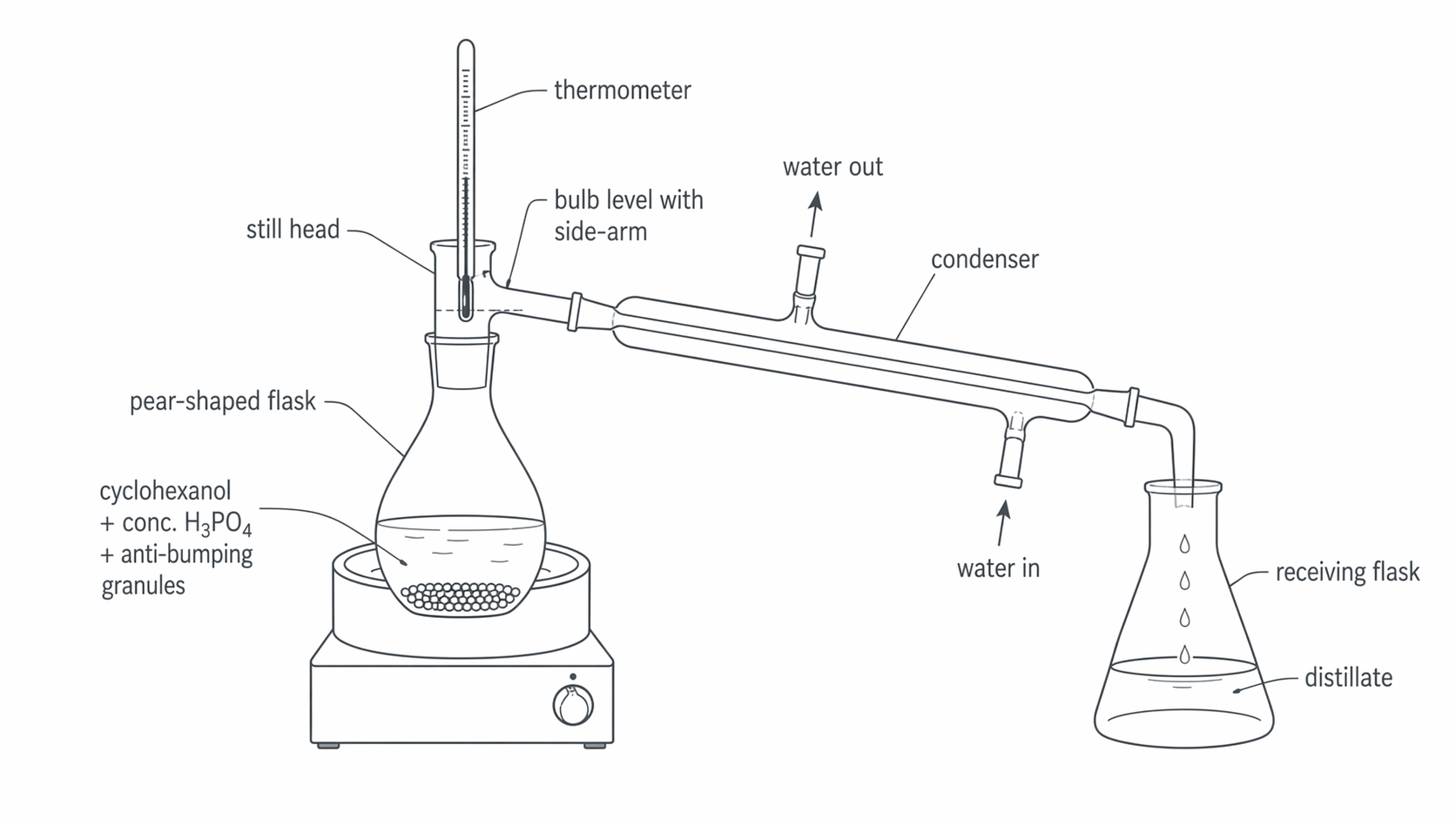
Each detail of that setup has a reason behind it. Anti-bumping granules promote smooth boiling, so liquid does not surge violently into the condenser. The thermometer bulb must sit at the entrance to the condenser so it measures the temperature of the vapour that is actually being collected, not just the temperature of the hot liquid in the flask. Cooling water enters at the bottom of the condenser and leaves at the top so the jacket stays completely full, giving efficient heat transfer.
The apparatus must not be sealed. On heating, gases and vapours expand; in a sealed system pressure would build up and could force liquid out or crack the glassware. The condenser is usually arranged with a slight downward slope so condensed liquid runs naturally into the receiver rather than pooling inside the apparatus.
Safety is part of the chemistry here, not an afterthought. Cyclohexene is flammable, so a naked flame should not be used. Use a suitable electric heating mantle or controlled sand bath capable of heating the reaction mixture sufficiently. Concentrated phosphoric acid is corrosive, so eye protection is essential and the acid should be added carefully. The glassware should be clamped securely because the setup contains hot liquid and several joints.
Purifying the distillate
The first distillate is a crude mixture. It contains cyclohexene, but it can also contain water and small amounts of cyclohexanol or acid carried over from the reaction. That is why the product is purified after distillation instead of being assumed pure straight away.
The crude distillate is transferred to a separating funnel and shaken with saturated sodium chloride solution. This brine wash helps water stay in the aqueous layer and improves separation between the organic and aqueous liquids. Cyclohexene is less dense than the aqueous layer, so the cyclohexene-rich layer is the upper layer. The lower aqueous layer is run off first and discarded.
Continue this lesson.
You’re previewing NovaLearn without an account. Create a free account to read the rest.
Create free account