3.1.4.3 - Applications of Hess's Law
Some enthalpy changes are straightforward to measure directly, but many useful reactions are not. Hess's law lets us calculate the enthalpy change for a difficult reaction by linking it to reactions whose enthalpy changes are known. In this lesson you will learn how to use Hess's law with enthalpies of formation and enthalpies of combustion, and how sign changes and stoichiometric coefficients control the final value.
Why Indirect Routes Work
If a set of reactants ends up as the same products, the total enthalpy change must be the same whatever route connects them. That is because enthalpy depends only on the starting point and finishing point, not on the intermediate steps.
Hess's law
The enthalpy change for a reaction is the same whichever route is taken from reactants to products.
In practice, this means a hard-to-measure reaction can be replaced by a thermochemical cycle made from easier reactions. The cycle may be drawn as a triangle or as an enthalpy diagram, but the same rules always apply. If you reverse an equation, the sign of changes. If you multiply an equation by a number, you must multiply its value by the same number.
For example, attempting to measure the formation of carbon monoxide by burning carbon can also produce carbon dioxide. A cycle using complete combustion to the same carbon dioxide product avoids that competing reaction. The cycle is a calculation route, not a claim that each reverse step happens spontaneously.
A useful first step is to write the balanced target equation with state symbols before doing any arithmetic. That tells you which tabulated values are needed and how many moles of each substance are involved.
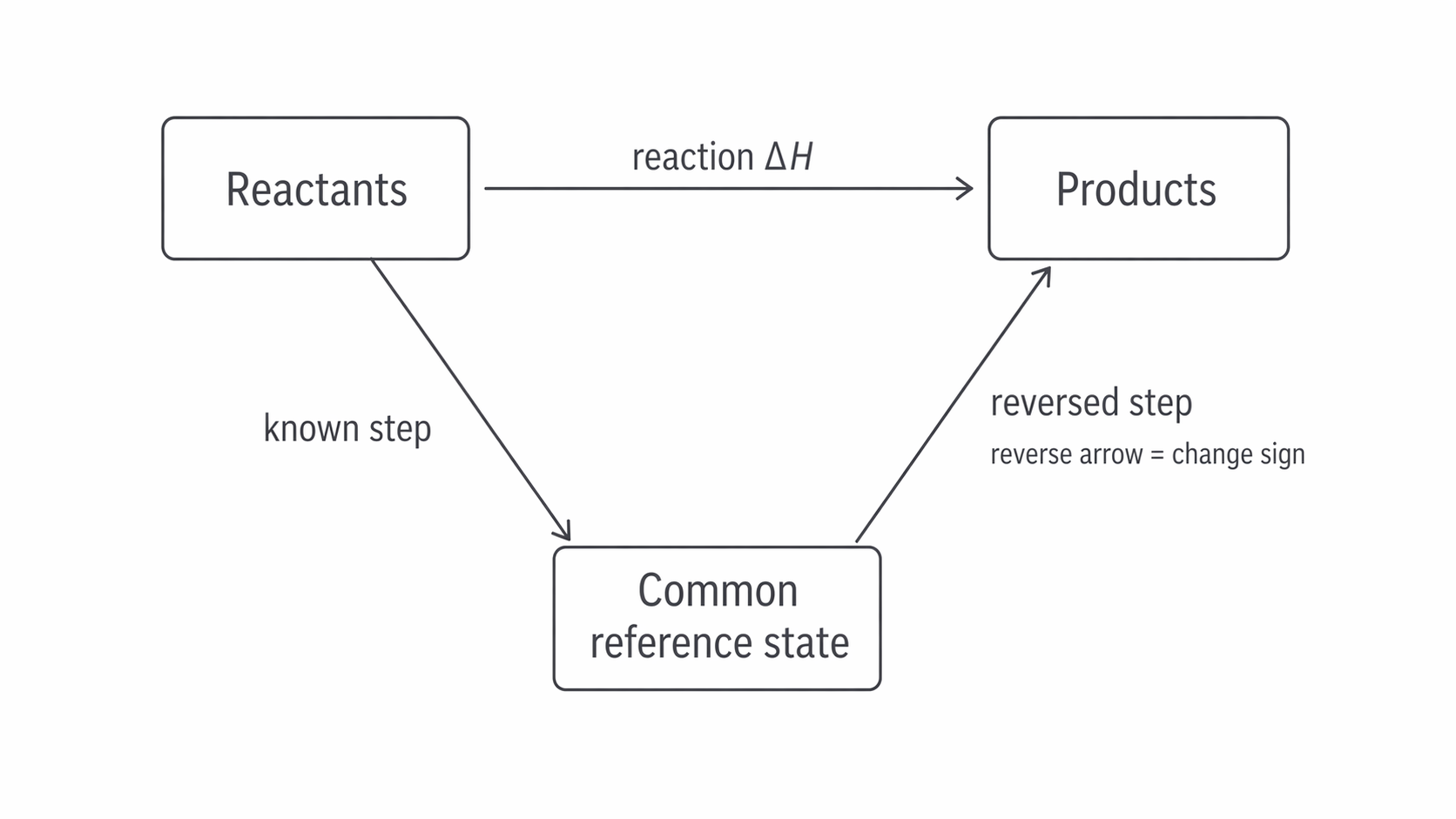
The diagram below shows the basic structure of a Hess cycle: the direct route across the top must match the total enthalpy change around the indirect route, and reversing any arrow reverses the sign attached to that step.
[DIAGRAM: asset_name: 1.4.3 - Applications of Hess's Law - Diagram 1; asset_slug: 1.4.3 - Applications of Hess's Law - Diagram 1; recommended_method: retained_png; description: Hess law compares a direct reaction route with an indirect route; reversing a step reverses its enthalpy sign.]
Measuring an indirect hydration enthalpy
A hydration step can be found by dissolving an anhydrous salt and its hydrated form separately to reach the same final aqueous state. For example:
Measure the two dissolution enthalpies using an insulated cup, a measured mass of water and a thermometer. Weigh each solid accurately, stir until fully dissolved and record temperature against time to estimate the corrected temperature change. Use the total solution mass in , then divide by the moles of salt and reverse the sign for the reaction enthalpy. Choose water quantities so that both routes give the same final amount and concentration of solution; account for water supplied by the hydrate. Keep initial temperature and insulation comparable.
If the dissolution enthalpies are and , the indirect route is anhydrous salt → solution → hydrated salt. Its enthalpy is . Heat exchange, incomplete dissolution or a partially hydrated starting solid would undermine the result. Repeat measurements and compare the variation before deciding how closely the measured cycle agrees with a reference value.
Calculations From Enthalpies of Formation
Standard enthalpy changes of formation connect substances to their elements in standard states. That is why the lower level of a formation cycle is written in terms of elements such as , , and .
Standard enthalpy change of formation
The enthalpy change when 1 mol of a compound is formed from its constituent elements under standard conditions, with all substances in their standard states.
A key consequence is that the enthalpy of formation of an element in its standard state is by definition. So for , , and is zero.
For formation data:
Hess's law with formation data
- multiply each value by its coefficient in the balanced equation; of an element in its standard state is 0
The cycle works because you imagine taking the reactants back to their elements, then forming the products from those same elements.
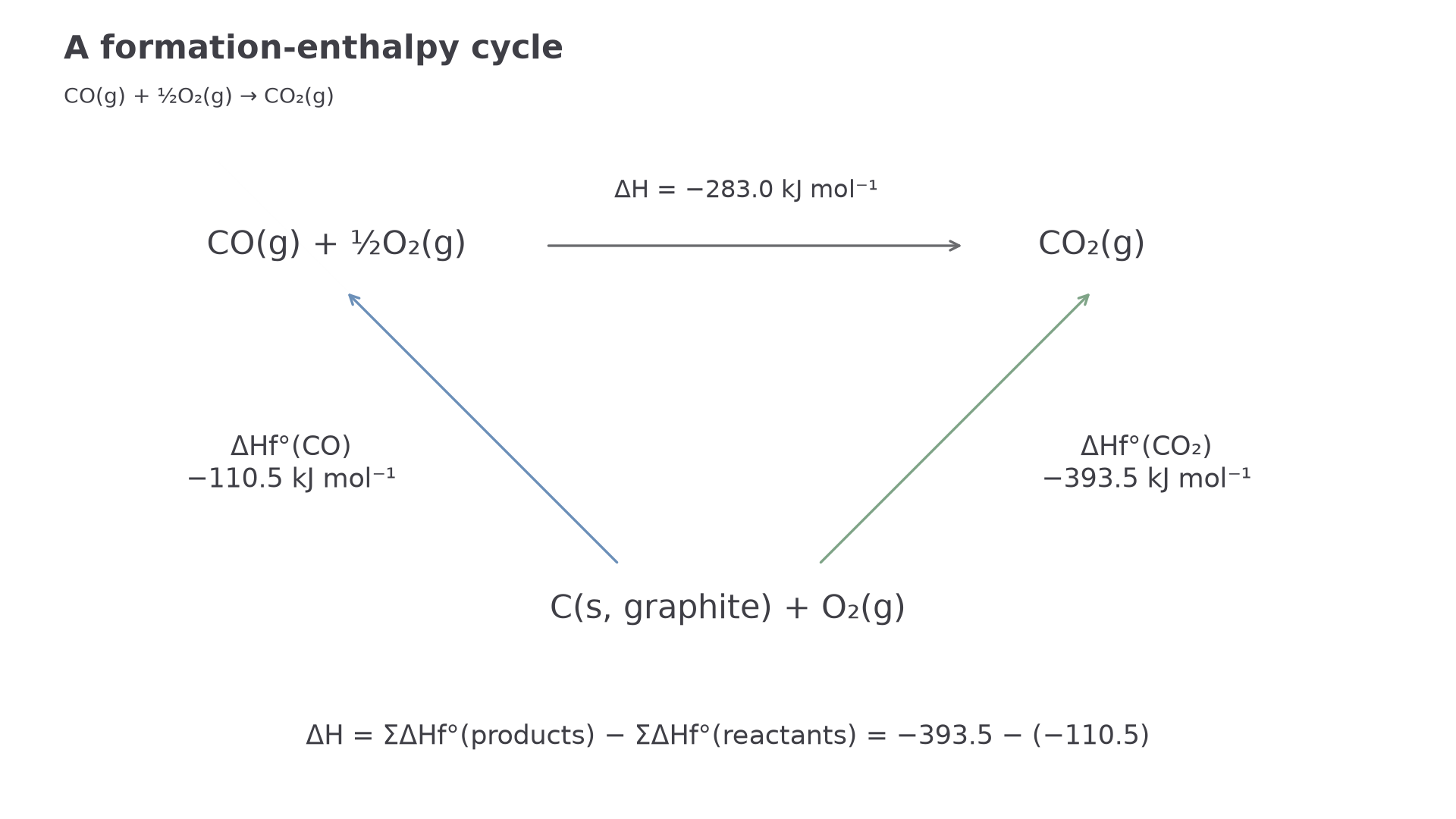
The diagram below shows the corresponding formation cycle. Tracing the reactants down to the elements means reversing the reactant-side formation arrow, so its sign changes during the calculation.
[DIAGRAM: asset_name: 1.4.3 - Applications of Hess's Law - Diagram 2; asset_slug: 1.4.3 - Applications of Hess's Law - Diagram 2; recommended_method: deterministic_code; description: A carbon monoxide formation cycle gives −393.5 − (−110.5) = −283.0 kJ per mole.]
Worked example:
Use , , and in .
The reaction is exothermic because the answer is negative. The for hydrogen is still important: the value is zero, but the coefficient still matters because the balanced equation still matters.
Notice that and contribute zero because they are elements in their standard states.
Calculations From Enthalpies of Combustion
Sometimes formation data are unavailable, but combustion data are common because complete burning can be measured reliably. In a combustion cycle, both sides of the target equation are imagined burning down to the same combustion products, usually and .
Standard enthalpy change of combustion
The enthalpy change when 1 mol of a substance is completely burned in oxygen under standard conditions, with all substances in their standard states.
For combustion data, the subtraction order reverses:
Hess's law with combustion data
- multiply each value by its coefficient in the balanced equation
That order matters. You go down from the reactants using tabulated combustion values, then back up to the products by reversing the product combustion arrow.
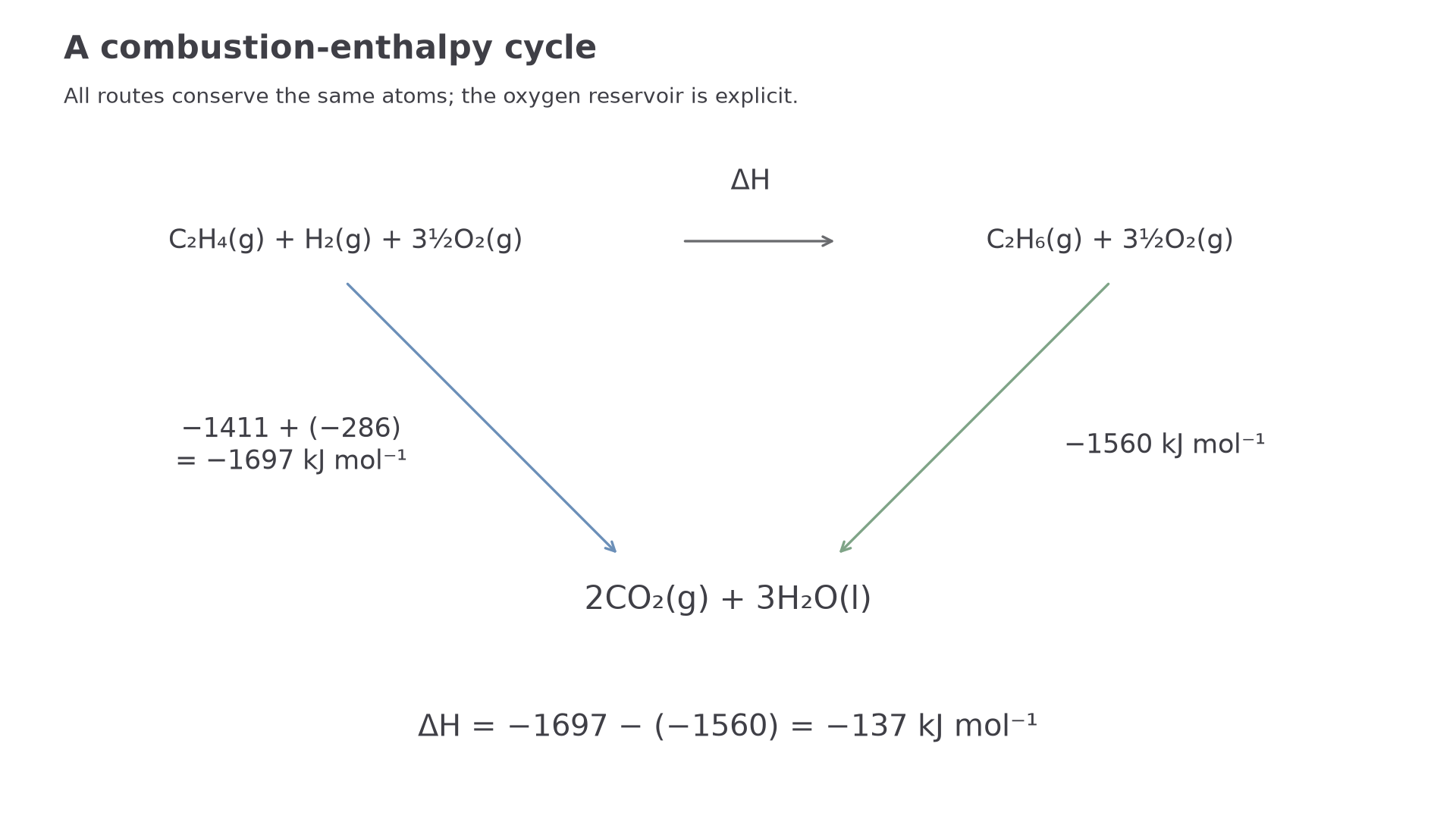
The diagram below shows the same target reaction as a combustion cycle. Both sides burn to the same final combustion products, and the hydrogen combustion value is counted twice because the balanced equation contains .
[DIAGRAM: asset_name: 1.4.3 - Applications of Hess's Law - Diagram 3; asset_slug: 1.4.3 - Applications of Hess's Law - Diagram 3; recommended_method: deterministic_code; description: An atom-balanced ethene hydrogenation combustion cycle gives −1697 − (−1560) = −137 kJ per mole.]
Worked example:
Use , , and in .
First find the total for the reactants:
Then subtract the total for the products:
Again the answer is , exactly as Hess's law predicts. You still need to multiply by the stoichiometric coefficient, and the subtraction order must stay as written. Oxygen may appear on both sides of the cycle, but it does not change the result because it starts and finishes in the same state.
When both formation data and combustion data are available, either route should lead to the same final value for the same target reaction.