3.3.9.2 - Acylation
Acylation is the chemistry of transferring an acyl group, , onto another molecule. In this topic, acyl chlorides and acid anhydrides are the key acylating agents, and the key ideas are recognising their structures, predicting their products with different nucleophiles, and outlining the nucleophilic addition-elimination mechanism for acyl chlorides. If you can see the reaction as "attack the carbonyl carbon, then lose a leaving group", the whole topic becomes much easier to control.
Recognising The Key Functional Groups
Acylation starts from carboxylic acid derivatives. These are compounds related to carboxylic acids in which the - part of has been replaced by another group.
Acylation
Acylation is the introduction of an acyl group, , into a molecule.
An acyl chloride has the general structure . For example, ethanoyl chloride is . An acid anhydride contains two acyl groups joined by an oxygen atom, so its general structure is . Ethanoic anhydride is . The amides studied here contain - or -. In an N-substituted amide such as -, one hydrogen on nitrogen has been replaced by a carbon-containing group. Amides can also have both nitrogen hydrogens substituted.
is ethanamide, while is an N-substituted amide. That detail matters because one of the reactions in this lesson is the formation of N-substituted amides from primary amines.
The diagram below sets those key structures side by side so you can see that the carbonyl group stays the same while the group attached to the carbonyl carbon changes.
[DIAGRAM: asset_name: 3.9.2 - Acylation - Diagram 1; asset_slug: 3.9.2 - Acylation - Diagram 1; recommended_method: retained_png; description: Side-by-side displayed structures of ethanoyl chloride H3C-C(=O)-Cl, ethanoic anhydride H3C-C(=O)-O-C(=O)-CH3, ethanamide H3C-C(=O)-NH2, and N-methylethanamide H3C-C(=O)-NH-CH3. Label the C=O unit as the carbonyl group and note that the group attached to the carbonyl carbon changes from Cl to OCOCH3 to NH2 or NHCH3.]
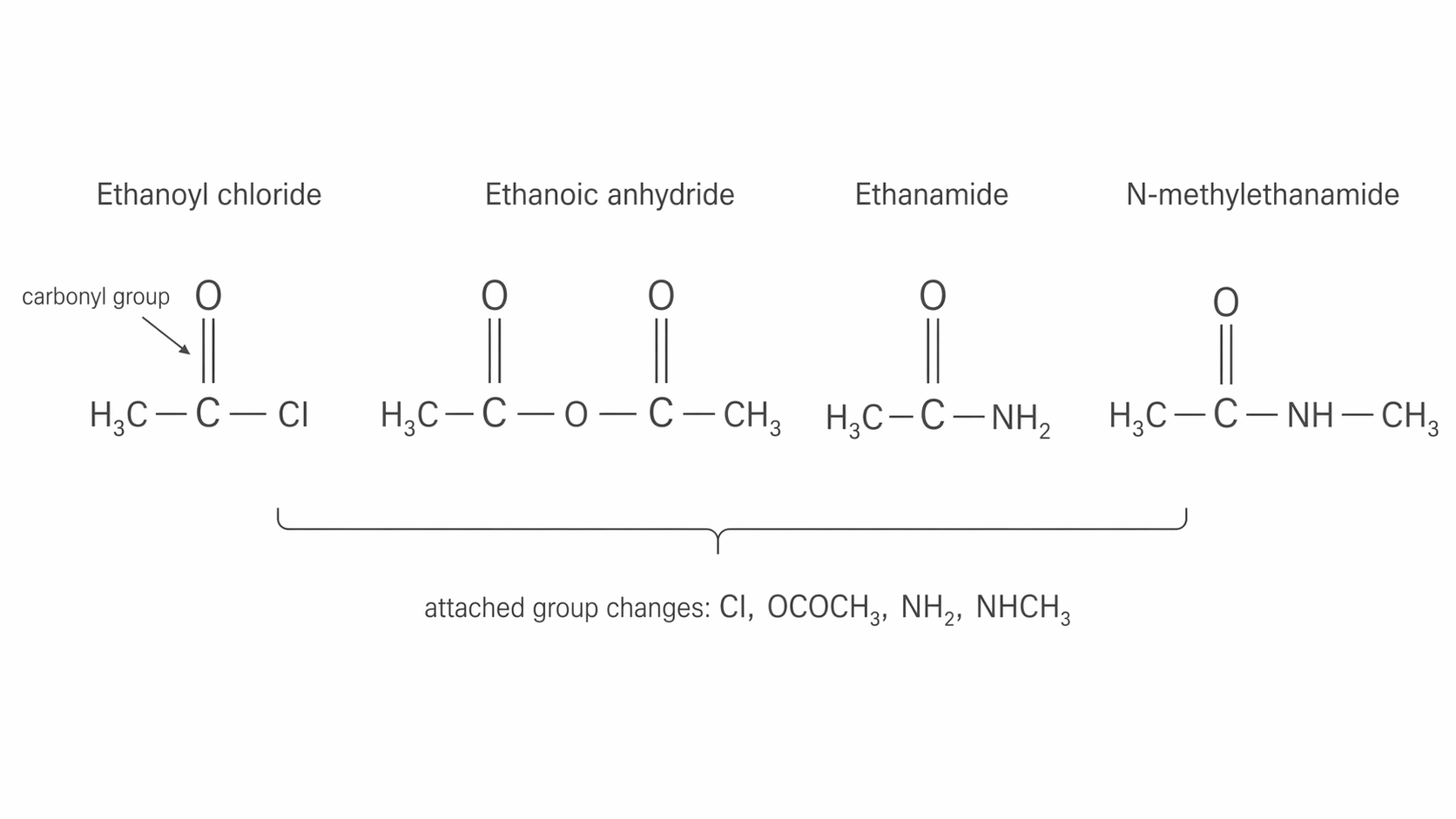
Acyl chlorides and acid anhydrides are reactive because the carbonyl carbon is electron-poor and can be attacked by a nucleophile. Acyl chlorides are the more reactive of the two because the bond is strongly polar and chloride ion is a very good leaving group. Acid anhydrides are still useful acylating agents, but they react less violently and are easier to handle. Amides are much less reactive, so in this topic you mostly meet them as products rather than as reagents.
Predicting The Products Of Acylation
The reaction pattern is easier than it first looks. A nucleophile, which is simply a species that donates a lone pair of electrons, attacks the carbonyl carbon. The group already attached to that carbon is then replaced.
Nucleophilic Addition-Elimination
This is a reaction in which a nucleophile adds to the carbonyl carbon to form an intermediate, and then a leaving group is eliminated as the carbonyl group reforms.
For acyl chlorides, the leaving group is . For acid anhydrides, the leaving group is a carboxylate-based group, so the by-product becomes a carboxylic acid rather than hydrogen chloride. The products are worth learning as a pattern rather than as isolated facts.
With acyl chlorides:
- water gives a carboxylic acid and
- an alcohol gives an ester and
- ammonia gives an amide; the overall equation uses two molecules and produces
- a primary amine gives an N-substituted amide; overall, a second amine molecule removes the proton and forms an alkylammonium chloride salt
With acid anhydrides, the simplified product equations are:
- water gives carboxylic acids
- an alcohol gives an ester and a carboxylic acid
- ammonia gives an amide and a carboxylic acid
- a primary amine gives an N-substituted amide and a carboxylic acid
If excess ammonia or amine is present, it can also neutralise the carboxylic-acid by-product to form the corresponding ammonium or alkylammonium carboxylate salt.
Some standard examples are:
- + → +
- + → +
- + 2 → +
- + 2 → +
- + → 2
- + → +
- + → +
- + → +
The diagram below compares the product pattern for the two acylating agents and makes the by-products easy to spot at a glance.
[DIAGRAM: asset_name: 3.9.2 - Acylation - Diagram 2; asset_slug: 3.9.2 - Acylation - Diagram 2; recommended_method: retained_png; description: Two-column comparison table with columns headed "Ethanoyl chloride" and "Ethanoic anhydride" and rows for water, ethanol, ammonia, and methylamine. Show these products in each row: water gives ethanoic acid + HCl versus 2 ethanoic acid; ethanol gives ethyl ethanoate + HCl versus ethyl ethanoate + ethanoic acid; ammonia gives ethanamide + NH4Cl versus ethanamide + ethanoic acid; methylamine gives N-methylethanamide + CH3NH3Cl versus N-methylethanamide + ethanoic acid.]
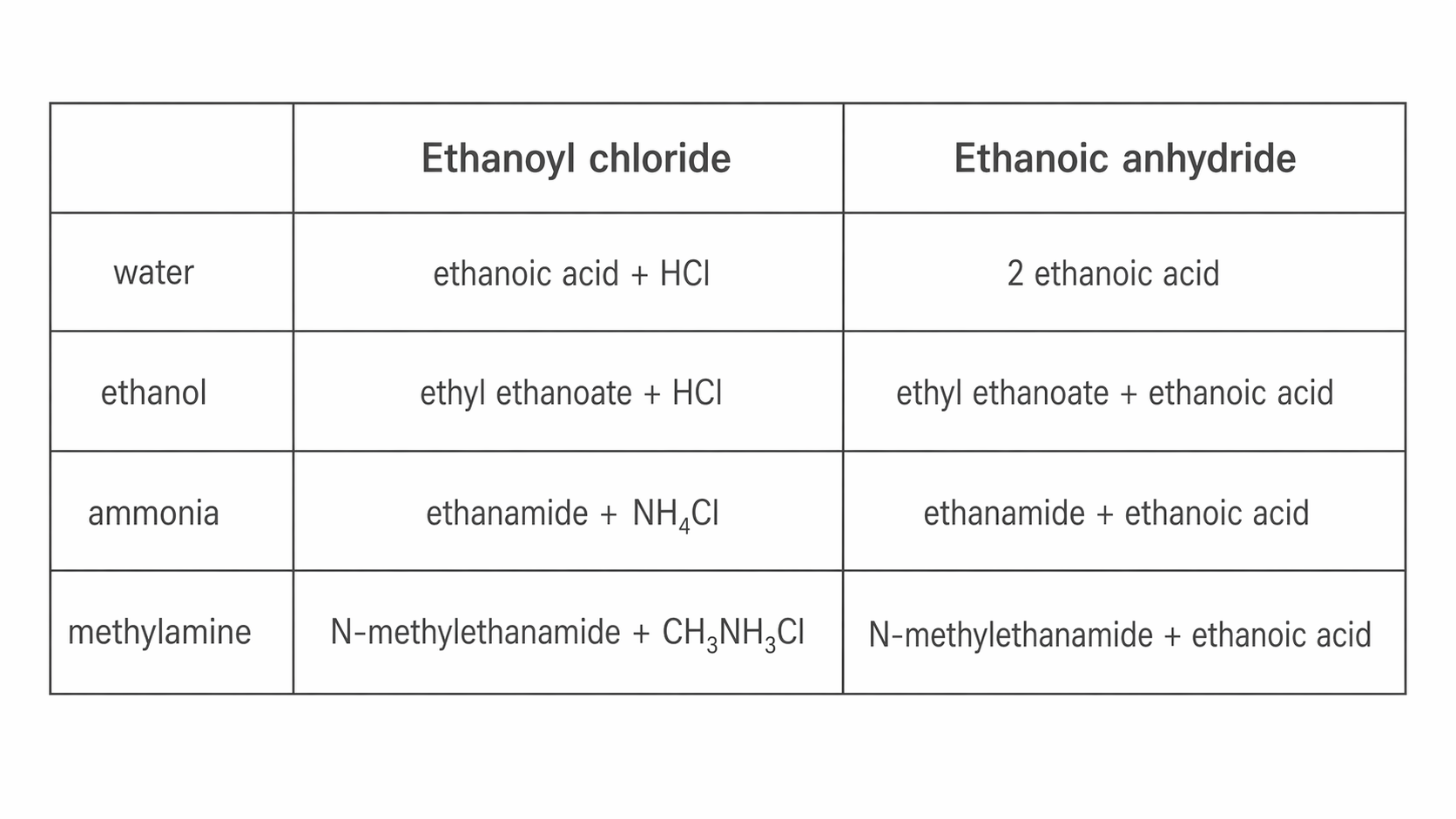
A quick way to predict the organic product is to keep the acyl group and swap the leaving group for the nucleophile-derived group. For example, in propanoyl chloride reacting with ammonia, keep and replace with to make propanamide, . In ethanoic anhydride reacting with ethanol, one ethanoyl group becomes part of the ester and the other ends up as ethanoic acid, so the products are ethyl ethanoate and ethanoic acid.
Acyl chlorides usually react more vigorously than acid anhydrides. Water can hydrolyse an acyl chloride rapidly, releasing steamy acidic fumes, while acid anhydrides are noticeably less aggressive. That difference becomes important later when we compare industrial routes to aspirin.
In small-scale test-tube comparisons, use the prescribed small volumes and add the acylating reagent carefully to water, ethanol, ammonia or a primary amine in separate labelled tubes. Work in a fume cupboard with eye protection because acyl chlorides and their HCl fumes are corrosive and the reactions can be vigorous. Record a table with reagent pair, temperature change/effervescence or fumes, organic product and by-product; distinguish the observation from the inferred equation. Never identify a product by smelling a tube directly.
Outlining The Acyl Chloride Mechanism
The nucleophilic addition-elimination mechanism for acyl chlorides reacting with water, alcohols, ammonia, and primary amines follows the same backbone every time.
Continue this lesson.
You’re previewing NovaLearn without an account. Create a free account to read the rest.
Create free account