3.3.4.3 - Addition Polymers
Addition polymers are one of the clearest examples of structure controlling properties. In this lesson, you will learn how alkene monomers become long saturated chains, how to move confidently between monomer and polymer structures, and why these materials are so useful yet so difficult to dispose of. We will also connect chain shape to intermolecular forces so the properties of materials such as poly(ethene) and PVC make chemical sense rather than feeling like facts to memorise.
From Alkenes to Polymer Chains
Addition polymers are made from alkenes and substituted alkenes. The key feature of the monomer is the carbon-carbon double bond, . During polymerisation, that double bond opens and each monomer links to the next one by new single bonds, building a long chain.
Addition polymer
An addition polymer is a polymer formed when many alkene molecules join by opening their bonds, with no other small molecule eliminated.
The original alkene may be simple, such as ethene, or substituted, such as chloroethene where one hydrogen has been replaced by chlorine. In both cases, the polymer backbone becomes a long chain of carbon atoms joined by single bonds only. That means the polymer is saturated even though the monomer was unsaturated.
Phenylethene, , can be polymerised in a supervised microscale preparation. A measured small sample with a suitable radical initiator is warmed using the specified controlled heating method; viscosity increases as long chains form. Phenylethene is flammable and harmful, and polymerisation is exothermic: avoid naked flames, control heating and work under the prescribed ventilation. Record the change from mobile liquid to viscous/solid polymer. The phenyl group remains a side group in ; no small molecule is lost.
The key structural change is that addition polymers come from alkenes, not alkanes, and the bond in the monomer does not stay in the polymer chain.
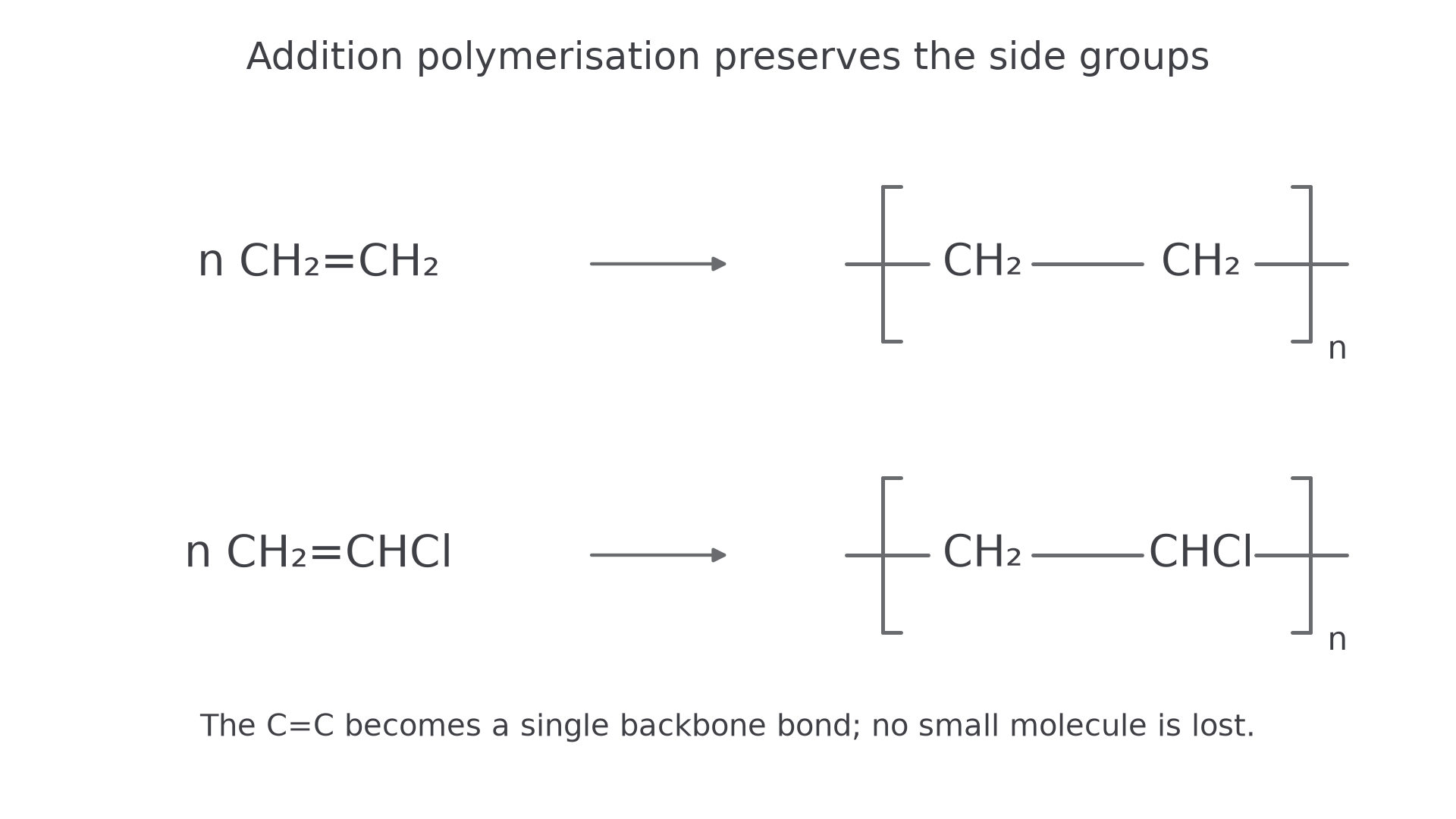
The diagram below shows this change for both ethene and chloroethene: the monomer double bond opens, and the polymer chain is built from new single bonds along the backbone.
[DIAGRAM: asset_name: 3.4.3 - Addition Polymers - Diagram 1; asset_slug: 3.4.3 - Addition Polymers - Diagram 1; recommended_method: retained_png; description: Two-row comparison of addition polymer formation. Top row: show n CH2=CH2 changing into the repeating unit [-CH2-CH2-]n with brackets, continuation bonds through the brackets, and the label poly(ethene). Label that the C=C bond opens and the backbone now contains new single bonds. Bottom row: show n CH2=CHCl changing into the repeating unit [-CH2-CHCl-]n with brackets, continuation bonds through the brackets, and the label poly(chloroethene).]
Repeating Units and Reverse Engineering
This topic works in both directions: from monomer to repeating unit, from a polymer section to the repeating unit, or from a polymer section back to the monomer. The chemistry becomes much clearer when the same rules are followed each time.
Repeating unit
A repeating unit is a section that repeats along a polymer chain. For alkene addition-polymer questions, show the two backbone carbons derived from one monomer and retain their substituents.
To draw the repeating unit from a monomer:
- Find the two carbon atoms that formed the original bond.
- Change that double bond into a single bond.
- Keep any side group on the same carbon as before.
- Draw brackets around the unit and show a bond passing through each side of the brackets to represent the continuing chain.
For example, propene, , forms the repeating unit . Chloroethene, , forms .
To work backwards from a polymer chain section, first find the shortest pattern that repeats. That gives the repeating unit. Then turn the bond between the two backbone carbons of that unit back into a double bond to recover the monomer. Any side group stays attached to the same carbon. So if the polymer contains , the monomer was .
The usual mistake is to lose a side group, move it onto the wrong carbon, or forget the continuation bonds through the brackets. Those are structural errors, not just untidy drawing, because they change what molecule you are claiming to show.
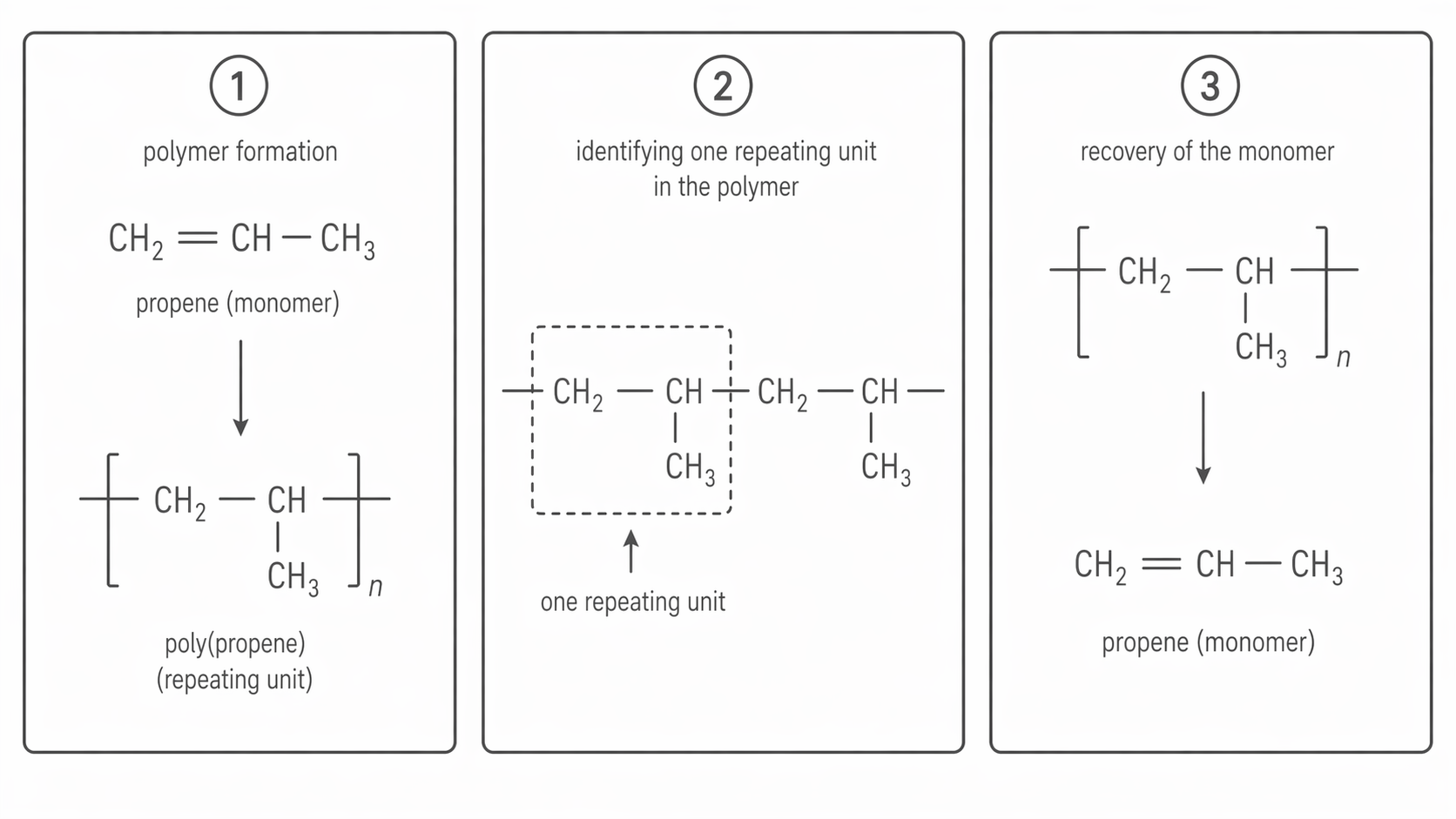
The diagram below walks through the propene example in both directions, from monomer to repeating unit and then back again from the repeating unit to the original alkene.
[DIAGRAM: asset_name: 3.4.3 - Addition Polymers - Diagram 2; asset_slug: 3.4.3 - Addition Polymers - Diagram 2; recommended_method: retained_png; description: Three linked panels about propene and its repeating unit. Panel 1: show monomer CH2=CHCH3 changing into the repeating unit [-CH2-CH(CH3)-] with brackets and continuation bonds. Panel 2: show the polymer section -CH2-CH(CH3)-CH2-CH(CH3)- with one repeating unit boxed or dashed out and labelled one repeating unit. Panel 3: show the repeating unit [-CH2-CH(CH3)-] changing back into monomer CH2=CHCH3 by restoring the double bond between the two backbone carbons.]
Notebook practice (ungraded): draw the two-carbon repeating unit of poly(propene), with its methyl side group, brackets and continuation bonds crossing the brackets. Check your drawing against the worked example above. This notebook drawing is not submitted or marked here; the question below assesses your interpretation in text. Testing includes a separately assessed repeating-unit drawing.
Naming Addition Polymers
The IUPAC naming rule is straightforward: name the polymer as poly(name of monomer) using the alkene's systematic name in brackets. That gives names such as poly(ethene), poly(propene), and poly(chloroethene).
Continue this lesson.
You’re previewing NovaLearn without an account. Create a free account to read the rest.
Create free account