3.3.14 - Organic Synthesis
Organic synthesis is about choosing a sequence of familiar reactions that turns a starting material into a target molecule. The real challenge is rarely a single reagent in isolation; it is spotting how the carbon skeleton changes, which functional-group changes are needed, and how to reach the product in as few sensible steps as possible. This lesson shows both the chemistry and the decision-making behind a good synthetic route.
What makes a route worth using
Making a product is not enough on its own. A chemist also wants a route that is safe, economical, and produces as little waste as possible. That is why the specification highlights solvent use, hazardous starting materials, number of steps, and atom economy.
If a solvent is not needed, chemists try to avoid using one. Solvents often have to be separated from the product afterwards, which adds extra processing. Many organic solvents are also flammable, toxic, or environmentally harmful, so avoiding them can reduce risk and reduce waste at the same time.
Using non-hazardous starting materials matters for a similar reason. Safer starting materials are easier to store, transport, and handle. They also reduce the chance of poisoning, fire, corrosion, or difficult waste-disposal problems during large-scale manufacture.
Atom economy
Atom economy measures what percentage of the atoms in the reactants end up in the desired product rather than in unwanted by-products.
A route with high atom economy wastes fewer atoms. That usually means less raw material is thrown away and less waste has to be treated. This is different from percentage yield: yield tells you how much product you actually obtained, whereas atom economy tells you how much waste the reaction is designed to make in theory.
Atom Economy
The number of steps matters because losses happen at every stage. Even if each step works well, some product is left behind in apparatus, lost during purification, or not formed because the reaction does not go to completion. For example, three steps at 80% yield each give an overall yield of only 0.80 x 0.80 x 0.80 = 51.2%. Fewer steps usually mean a better overall yield, less time spent purifying intermediates, and lower cost.
For a balanced equation with coefficients other than one, multiply each product by its stoichiometric coefficient before calculating atom economy. A recovered catalyst is not a stoichiometric reactant. Comparing routes also needs actual yield, energy and hazards; high atom economy alone does not establish the best process.
How to plan a synthesis
When you plan a synthesis, do not start by guessing reagents. Start by comparing the starting compound with the target compound.
Target molecule
The target molecule is the compound you are trying to make from the starting material.
The first check is the carbon skeleton. If the starting compound and target have the same number of carbon atoms, you usually need a functional-group conversion rather than a chain-length change. If the target has one more carbon atom, a nitrile is often the key intermediate because the carbon in the group becomes part of the chain. At this level, that is one of the most useful chain-extension ideas to recognise quickly.
The second check is the functional group. Ask yourself what immediate precursor could make the target in one known reaction. For example, if the target is a carboxylic acid, a primary alcohol or an aldehyde may be a good precursor. If the target is an amine with one extra carbon, a nitrile is often the best halfway point because nitriles can be reduced to amines.
The diagram below summarises the main route-planning patterns worth checking before you choose reagents.
[DIAGRAM: asset_name: 3.14 - Organic Synthesis - Diagram 1; asset_slug: 3.14 - Organic Synthesis - Diagram 1; recommended_method: code_generated; description: Three concrete synthesis examples: same-skeleton conversion, one-carbon nitrile extension and aromatic nitration–reduction–acylation, with conditions.]
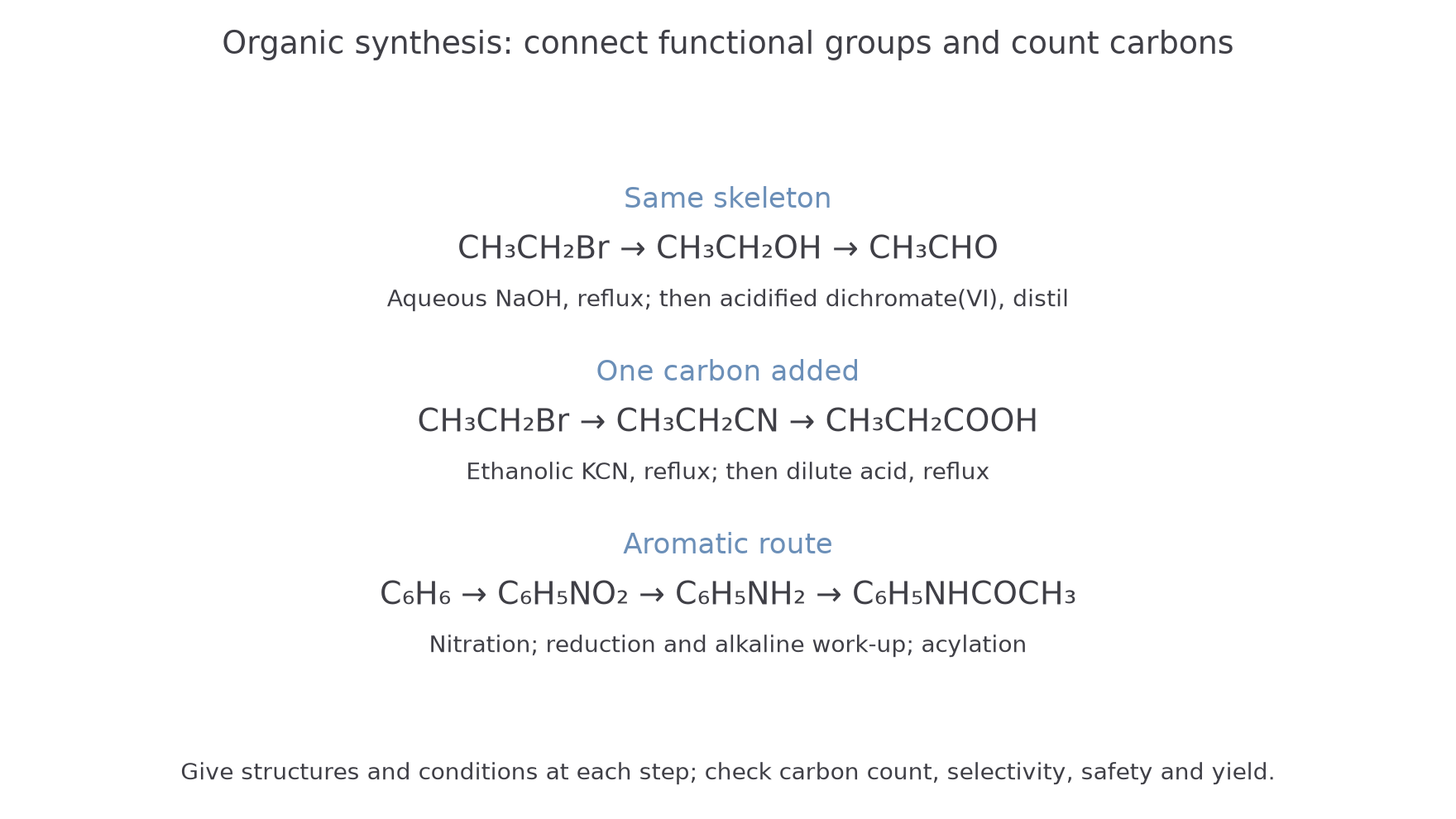
Then work both ways. Work forwards from the starting material using reactions you know, and work backwards from the target using likely precursors. The best routes are the ones where those two lines of thought meet in the middle in no more than four steps.
High-value route patterns to recognise
Once you know whether the carbon skeleton changes, most synthesis questions reduce to recognising a small number of bridge reactions.
Continue this lesson.
You’re previewing NovaLearn without an account. Create a free account to read the rest.
Create free account