3.3.6.1 - Test-Tube Tests for Functional Groups
Identifying an unknown organic compound often starts with simple reagent tests rather than a full structural analysis. Each test looks for a characteristic kind of reactivity, such as decolourising bromine water, being oxidised, releasing carbon dioxide, or forming halide ions. In this lesson, you will learn the key reagents, the positive observations, and how to combine those observations so that the tests actually help you identify the functional group present.
How to approach an unknown organic compound
For each test, link three things together: the functional group, the reagent, and the observation. A reagent name on its own tells you very little unless you also know the colour change, precipitate, or gas it should produce.
Functional group
A functional group is an atom or group of atoms in an organic compound that determines its characteristic chemical reactions.
Use a fresh sample for each test. That matters because one reagent can change the compound before the next test is carried out. For example, if a sample has already been oxidised with acidified potassium dichromate, you can no longer treat the result as if it were the original unknown compound.
The diagram below shows one clear way to organise those fresh portions into a functional-group testing plan for a single unknown.
[DIAGRAM: asset_name: 3.6.1 - Identification of Functional Groups by Test-Tube Reactions - Diagram 1; asset_slug: 3.6.1 - Identification of Functional Groups by Test-Tube Reactions - Diagram 1; recommended_method: retained_png; description: Flowchart titled "Testing an unknown organic compound". One central box labelled "Unknown organic compound" branches to four main fresh-sample tests. Branch 1: add bromine water and shake; orange-brown to colourless identifies an alkene. Branch 2: add sodium carbonate; effervescence and gas turning limewater cloudy identifies a carboxylic acid. Branch 3: add acidified K2Cr2O7 and warm; orange to green means the compound could be a primary alcohol, a secondary alcohol, or an aldehyde. From that positive orange-to-green result, add a clearly nested fresh-sample follow-up branch: warm with Tollens' reagent or Fehling's solution; a silver mirror or brick-red precipitate identifies an aldehyde. Branch 4: warm with NaOH(aq), then acidify with HNO3, then add AgNO3(aq); an AgX precipitate identifies a halogenoalkane.]
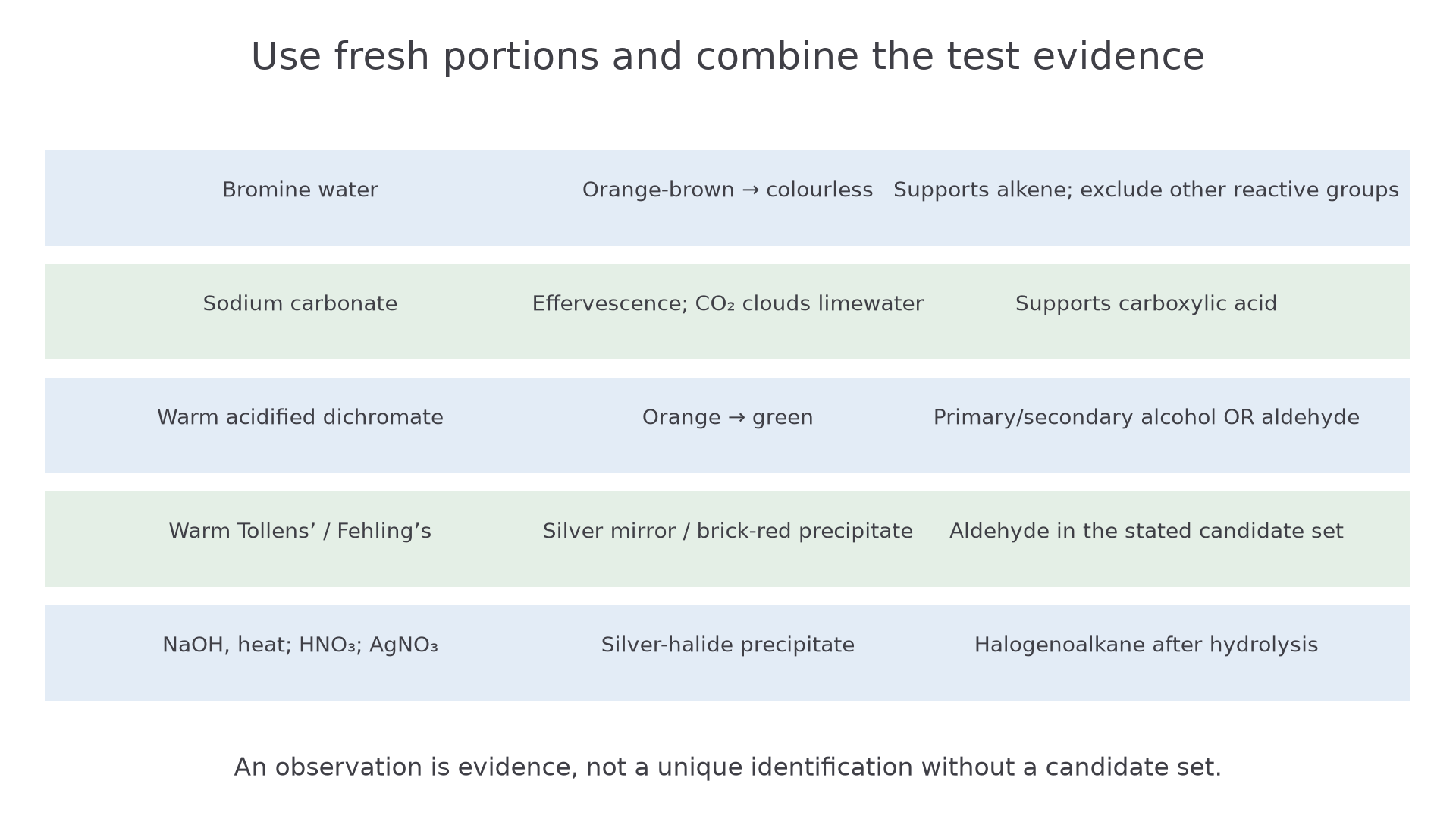
Not every positive test is unique. Acidified potassium dichromate, for example, does not distinguish on its own between a primary alcohol, a secondary alcohol, and an aldehyde. Good identification therefore depends on combining evidence, not memorising disconnected facts.
Quick tests for alkenes and carboxylic acids
An alkene is identified using bromine water. Bromine water is orange-brown, and when it reacts with a carbon-carbon double bond the colour disappears. So the positive observation is that bromine water is decolourised, going from orange-brown to colourless.
The reason this works is that the bond is reactive. Bromine adds across that double bond, so the coloured bromine is used up. Bromine-water decolourisation is useful evidence for a bond when comparing simple alkenes with non-reducing saturated compounds. It is not unique to alkenes: some other groups, including aldehydes and phenols, can also consume bromine, so combine this result with other tests.
Carboxylic acids are identified by adding sodium carbonate. Because the compound is acidic, it reacts with the carbonate to produce carbon dioxide gas. You therefore see effervescence, and the gas turns limewater cloudy.
In ionic terms, the key step is:
2 + → +
So the observation that matters is not just "bubbles". It is bubbles because carbon dioxide is being formed.
Oxidation tests for alcohols and aldehydes
Acidified potassium dichromate, /, is used as an oxidation test. The reagent starts orange. If a primary alcohol or a secondary alcohol is present, it is oxidised and the reagent changes from orange to green. A tertiary alcohol does not react under these conditions, so the solution remains orange.
Oxidising agent
An oxidising agent is a species that causes oxidation by accepting electrons. It is itself reduced.
A common trap here is that aldehydes also reduce acidified potassium dichromate from orange to green. So a green result does not automatically mean "alcohol". It means the compound can be oxidised by this reagent, and you need another test if you want to identify the functional group securely.
That follow-up test is usually Tollens' reagent or Fehling's solution. If an aldehyde is present, warming with Tollens' reagent gives a silver mirror. Heating with Fehling's solution gives a brick-red precipitate. For the simple alcohol-versus-aldehyde-versus-ketone comparisons here, alcohols and ketones give no visible change with Tollens' reagent and Fehling's solution stays blue.
Worked logic
Continue this lesson.
You’re previewing NovaLearn without an account. Create a free account to read the rest.
Create free account