3.3.3.3 - Ozone Depletion
Ozone high in the atmosphere is one of the few cases where a reactive substance is clearly helpful. In this lesson, you will see why stratospheric ozone protects life from ultraviolet radiation, how CFCs release chlorine radicals in the upper atmosphere, and why one chlorine radical can help destroy many ozone molecules. You will also link the chemistry to the evidence that led to bans on CFCs and to the development of safer chlorine-free alternatives.
Why ozone matters and why CFCs became a problem
Ozone, , forms naturally in the upper atmosphere. There, it absorbs ultraviolet radiation from the Sun before that radiation reaches the Earth's surface in large amounts. That matters because too much ultraviolet radiation damages living tissue and can damage DNA.
Ozone layer
The ozone layer is the region of the stratosphere that contains enough ozone to absorb a significant fraction of incoming ultraviolet radiation.
The chemistry problem began with chlorofluorocarbons, or CFCs. These compounds were widely used as refrigerants and solvents because they are very stable and unreactive under ordinary conditions. That sounds useful, but it also means they do not break down quickly lower in the atmosphere. Instead, they can drift upwards into the stratosphere, where the ultraviolet radiation is energetic enough to start a different kind of chemistry.
A common mix-up here is forgetting where ozone is useful. The helpful ozone in this lesson is specifically ozone in the upper atmosphere. That ozone is beneficial because it absorbs UV radiation before it can do harm lower down.
How chlorine radicals are formed from CFCs
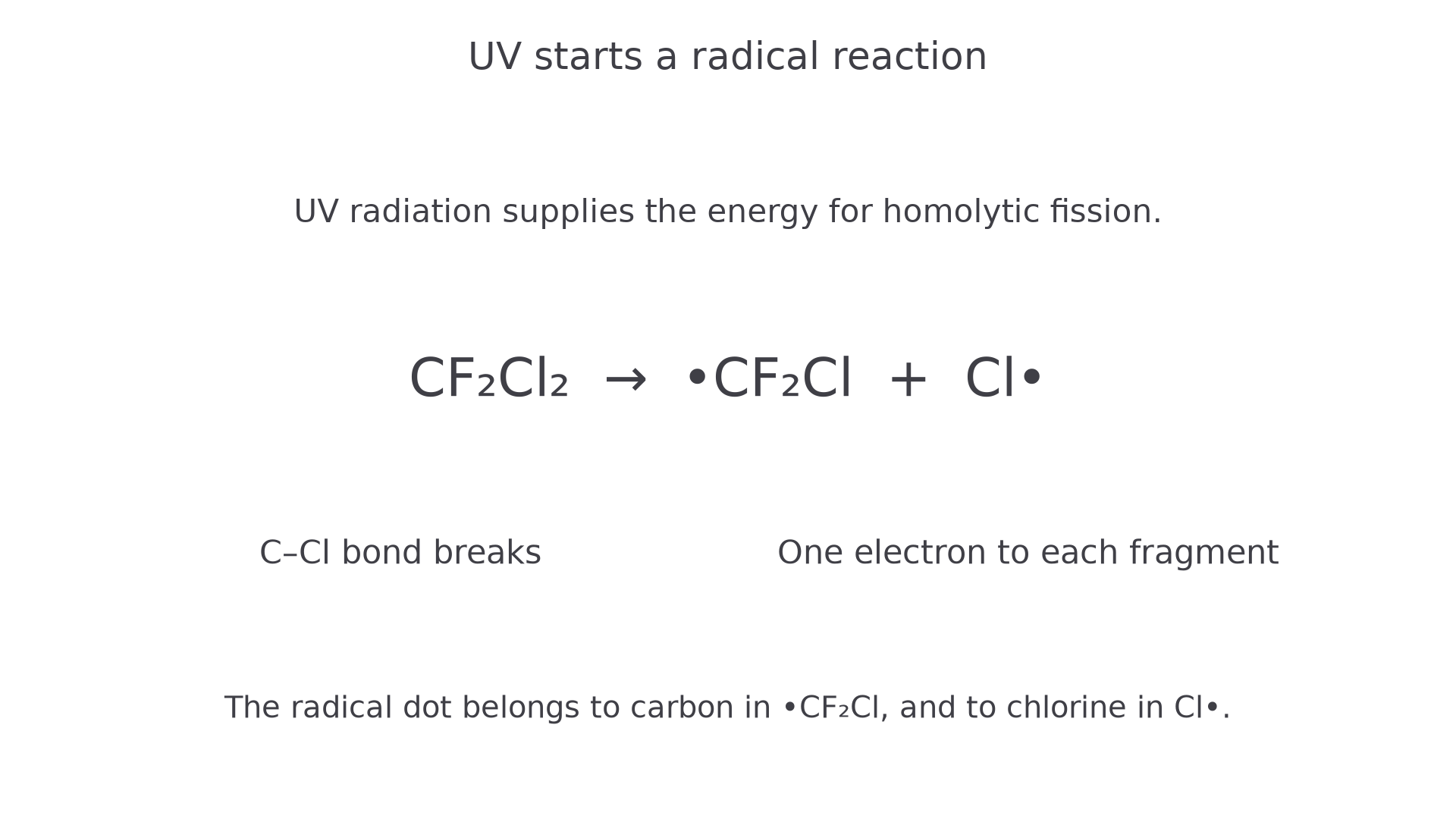
When ultraviolet radiation reaches a CFC molecule in the upper atmosphere, it can break a bond. The bond breaks homolytically, so one electron from the shared pair goes to each fragment.
Free radical
A free radical is a species with an unpaired electron.
That means chlorine atoms are produced as chlorine radicals, written as . A simple example is:
The bond has a lower bond enthalpy than , so the available ultraviolet photons can break it more readily. The unpaired electron in the carbon-containing fragment is on carbon; the other fragment is .
The exact carbon-containing radical does not matter as much as the key point: ultraviolet radiation breaks a bond in a CFC and forms a chlorine radical in the upper atmosphere.
The diagram below shows ultraviolet radiation breaking a bond in a CFC by homolytic fission to produce a chlorine radical.
[DIAGRAM: asset_name: 3.3.3 - Ozone Depletion - Diagram 1; asset_slug: 3.3.3 - Ozone Depletion - Diagram 1; recommended_method: retained_png; description: Simple initiation step for ozone depletion shown as a clean reaction scheme. Draw CF2Cl2 with carbon at the centre, two fluorine atoms and two chlorine atoms attached, and lightly highlight one specific C-Cl bond as the bond broken by ultraviolet radiation. Place UV above the reaction arrow. Use two single-headed fishhook arrows from that highlighted C-Cl bond to show homolytic fission, and show the products as the carbon-containing radical CF2Cl• plus a chlorine radical Cl•.]
Because radicals are highly reactive, the newly formed does not stay idle. It reacts with ozone and begins a catalytic cycle.
How chlorine radicals catalyse ozone depletion
The ozone-depletion mechanism has two main steps:
In the first step, a chlorine radical reacts with an ozone molecule to form a chlorine monoxide radical, , and oxygen. In the second step, that radical reacts with another ozone molecule and regenerates the original chlorine radical.
Catalyst
A catalyst is a substance that increases the rate of a reaction and is regenerated at the end of the reaction, so it is unchanged overall.
That regeneration is the crucial point. The chlorine radical appears at the start of the first equation and reappears at the end of the second. It is therefore not used up overall, so it acts as a catalyst.
If you add the two equations together, both radical species cancel:
So the overall effect is that ozone is converted into oxygen. Because the chlorine radical is regenerated, one can repeat the cycle many times and help destroy many ozone molecules. This is why even relatively small amounts of chlorine radicals can make a serious difference to ozone concentration in the stratosphere.
Continue this lesson.
You’re previewing NovaLearn without an account. Create a free account to read the rest.
Create free account