3.3.1.2 - Reaction Mechanisms
Reaction mechanisms are the "how" behind an organic reaction. Instead of only showing reactants and products, they show which electrons move, so you can see why one bond forms while another breaks. In this lesson, you will separate free-radical steps from electron-pair mechanisms and learn the drawing rules that keep the chemistry clear and correct.
What mechanisms actually show
In organic chemistry, a mechanism is useful because it tracks electron movement. If you know where the electrons start, you can usually predict where the new bond will appear and which bond will disappear.
Curly arrow
A full-headed curly arrow shows the movement of a pair of electrons from one place in a molecule or ion to another.
For electron-pair mechanisms in this topic, there are two core arrow rules. If a new covalent bond is forming, the arrow starts from the electrons that will make that bond. If a covalent bond is breaking, the arrow starts from the bond itself, because the bonding pair is what moves.
Lone pair
A lone pair is a pair of electrons on one atom that is not being used in a covalent bond.
That means a bond-forming arrow in the mechanisms studied here can begin:
- from a lone pair on an atom or ion
- from another covalent bond, such as a bond
A bond-breaking arrow does not start at the atom that leaves. It starts at the bond, then points to the atom that takes both electrons from that bond.
The diagram below compares the two key starting points for curly arrows in electron-pair mechanisms: a lone pair when a bond forms, and the bond itself when a bond breaks.
[DIAGRAM: asset_name: 3.1.2 - Reaction Mechanisms - Diagram 1; asset_slug: 3.1.2 - Reaction Mechanisms - Diagram 1; recommended_method: retained_png; description: Side-by-side electron-pair mechanism rules. Left panel: hydroxide shown as [OH]- with visible lone pairs attacking bromoethane shown as CH3-CH2-Br; a full-headed curly arrow starts exactly at an oxygen lone pair and ends at the CH2 carbon bonded to Br. Right panel: the same bromoethane with a full-headed curly arrow starting from the C-Br bond itself and ending on Br. Include callout labels marking "starts at lone pair" and "starts at C-Br bond".]
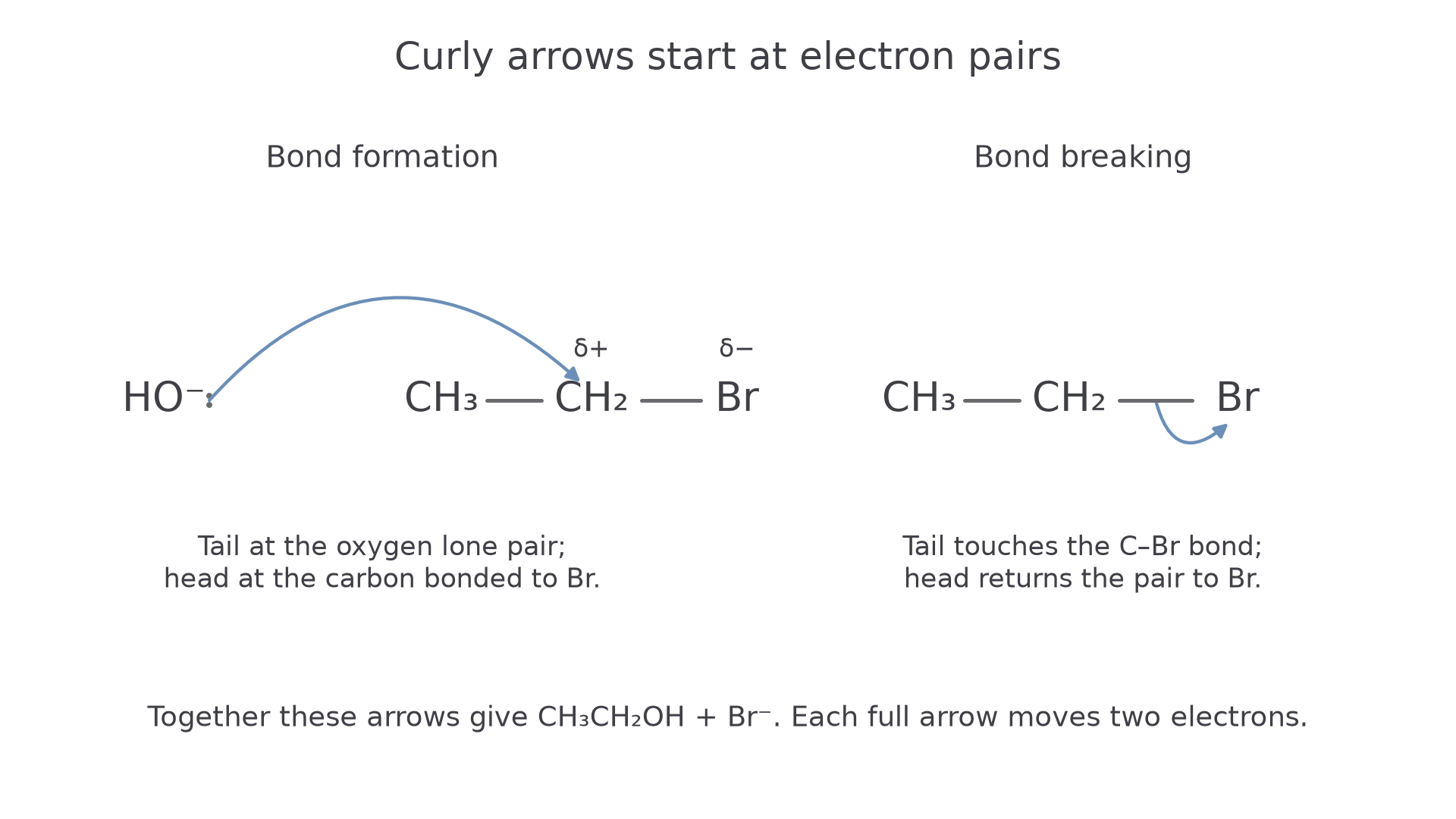
This is the core rule: arrows start where electrons already are. If an arrow begins at an atom that does not own the electron pair, the mechanism is wrong even if the product looks sensible.
Free-radical mechanisms
Free-radical mechanisms are different because they involve species with an unpaired electron. A dot beside the formula marks the unpaired electron, so means a chlorine radical and means a methyl radical.
Radical
A radical is a species with an unpaired electron.
For radicals, keep two things clear. First, the unpaired electron must be shown with a dot. Second, each step should be written as a balanced equation. You are not required to use curly arrows for free-radical mechanisms here.
The standard example is chlorination of methane under UV light.
Initiation:
This is the step that starts the chain. Energy from UV light breaks the bond so that one electron goes to each chlorine atom, producing two radicals.
Propagation:
These are chain steps. A radical is used up, but another radical is formed, so the reaction can continue. Notice that each equation is balanced and every radical is marked clearly.
Termination:
Termination removes radicals because two radicals join to make a molecule with only paired electrons. Once radicals are removed, the chain reaction slows or stops.
A quick self-check helps here. In the first propagation step, chlorine radical removes one hydrogen atom from methane. That gives and leaves behind. Nothing has "vanished": the atoms still balance, and the radical has simply moved from chlorine to the methyl group.
The diagram below sets out chlorination of methane in the three standard stages: initiation, propagation, and termination.
[DIAGRAM: asset_name: 3.1.2 - Reaction Mechanisms - Diagram 2; asset_slug: 3.1.2 - Reaction Mechanisms - Diagram 2; recommended_method: retained_png; description: Free-radical chlorination of methane arranged in three labelled sections: Initiation, Propagation, and Termination. Show balanced equations only, with no curly arrows. Initiation: Cl2 -> 2Cl. Propagation: Cl. + CH4 -> HCl + CH3. and CH3. + Cl2 -> CH3Cl + Cl. Termination: Cl. + Cl. -> Cl2, CH3. + Cl. -> CH3Cl, and CH3. + CH3. -> C2H6. Use radical dots exactly as shown.]
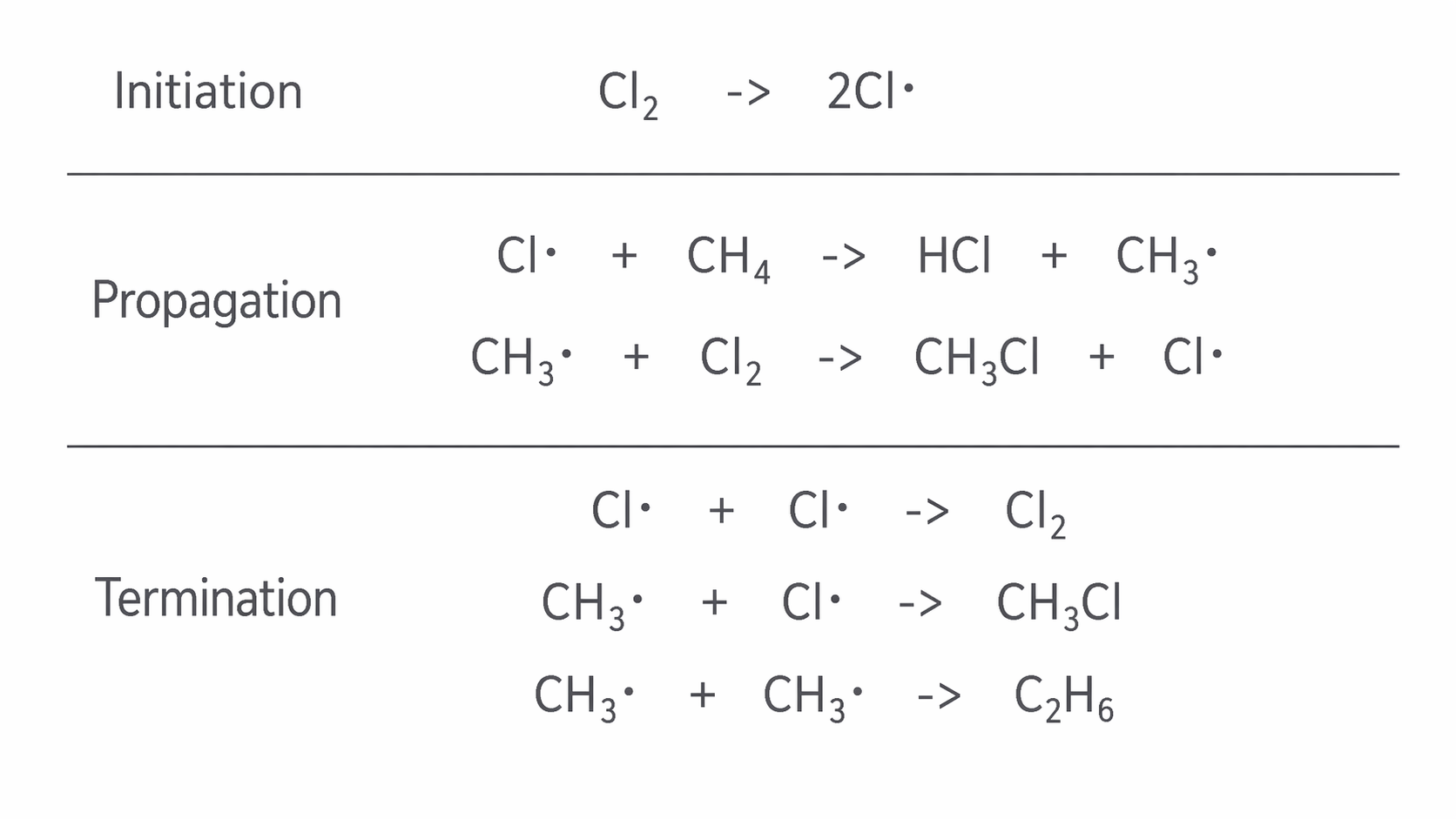
Keep three details under control here: show the radical dot, balance each step, and do not force electron-pair arrow notation into a radical chain mechanism. Each step should stand as a complete chemical equation.
Continue this lesson.
You’re previewing NovaLearn without an account. Create a free account to read the rest.
Create free account