3.3.12.2 - Biodegradability and Disposal of Polymers
This lesson is about a simple but powerful idea: disposal problems depend on polymer structure. If a polymer chain contains only strong, non-polar carbon-carbon and carbon-hydrogen bonds, it tends to persist in the environment. If the chain contains polar ester or amide links, hydrolysis becomes possible, so the polymer is much easier to break down and recycle sensibly.
Why Polyalkenes Persist
Poly(ethene), poly(propene), and similar polyalkenes are addition polymers. Their chains are essentially long hydrocarbon backbones, so they behave like very large alkane molecules. That is why they are described as chemically inert under ordinary environmental conditions.
Biodegradable
A biodegradable polymer can be broken down by living organisms, such as microorganisms, using enzymes to produce smaller molecules. Hydrolysable links make biological breakdown possible, but do not guarantee a rapid rate in every environment.
For polyalkenes, that attack is difficult. The chain contains strong C-C and C-H covalent bonds, and these bonds are nearly non-polar. There is no ester link and no amide link for water to hydrolyse. As a result, there is no obvious weak point in the chain, so polyalkenes do not break down easily in soil or landfill and can remain there for many years.
The diagram below compares a poly(ethene) repeat unit with polyester and polyamide repeat units, showing why only the latter two contain hydrolysable links.
[DIAGRAM: asset_name: 3.12.2 - Biodegradability and Disposal of Polymers - Diagram 1; asset_slug: 3.12.2 - Biodegradability and Disposal of Polymers - Diagram 1; recommended_method: code_generated; description: Comparison of polyethene, polyester and polyamide backbone links; explicit C(=O)–O and C(=O)–NH structures show hydrolysable groups.]
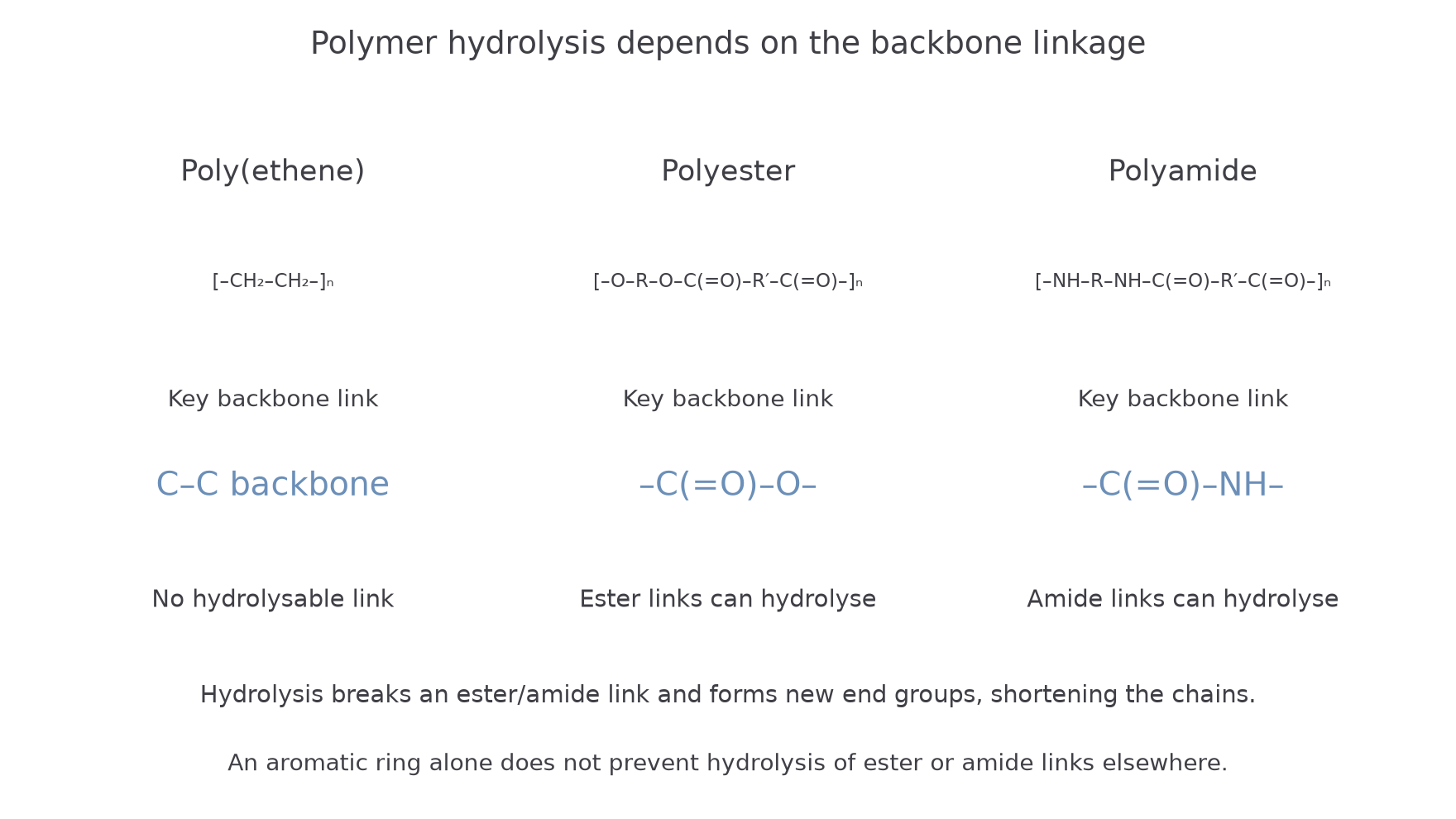
This explains the phrase "chemically inert and non-biodegradable". Polyalkenes are inert because they are unreactive in everyday conditions, and they are non-biodegradable because the environment has no easy chemical route for cutting the chain into smaller fragments.
Why Hydrolysis Works for Polyesters and Polyamides
Polyesters and polyamides are different because their repeat units contain functional groups, not just hydrocarbon chains. That single structural change is what makes biodegradability possible.
Hydrolysis
Hydrolysis is a reaction in which water breaks a covalent bond. In a polymer, hydrolysis cuts links in the chain and produces smaller molecules.
In a polyester, the chain contains ester links, . In a polyamide, the chain contains amide links, . Both links contain a carbonyl group, , and that makes the bonding polar. Oxygen is strongly electronegative, so electron density is pulled towards it and the carbonyl carbon becomes partially positive. That gives water, or hydroxide ions in alkaline conditions, a site they can attack.
Once that bond is attacked, the polymer chain can be split. In other words, hydrolysis is effectively the reverse of the condensation reaction that formed the polymer in the first place. The products are smaller molecules rather than one giant chain, so the material is much easier to break down than a polyalkene.
It is worth keeping the comparison precise. Polyesters and polyamides are described as biodegradable because they can be hydrolysed. That does not mean every sample disappears quickly in everyday conditions; the breakdown can still be slow. The key point is structural: ester and amide links are susceptible to hydrolysis, but the hydrocarbon chains of polyalkenes are not.
A useful shortcut is this: if you can spot or in a repeat unit, think "polar linkage, hydrolysis possible". If the repeat unit is just a saturated carbon chain, think "addition polymer, chemically inert, not hydrolysed easily".
The solution conditions determine the final functional groups. Heating Terylene with aqueous sodium hydroxide gives ethane-1,2-diol and the disodium salt of benzene-1,4-dicarboxylic acid: alkali leaves both carboxyl groups as carboxylate ions. Heating nylon 6,6 with hydrochloric acid breaks the carbonyl C–N bonds and gives hexanedioic acid and ; the amine groups accept protons in acid. Merely breaking intermolecular attractions by melting is not hydrolysis: hydrolysis changes covalent bonds and chain length.
Continue this lesson.
You’re previewing NovaLearn without an account. Create a free account to read the rest.
Create free account