3.1.8.1 - Born-Haber Cycles
Born-Haber cycles let us split the formation or dissolution of an ionic compound into smaller enthalpy changes that can be measured or estimated. The power of the method is not the drawing itself, but the bookkeeping: if every arrow is defined carefully and signed correctly, you can calculate lattice enthalpy, hydration enthalpy, enthalpy of solution, or another missing value. This topic also explains why some "ionic" compounds are not perfectly ionic at all.
The enthalpy changes inside a Born-Haber cycle
A Born-Haber cycle is a Hess cycle built from a very specific start and finish. The usual starting point is the elements in their standard states, and the finish is either the ionic solid or the gaseous ions, depending on which enthalpy you are trying to find. The first step is to identify exactly which chemical species belong at each level of the cycle.
Standard enthalpy of formation
The standard enthalpy of formation, , is the enthalpy change when one mole of a compound is formed from its constituent elements in their standard states under standard conditions.
In a Born-Haber cycle, often gives the direct route from the elements to the ionic solid. The indirect route breaks that same process into smaller steps such as atomising elements, removing electrons from metal atoms, adding electrons to non-metal atoms, and then forming the ionic lattice.
Standard enthalpy of atomisation
The standard enthalpy of atomisation, , is the enthalpy change when one mole of gaseous atoms is formed from the element in its standard state under standard conditions.
For metals such as sodium, atomisation is simply the step from the solid metal to gaseous atoms. For molecular non-metals such as chlorine, you must create single gaseous atoms from molecules, so one mole of atoms needs . If bond enthalpy data are given instead of an atomisation enthalpy, you convert carefully using the stoichiometry of the bond being broken.
Mean bond enthalpy
The mean bond enthalpy is the average enthalpy change required to break one mole of a specified covalent bond in gaseous molecules.
That word average matters. A mean bond enthalpy is not taken from one exact compound only, so if a cycle supplies a bond enthalpy for or , use it as data for the bond-breaking step, but do not confuse it with lattice enthalpy. The first ionisation energy is the enthalpy change when one mole of gaseous atoms each loses one electron to form one mole of gaseous ions. The first electron affinity is the enthalpy change when one mole of electrons is added to one mole of gaseous atoms to form one mole of gaseous ions. First ionisation energy is always endothermic because an electron is removed from an atom; first electron affinity is usually exothermic because an electron is attracted to a neutral atom. In compounds with or ions, successive steps matter: needs first and second ionisation energies, while needs first and second electron affinities.
Calculating lattice enthalpy from a Born-Haber cycle
The final step in a standard Born-Haber cycle is usually the lattice step, and this is where sign errors easily creep in. In this specification, lattice enthalpy can be defined in two ways, so you must state which one you are using.
Lattice enthalpy
Lattice enthalpy may be defined as either the enthalpy change when one mole of an ionic solid is formed from its gaseous ions, or the enthalpy change when one mole of an ionic solid is separated into its gaseous ions. The formation value is negative; the dissociation value has the same magnitude but a positive sign.
Suppose we want the lattice enthalpy of formation of sodium chloride. The direct route is
with .
The indirect route is:
followed by lattice formation from the gaseous ions. The diagram below lays out the direct and indirect routes for sodium chloride on one cycle.
[DIAGRAM: asset_name: 1.8.1 - Born-Haber Cycles - Diagram 1; asset_slug: 1.8.1 - Born-Haber Cycles - Diagram 1; recommended_method: matplotlib_exact_plot; description: NaCl Born-Haber cycle with separate successive Na and Cl atomisations, ionisation, electron affinity consuming the gaseous electron, lattice formation and direct formation. Values +108,+122,+496,-349,-788 and -411 kJ mol^-1; all spectator species retained.]
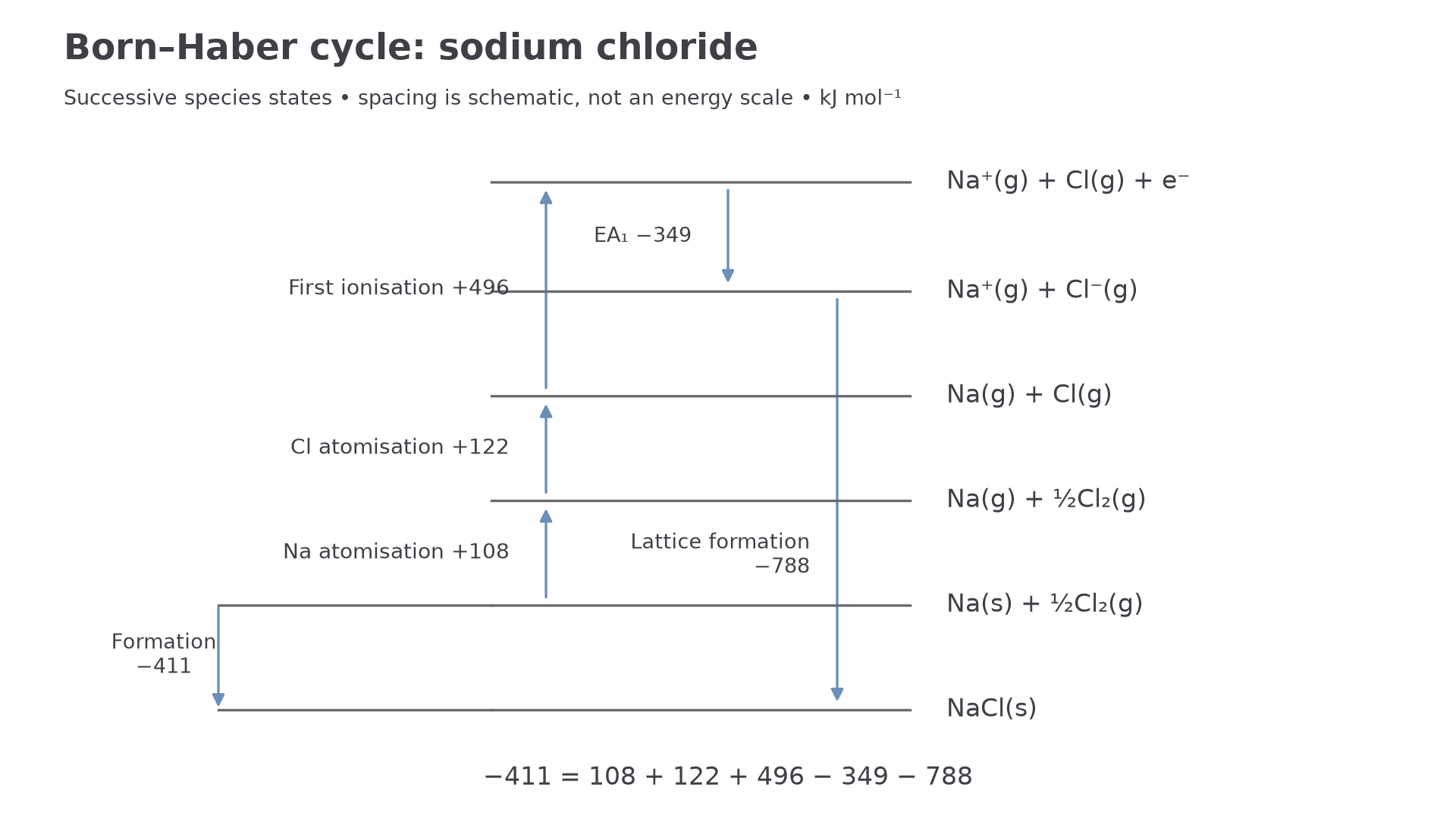
By Hess's law:
So
The arithmetic is easier to trust if you ask one question at the end: should lattice formation be exothermic? Yes, so a negative answer is chemically sensible. If you were using lattice dissociation instead, the answer would be .
Exactly the same logic works if the lattice enthalpy is known and some other arrow is missing. The cycle does not care which quantity is unknown; it only cares that every enthalpy change refers to the correct chemical equation.
Using the cycle to find a different unknown
More demanding cycles usually involve ions that are not simply and . For , one magnesium atom must lose two electrons, so both the first and second ionisation energies are needed. Two chlorine atoms are formed and each gains one electron, so the chlorine atomisation and first electron affinity terms are both doubled.
A compact way to write that cycle is:
This is why definitions matter so much. The second ionisation energy is not the energy to remove two electrons in one step from magnesium atoms; it is the enthalpy change for
Likewise, if a cycle contains , the second electron affinity must be included because the second electron is being added to an already negative ion. That step is endothermic, even though the first electron affinity of oxygen is exothermic.
The same chemistry can also appear in bond-enthalpy form. If chlorine data are given as bond enthalpy, the step to form one mole of chlorine atoms is half of that value because one mole of atoms comes from half a mole of molecules. It is an easy place to slip, because the stoichiometry changes even though the chemistry does not.
Continue this lesson.
You’re previewing NovaLearn without an account. Create a free account to read the rest.
Create free account