Required practical 11 - Transition-Metal Ion Tests
Use initial colour, precipitation, behaviour in excess reagent and carbonate reactions together to identify aqueous metal ions.
Setting up the tests properly
In aqueous solution, many metal ions exist as aqua complexes such as or . When you add reagents such as , or , those complexes react in different ways. That is why qualitative analysis works: different ions give different visible results.
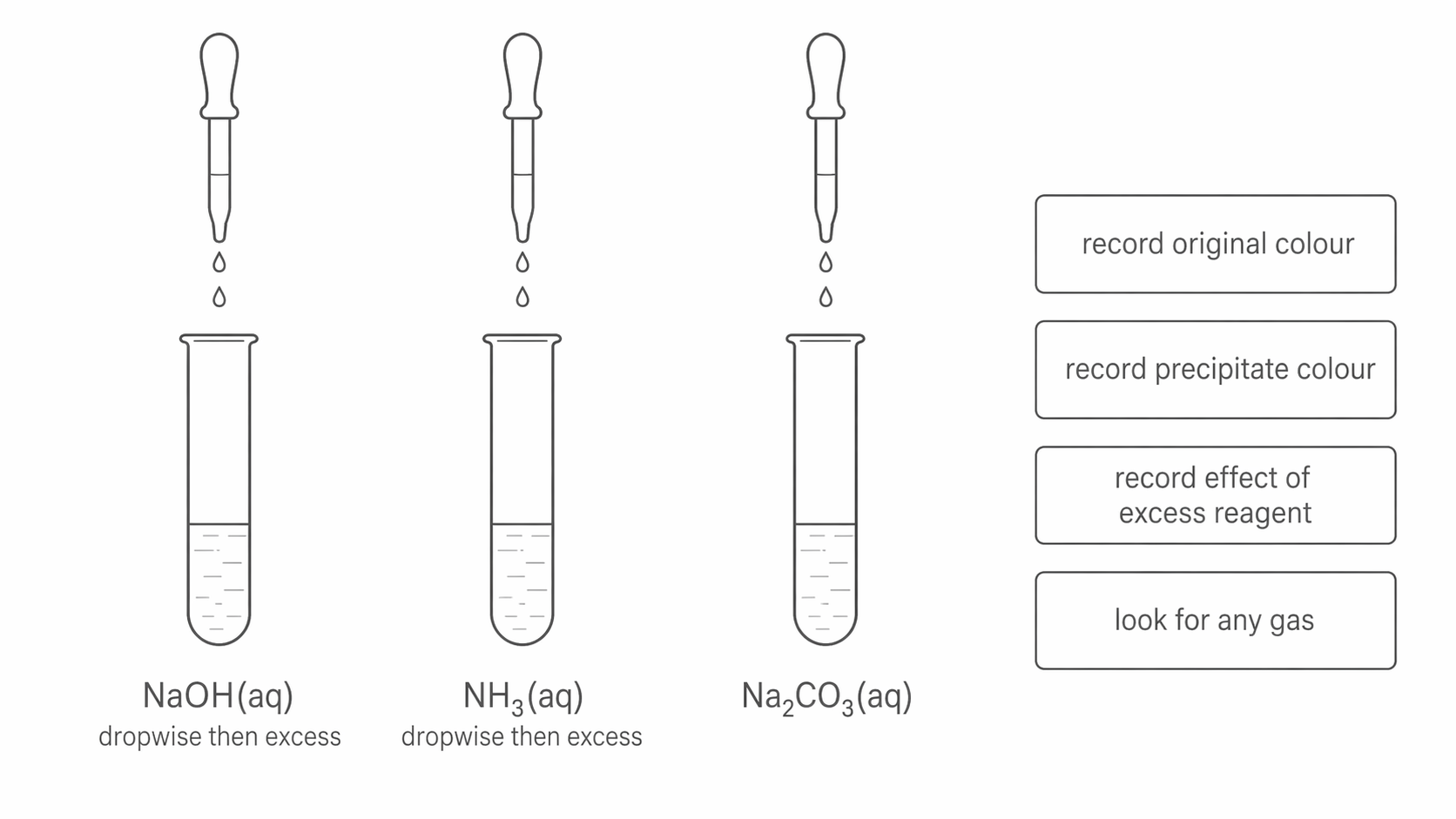
For this practical, the safest and clearest approach is to use separate fresh portions of the unknown solution. Put the same number of drops of the unknown into three clean test tubes. Add to the first tube dropwise and then in excess, to the second tube dropwise and then in excess, and to the third tube. Record the initial colour of the solution, then every visible change after each addition.
Precipitate
A precipitate is an insoluble solid formed when reacting species in solution produce a product that does not stay dissolved.
Use small volumes throughout, keep the test tubes against a white background, and compare them side by side. Clean glassware matters because traces of a previous reagent can create false observations. Add the reagent slowly enough to see the first precipitate appear before you decide what happens in excess.
The diagram below shows a simple three-tube setup that keeps the reagent tests separate and makes the observation checklist explicit.
[DIAGRAM: asset_name: RP 11 - Carry Out Simple Test-Tube Reactions to Identify Transition Metal Ions in Aqueous Solution - Diagram 1; asset_slug: RP 11 - Carry Out Simple Test-Tube Reactions to Identify Transition Metal Ions in Aqueous Solution - Diagram 1; recommended_method: retained_png; description: Monochrome exam-clean setup with three separate test tubes, each containing the same starting unknown solution. A dropper above the first tube is labelled NaOH(aq) with "dropwise then excess", a dropper above the second is labelled NH3(aq) with "dropwise then excess", and a dropper above the third is labelled Na2CO3(aq). Four callout boxes list the observation checklist: "record original colour", "record precipitate colour", "record effect of excess reagent", and "look for any gas".]
and are irritant, and sodium hydroxide can damage skin and eyes. Wear goggles, avoid skin contact, and handle ammonia carefully because its fumes are irritating. Small quantities are enough for clear observations, so there is no gain in using large volumes.
The phrase "in excess" matters. It means enough reagent has been added that any further change has already happened. In this practical, some ions form a precipitate first and then dissolve when much more reagent is added, so stopping too early can lose the key identification clue.
Label the candidate set as Fe²⁺, Fe³⁺, Cu²⁺ and the comparison ion Al³⁺; these observations do not uniquely distinguish every possible ion in chemistry. Record results in a table before deciding the identity. If warming is required by the supplied protocol, use a gently heated water bath and a test-tube holder, keeping the tube pointed away from people. Routine hydroxide/ammonia/carbonate comparisons here are observed initially at room temperature. Laboratory performance, safe heating and independent observation require teacher observation; a written answer cannot certify them.
Keep a dated record of the method title/version, reagent concentrations, observations made at the time and your conclusion. If you consult a handbook or safety source, record its title and page or URL, and state which procedural choice or expected observation it supports. Compare any disagreement with your result against concentration, contamination and timing before changing the identification. This records how secondary information informed the investigation rather than replacing your own observations.
The most useful observation patterns
The quickest way to make sense of this practical is to compare the observation pattern for each likely ion rather than learning each test in isolation. Initial colour is useful, but it is not enough on its own. The decisive evidence usually comes from what happens after adding and , especially in excess.
| Ion in solution | Initial colour | then excess | then excess |
|---|---|---|---|
| pale green | green precipitate, insoluble in excess; gradually turns brown in air | green precipitate, insoluble in excess; gradually turns brown in air | |
| yellow-brown | brown precipitate, insoluble in excess | brown precipitate, insoluble in excess | |
| blue | blue precipitate, insoluble in excess | blue precipitate, then dissolves in excess to give a deep blue solution | |
| (comparison ion) | colourless | white precipitate, dissolves in excess | white precipitate, insoluble in excess |
The result is easy to misread if you rush. The initial precipitate is green, not brown. It becomes brown later because oxygen in the air oxidises to . If you only record "brown precipitate", you miss the key chemistry: the green iron(II) precipitate has changed after standing in air.
Copper(II) gives the standout result with ammonia. At first, ammonia behaves as a base and a pale blue precipitate forms. In excess ammonia, that precipitate dissolves and a deep blue complex forms. That final deep blue solution is one of the most recognisable observations in this topic.
Ligand
A ligand is an ion or molecule that forms a co-ordinate bond by donating a lone pair of electrons to a central metal ion.
In the copper test, ammonia is not only acting as a base. In excess, it also acts as a ligand and replaces some water molecules around the copper ion.
Continue this lesson.
You’re previewing NovaLearn without an account. Create a free account to read the rest.
Create free account