3.2.5.3 - Shapes of Complex Ions
Draw complex-ion geometries with correct co-ordination numbers, bond angles and three-dimensional conventions, and distinguish geometric and optical isomers.
Packing ligands around a metal ion
When a transition metal ion accepts lone pairs from ligands, a complex ion forms.
Complex ion
A species containing a central metal ion surrounded by ligands joined to it by coordinate bonds.
Coordination number
The number of coordinate bonds formed to the central metal ion, or the number of ligand donor atoms bonded to it.
Coordination number strongly influences shape, but it does not always fix the geometry on its own.
Small ligands such as and commonly pack six around a transition metal ion. Six bonded positions give an octahedral complex, with bond angles of .
Larger ligands such as need more space. Often only four can fit around the same metal ion, so these complexes are commonly tetrahedral, with bond angles of .
However, coordination number 4 does not always mean tetrahedral. Some complexes, especially of platinum and nickel, arrange four ligands in one plane around the metal ion. That shape is square planar, and adjacent bond angles are .
Silver is the special case to remember. forms , with only two ligands around the metal ion, so the shape is linear and the bond angle is .
| Common pattern | Typical shape | Key angle | Example |
|---|---|---|---|
| 6 small ligands around a transition metal ion | octahedral | ||
| 4 larger ligands around a transition metal ion | tetrahedral | ||
| 4 ligands in one plane | square planar | ||
| 2 ligands around silver(I) | linear |
The diagram below compares the four shapes you need to recognise most often in this topic and links each one to its characteristic bond angle.
[DIAGRAM: asset_name: 2.5.3 - Shapes of Complex Ions - Diagram 1; asset_slug: 2.5.3 - Shapes of Complex Ions - Diagram 1; recommended_method: retained_png; description: Four labelled coordination sketches arranged in a grid. Show an octahedral complex with six ligand positions and 90 degrees, a tetrahedral complex with four ligand positions and 109.5 degrees, a square-planar complex with four ligands in one plane and 90 degrees, and a linear silver complex with two opposite ligands and 180 degrees. Label true angles: octahedral and square planar 90 and 180 degrees, tetrahedral 109.5 degrees, linear 180 degrees.]
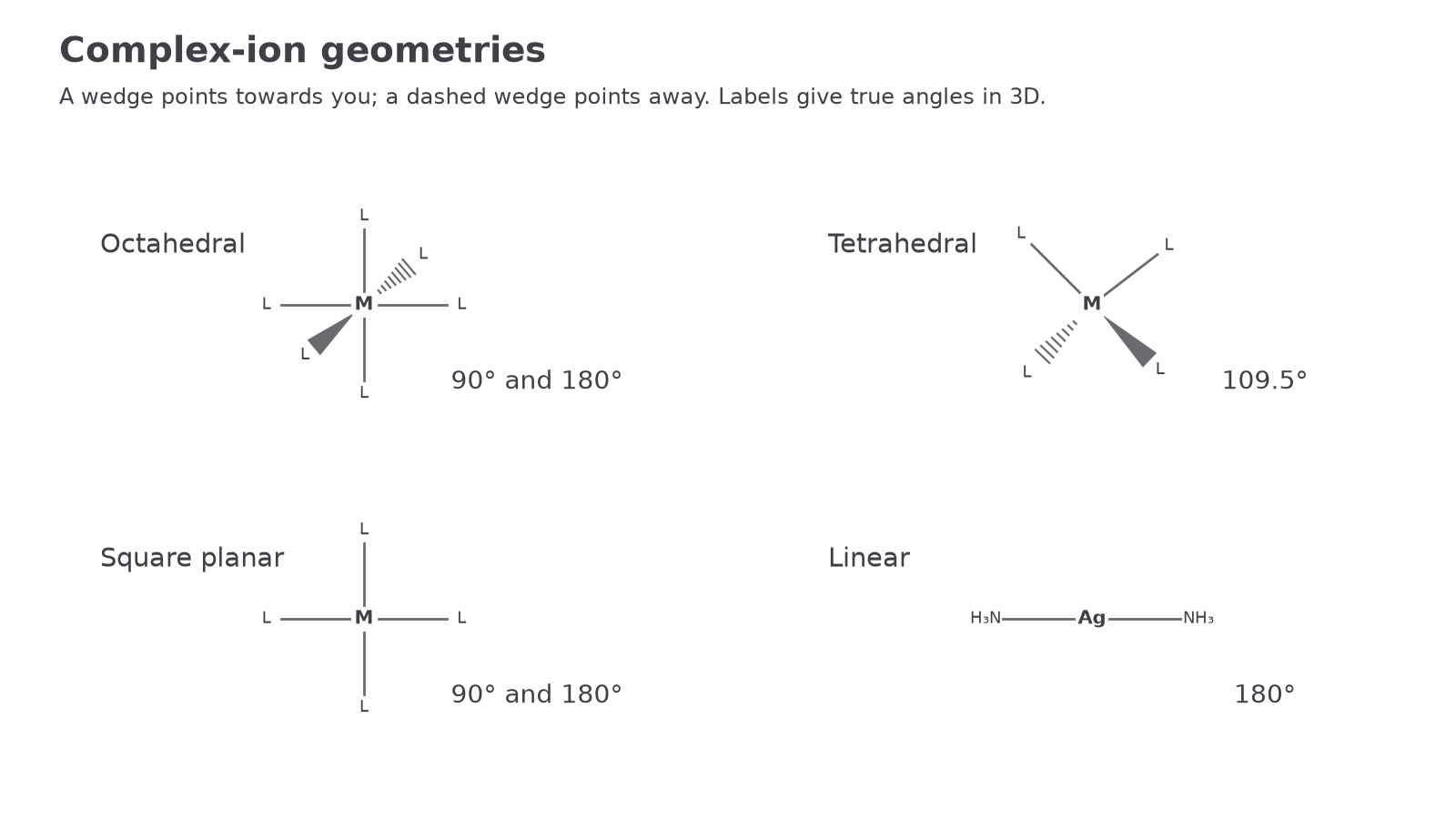
The pattern to notice is this: small ligands such as and often give coordination number 6 and octahedral complexes, while larger ligands such as often give coordination number 4 and tetrahedral complexes. Then check the important four-coordinate exception: some complexes, especially of platinum and nickel, are square planar instead.
Ligand size therefore explains a common pattern, not an absolute rule. For four-coordinate complexes, you must still decide whether the arrangement is tetrahedral or square planar.
To draw an octahedral ion, place six donor atoms around the central metal: two axial and four equatorial. Use a solid wedge for a bond towards the viewer and a dashed wedge for one behind the page; plain lines lie in the page. A tetrahedral ion has four bonds with two in the page, one solid wedge and one dashed wedge. Square-planar and linear complexes can be drawn entirely in the page. Octahedral and square-planar complexes have adjacent angles of 90° and opposite angles of 180°; tetrahedral angles are 109.5°, and linear angles 180°. Perspective changes angles on paper, so label the true molecular angle. Enclose the whole complex in brackets with its total charge outside.
For ungraded notebook practice, draw in three dimensions. Include four donor atoms, two plain bonds, one solid wedge, one dashed wedge, the overall charge and a bond angle. Compare your drawing with the tetrahedral convention in the diagram: four Co–Cl bonds, 109.5°, and brackets enclosing the complex with 2− outside. Equivalent correct perspectives are valid.
Cis-trans isomerism in octahedral complexes
Some octahedral complexes can exist as two different geometrical arrangements even though they have the same formula.
Monodentate ligand
A ligand that forms one coordinate bond to a metal ion using one lone pair from one donor atom.
These one-point ligands are the ones that allow the simple adjacent-versus-opposite comparison used in octahedral cis-trans isomerism.
Cis-trans isomerism
A type of geometrical isomerism in which identical ligands are either adjacent to each other (cis) or opposite each other (trans).
In octahedral complexes with monodentate ligands, the positions of identical ligands can change. For example, in , the two chloride ligands can be next to each other or on opposite sides of the chromium ion.
- cis: the two identical ligands are adjacent
- trans: the two identical ligands are opposite
This is a special case of E-Z isomerism because the difference comes from relative positions in space, not from any change in bonding.
The diagram below shows how the same octahedral complex can place the two chloride ligands either next to each other or opposite each other.
[DIAGRAM: asset_name: 2.5.3 - Shapes of Complex Ions - Diagram 2; asset_slug: 2.5.3 - Shapes of Complex Ions - Diagram 2; recommended_method: retained_png; description: Two octahedral sketches of [CrCl2(H2O)4]+ side by side. Left sketch labelled cis with the two Cl- ligands adjacent and the remaining four positions occupied by H2O. Right sketch labelled trans with the two Cl- ligands opposite each other and the remaining four positions occupied by H2O. Add short notes adjacent under cis and opposite under trans.]
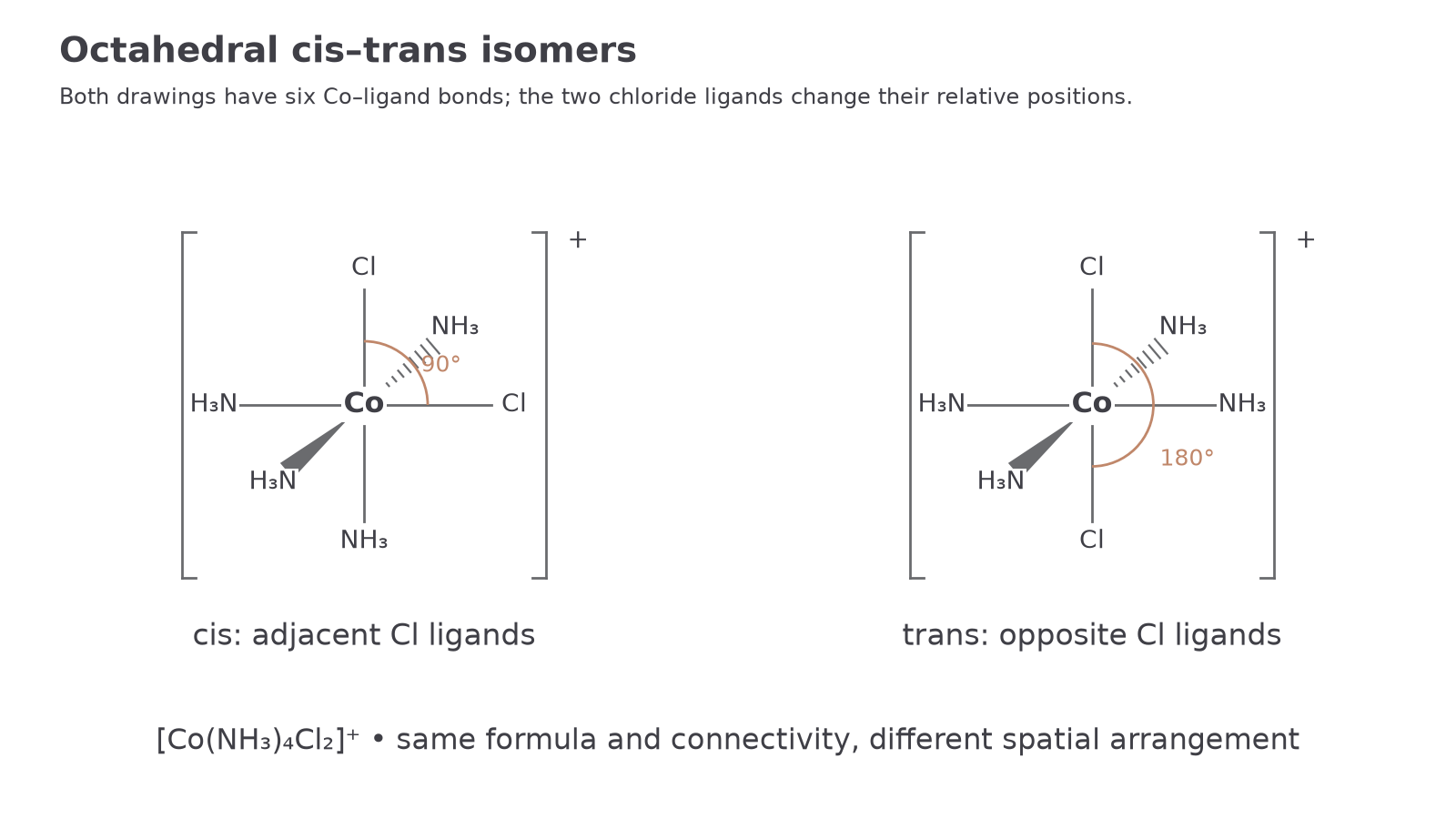
A common mistake is to think any octahedral complex can show cis-trans isomerism. It cannot. You need the right ligand pattern, so that "adjacent" and "opposite" give genuinely different arrangements.
Once you can picture those relative positions clearly, the isomerism becomes much easier to recognise.
Continue this lesson.
You’re previewing NovaLearn without an account. Create a free account to read the rest.
Create free account