Required practical 4 - Ion Identification Tests
Plan separate test-tube reactions, record reliable observations and combine confirmatory tests to identify cations and anions.
Getting trustworthy observations
In qualitative analysis, you identify a substance by what it does rather than by calculating an amount. That means the quality of the observation matters more than the quantity.
Qualitative analysis
Chemical testing used to identify which substances are present from observations such as colour changes, precipitates, or gases formed.
For this practical, the safest and clearest approach is to split the unknown into several small, fresh portions in separate clean test tubes. Then you carry out one test on each fresh portion. Do not keep adding every reagent to the same tube, because one reagent can interfere with the next test and make the final pattern impossible to interpret.
Precipitate
A solid formed when two solutions react and an insoluble product is produced.
Strong practical technique makes the chemistry easier to read:
- use clean test tubes and clean dropping pipettes
- add reagents a few drops at a time unless the method says otherwise
- mix gently after each addition
- record both the first observation and what happens in excess reagent
- keep the test tube less than half full so swirling is safer and observations stay visible
- use a fresh sample for each new reagent
Safety is built into the method. Sodium hydroxide, nitric acid, and sulfuric acid are corrosive or irritant. Barium chloride is harmful. Concentrated ammonia should be handled in a fume cupboard. When testing for ammonium ions, warm gently in a water bath rather than heating strongly with a flame. Forceps should be used to hold damp red litmus paper at the mouth of the test tube.
The diagram below shows the overall practical layout: split the unknown into fresh portions so each reagent tests an uncontaminated sample, and set up the ammonium and carbonate gas tests separately.
[DIAGRAM: asset_name: RP 04 - Carry Out Simple Test-Tube Reactions to Identify Cations and Anions - Diagram 1; asset_slug: RP 04 - Carry Out Simple Test-Tube Reactions to Identify Cations and Anions - Diagram 1; recommended_method: retained_png; description: Practical overview layout. Central test-tube rack with four clean fresh portions of the same unknown solution labelled fresh sample 1 to fresh sample 4, with separate dropping pipettes for NaOH(aq), dilute H2SO4(aq), dilute HNO3(aq), and AgNO3(aq) above them. At one side show a gently warmed test tube tested with damp red litmus paper held at the mouth; at the other side show a separate gas-delivery setup sending CO2 into limewater that turns cloudy.]
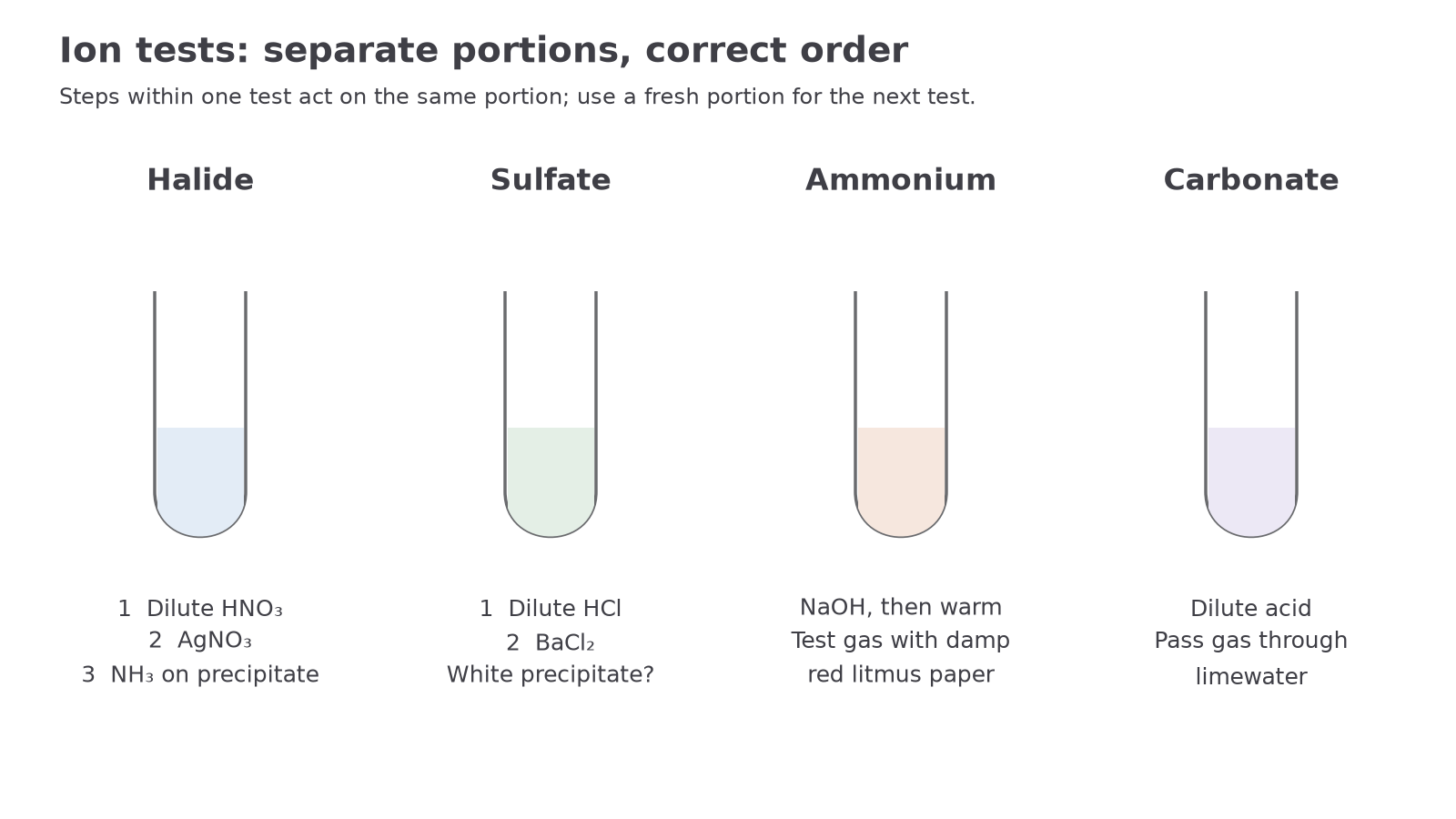
The practical becomes much easier once you stop treating it as a list to memorise and start treating it as a decision process: each reagent gives a clue, and the full pattern gives the identification.
Set out an observation table before starting, with a row for each fresh portion and columns for reagent order, initial result, excess reagent and inference. Record “no visible change” when appropriate rather than leaving a blank. Use a known sample as a positive control if a negative result may reflect a failed reagent. Follow the laboratory risk assessment for corrosive acids/alkalis, ammonia and toxic barium solutions, and collect silver and barium waste as instructed. Written planning and interpretation support practical preparation; safe manipulation and independent observations must be demonstrated in the laboratory.
Keep a dated record of the method title/version, reagent concentrations, observations made at the time and your conclusion. If you consult a handbook or safety source, record its title and page or URL, and state which procedural choice or expected observation it supports. Compare any disagreement with your result against concentration, contamination and timing before changing the identification. This records how secondary information informed the investigation rather than replacing your own observations.
Identifying Group 2 ions and ammonium ions
The cations in this specification are the Group 2 ions and . Group 2 ions are distinguished by using two different fresh samples: one tested with sodium hydroxide and one tested with dilute sulfuric acid.
Why do these two reagents help? Across Group 2, the hydroxides become more soluble, so hydroxide precipitates become less obvious down the group. The sulfates show the opposite trend: they become less soluble down the group, so sulfate precipitates become more obvious from magnesium to barium. That is why one reagent on its own is not enough, but the pair of tests is powerful.
For this required practical, record observations in a consistent pattern: what happens on addition, and what happens when the reagent is in excess.
The following Group 2 results are the AQA handbook exemplar using metal-ion solutions, and , initially about ten drops and then excess. The slight initial magnesium cloudiness is condition-dependent; the identifying sulfate result is no persistent precipitate in excess because magnesium sulfate is soluble.
| Cation in a fresh sample | added | in excess | dilute added to a separate fresh sample | dilute in excess | Best identification logic |
|---|---|---|---|---|---|
| slight white precipitate begins to form | white precipitate remains and becomes more obvious | very slight white cloudiness or precipitate may appear at first | colourless solution; no precipitate remains | strongest hydroxide precipitate, but no persistent sulfate precipitate | |
| slight white precipitate | slight white precipitate remains | slight white precipitate | slight white precipitate remains | slight precipitate with both reagents | |
| slight white precipitate | slight white precipitate remains | white precipitate | white precipitate remains | slight hydroxide precipitate, but a clear sulfate precipitate | |
| no visible change | no precipitate | white precipitate | white precipitate remains | no hydroxide precipitate, but sulfate precipitate forms |
In practice, the amount of white solid can be subtle, so compare the whole pattern rather than relying on one single word such as "slight" or "white".
Magnesium with dilute sulfuric acid needs careful description. A slight white cloudiness can appear when the acid is first added, but in excess the tube becomes colourless because no precipitate remains. Describe it as "very slight white cloudiness on addition; colourless in excess" rather than "white precipitate with sulfuric acid".
The key ionic equations are:
Ammonium ions are identified differently. Add to a fresh sample, warm gently, and test the gas at the mouth of the tube with damp red litmus paper. If is present, ammonia gas is released and the damp red litmus turns blue.
Warm gently rather than strongly because ammonia is very soluble in water, so the test works best when the gas is released steadily and detected immediately.
The table above is most useful when you read it as one whole pattern rather than as isolated observations: magnesium clears with excess sulfuric acid, barium shows no hydroxide precipitate, and ammonium is recognised by ammonia being released on warming.
That combination is why magnesium is usually the easiest Group 2 ion to spot in this practical: the hydroxide precipitate becomes clearly visible, but there is no persistent sulfate precipitate once the acid is in excess.
The small transient magnesium cloudiness shown in the AQA handbook's example results is not a persistent magnesium sulfate precipitate and is not a universal diagnostic observation. The dependable final distinction is soluble magnesium sulfate versus persistent precipitates for the less soluble sulfates under the stated conditions. Use the full comparison, not transient cloudiness alone.
Identifying hydroxide, carbonate, and sulfate ions
The anion tests are more varied because the observations are not all precipitates. Sometimes you are looking for a colour change, sometimes a gas, and sometimes a precipitate that appears only after the solution has been acidified first.
Hydroxide ions are identified with an indicator. A solution containing turns damp red litmus paper blue. Universal indicator would show an alkaline colour such as purple. This is a direct test on the solution itself.
Carbonate ions are identified by adding a dilute acid such as hydrochloric acid. If is present, you see effervescence because carbon dioxide is produced:
To confirm that the gas is carbon dioxide, bubble it through limewater. Limewater turns cloudy because a white precipitate of calcium carbonate forms:
The diagram below shows the standard carbonate confirmation setup: the gas from the acidified sample is passed into limewater to check that it is .
Continue this lesson.
You’re previewing NovaLearn without an account. Create a free account to read the rest.
Create free account