3.3.10.1 - Benzene Bonding and Stability
Benzene is one of the clearest examples in chemistry of a molecule that does not behave the way a simple "three double bonds in a ring" model would predict. In this lesson, you will see what the bonding in benzene is really like, why that bonding makes the ring unusually stable, how enthalpy data prove that extra stability, and why benzene usually keeps its ring intact by undergoing substitution rather than addition.
What the benzene ring is really like
If benzene were just a six-carbon ring with alternating single and double bonds, you would expect two different carbon-carbon bond lengths. A single bond is longer than a double bond, so an alternating pattern should give a slightly uneven hexagon.
That is not what experiment shows. Benzene is a planar regular hexagon, and all six carbon-carbon bonds are the same length: . That value is intermediate between a typical single bond () and a typical double bond ().
Each carbon atom is bonded to two other carbon atoms and one hydrogen atom. Those three sigma bonds lie in the same plane. Each carbon also has a orbital perpendicular to the plane of the ring, and those orbitals are the key to benzene's unusual bonding.
The diagram below shows the planar benzene ring, the perpendicular orbitals on each carbon, and the fact that every carbon-carbon bond has the same length.
[DIAGRAM: asset_name: 3.10.1 - Bonding (Aromatic Chemistry) (A-level only) - Diagram 1; asset_slug: 3.10.1 - Bonding (Aromatic Chemistry) (A-level only) - Diagram 1; recommended_method: code_generated; description: Oblique benzene ring with six perpendicular p orbitals and six hydrogens; top view has a delocalised circle and equal carbon–carbon bonds.]
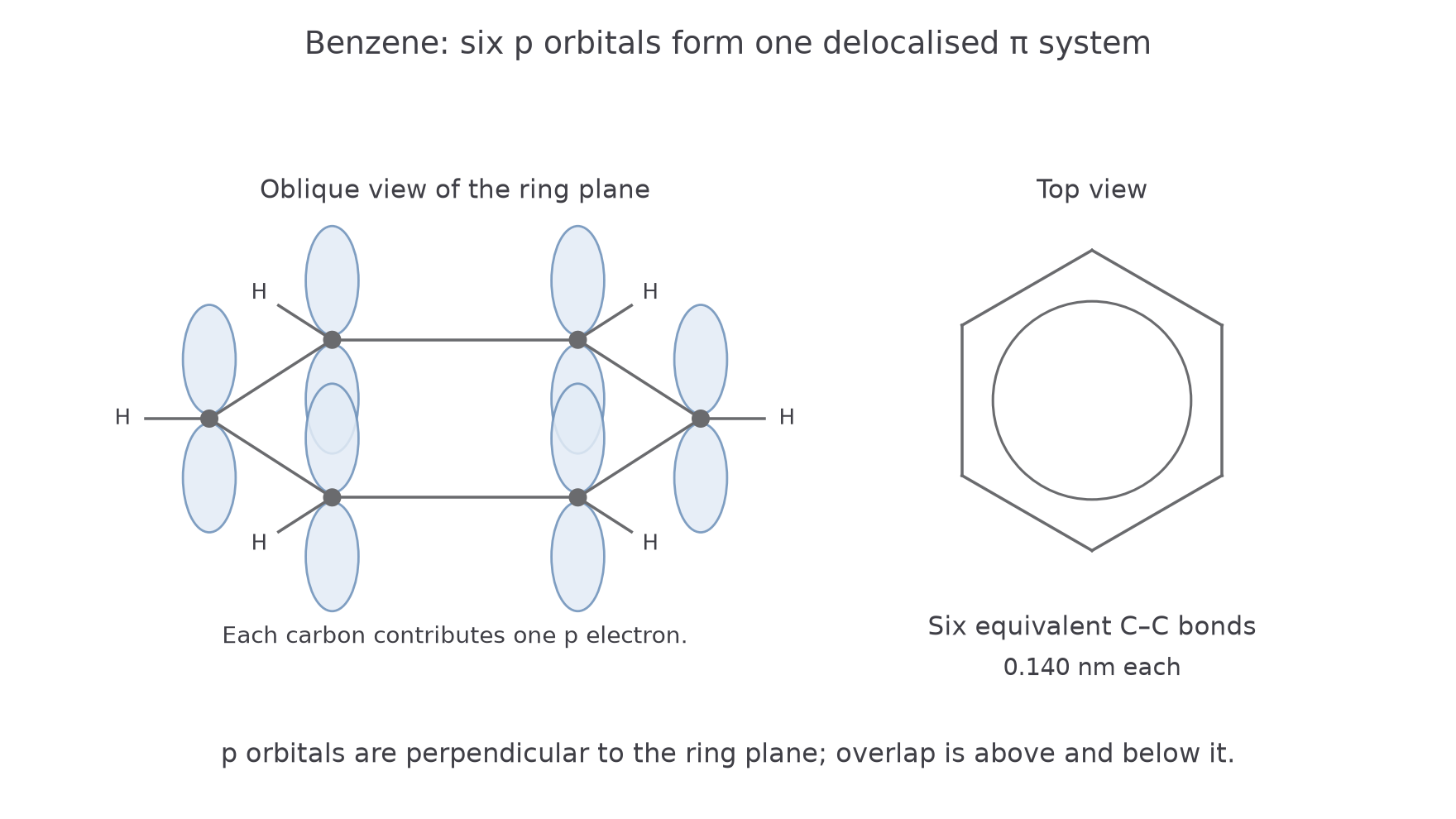
A common mistake is to say that benzene contains three ordinary double bonds that just "move around". The better picture is that benzene has six equal carbon-carbon bonds because the electrons are shared across the whole ring.
Delocalised p electrons and extra stability
Delocalised electrons
Delocalised electrons are electrons that are spread over more than two atoms rather than being found in one localised bond.
Each carbon contributes one electron from its orbital. The six orbitals overlap sideways, so the six electrons are delocalised over all six carbon atoms. Instead of three separate pi bonds, benzene has one continuous delocalised pi system above and below the ring.
The diagram below compares the side and top views that chemists use to represent this delocalised pi system.
[DIAGRAM: asset_name: 3.10.1 - Bonding (Aromatic Chemistry) (A-level only) - Diagram 2; asset_slug: 3.10.1 - Bonding (Aromatic Chemistry) (A-level only) - Diagram 2; recommended_method: code_generated; description: Oblique benzene ring with six overlapping p orbitals above/below the ring plane, and a top-view delocalised circle.]
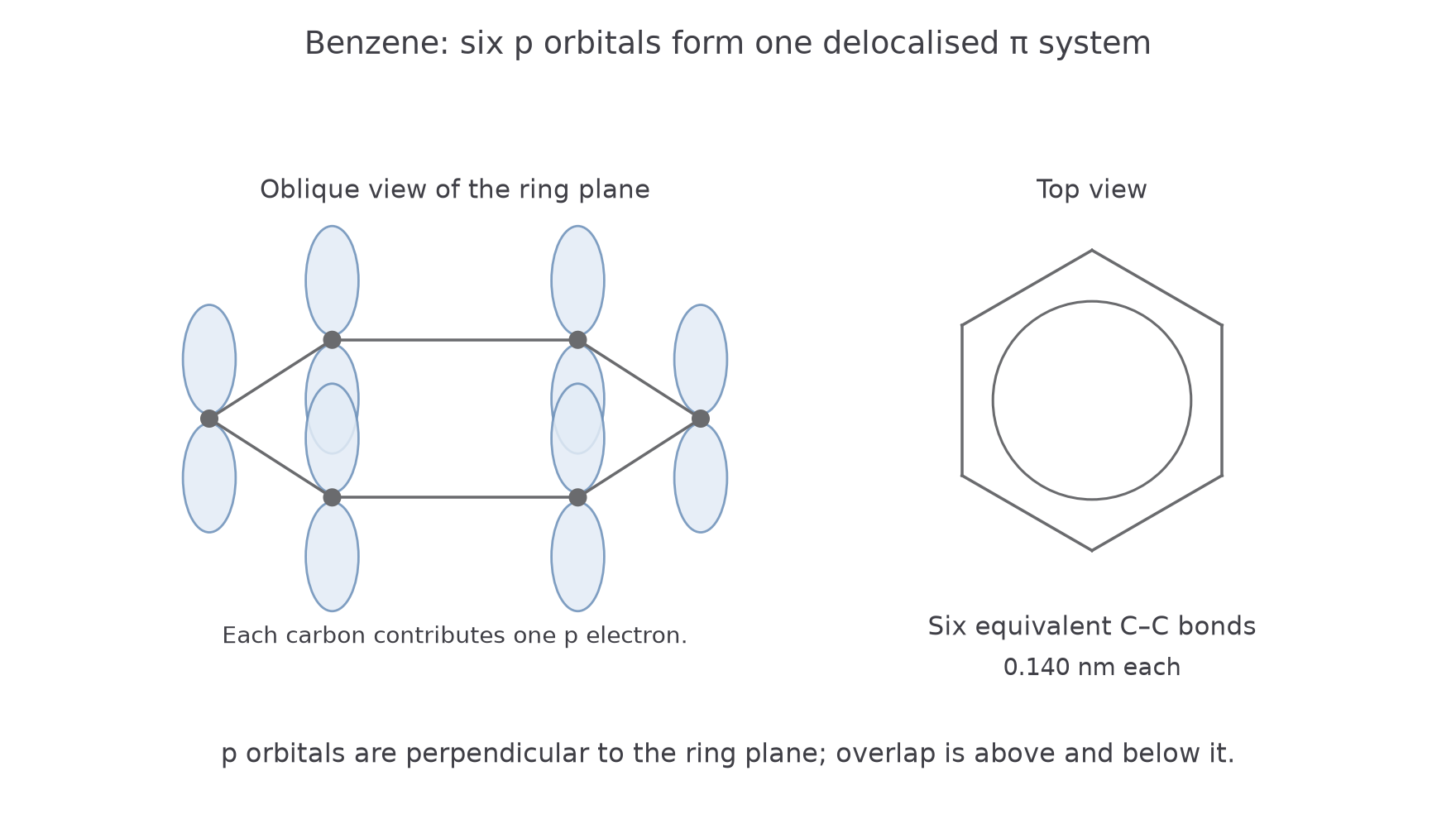
This delocalisation explains both key structural facts at once:
- all six carbon-carbon bonds become equivalent
- each bond has a strength, and therefore a length, intermediate between a single and a double bond
It also explains why benzene is more stable than the theoretical molecule cyclohexa-1,3,5-triene. In a localised triene model, the pi electrons would be confined to three separate double bonds. In benzene, spreading the electrons across the whole ring lowers the enthalpy of the molecule, so the ring is unusually stable.
The circle inside the hexagon represents electron delocalisation; it is not an extra physical bond. A Kekulé drawing is a useful representation, but the real molecule does not switch between two structures. Equivalent ring bonds also explain why there is only one arrangement with identical substituents on adjacent carbon atoms.
Thermochemical evidence for benzene's stability
Enthalpy change of hydrogenation
The enthalpy change of hydrogenation is the enthalpy change when 1 mol of an unsaturated compound reacts completely with hydrogen.
Continue this lesson.
You’re previewing NovaLearn without an account. Create a free account to read the rest.
Create free account