3.3.11.1 - Preparation of Amines
Amines are made by introducing an amino group into an organic molecule, but the route you use depends on the starting material. This lesson centres on three distinct preparation routes: halogenoalkane + ammonia, nitrile reduction, and nitro compound reduction. Once those routes feel like three distinct stories rather than one blurred list, the topic becomes much easier to navigate.
The amines in this lesson
An amine is derived from ammonia, , by replacing one or more hydrogen atoms with carbon-containing groups. This lesson focuses on primary amines, where the nitrogen is attached to one carbon-containing group only.
Primary amine
A primary amine is an amine in which the nitrogen atom is bonded to one carbon-containing group and two hydrogen atoms.
For this topic, it helps to split the chemistry into two families. Primary aliphatic amines have nitrogen bonded to an aliphatic carbon group (which may be open-chain or non-aromatic cyclic), such as ethylamine, . Aromatic amines have the nitrogen attached directly to an aromatic ring, such as phenylamine, . Here the focus is two preparation routes for primary aliphatic amines and one for aromatic amines.
The diagram below summarises the three preparation routes and shows why the halogenoalkane route can continue beyond the primary amine.
[DIAGRAM: asset_name: 3.11.1 - Preparation of Amines - Diagram 1; asset_slug: 3.11.1 - Preparation of Amines - Diagram 1; recommended_method: code_generated; description: Three primary-amine preparation routes, reagents separate from reaction arrows, retained nitrile carbon and alkaline work-up stated.]
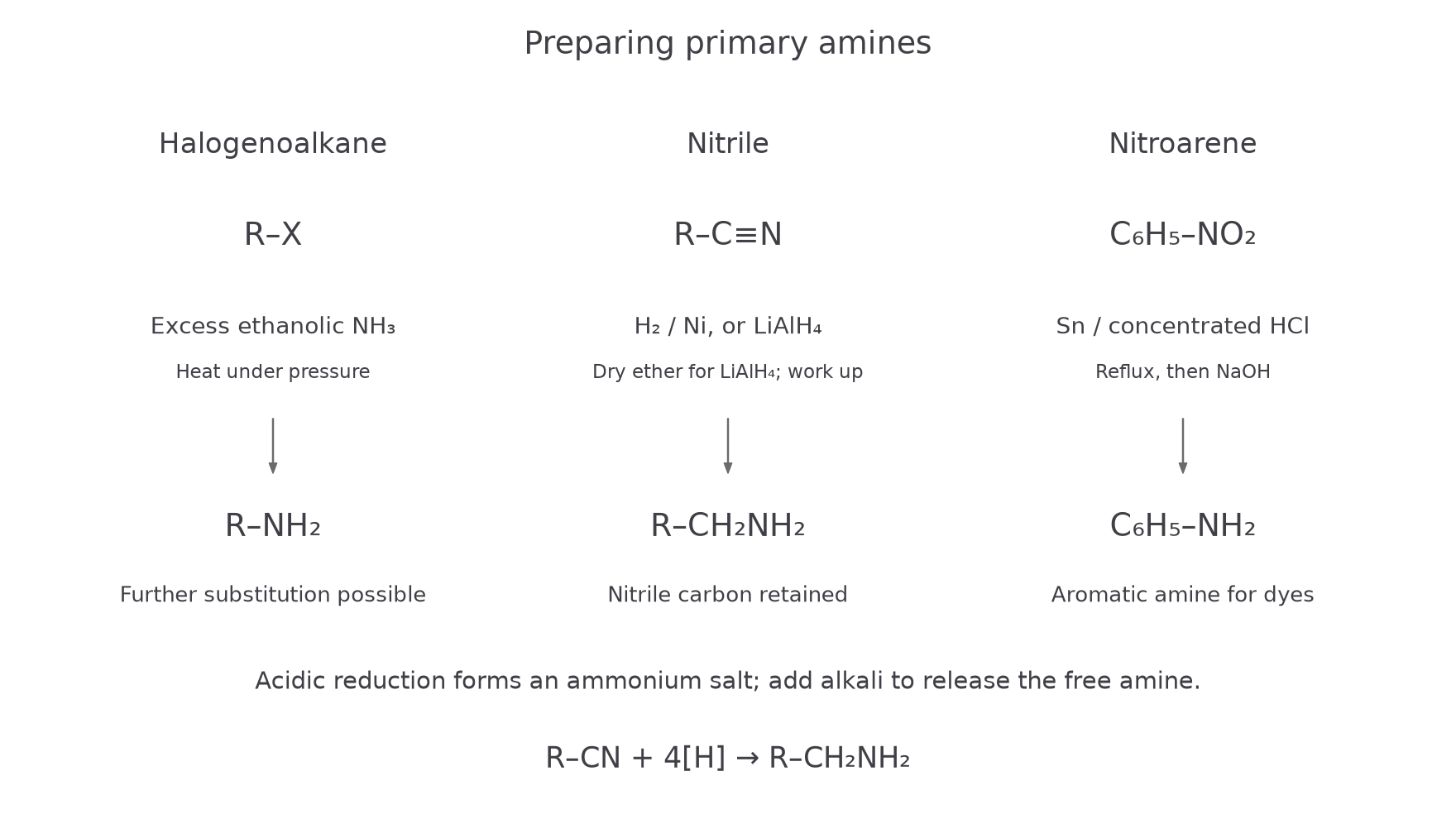
These routes stay clearer if you separate them by the kind of chemistry involved. The halogenoalkane route works by nucleophilic substitution and can give a mixture. The nitrile route is a reduction and gives a primary amine. The aromatic route is also a reduction, but it starts from a nitro compound rather than a nitrile.
Making a primary amine from a halogenoalkane
When ammonia reacts with a halogenoalkane, the lone pair on the nitrogen attacks the carbon bonded to the halogen. The halogen leaves, so this is a nucleophilic substitution reaction. In practice, the mixture is heated with excess ammonia in a sealed tube or under pressure so that ammonia does not escape as a gas.
An important equation to know is:
For example:
Why are there two molecules of ammonia? One acts as the nucleophile that forms the new C-N bond. The second removes a proton from the intermediate and ends up as the ammonium ion in the ammonium halide.
The main problem with this route is that the primary amine product still has a lone pair on nitrogen, so it can react again with more halogenoalkane. That means the mixture can continue on to make a secondary amine, then a tertiary amine, and eventually a quaternary ammonium salt. This is why the route is not perfectly selective.
State the conditions with enough detail to show what the chemistry needs: warm ammonia, usually ethanolic ammonia, and a sealed tube / pressure so ammonia stays in the reaction mixture.
Making a primary amine by reducing a nitrile
A nitrile contains the group . Reducing a nitrile converts that group into , so the product is a primary amine.
Continue this lesson.
You’re previewing NovaLearn without an account. Create a free account to read the rest.
Create free account