3.3.12.1 - Condensation Polymers
Condensation polymers are important because the functional groups in the monomers determine both the linkage in the chain and the forces between neighbouring chains. That is why Terylene behaves as a durable polyester, while nylon 6,6 and Kevlar are tougher polyamides. In this lesson, you will learn how to move confidently between monomers, repeat units, chain fragments, and the properties that make these materials useful.
What makes a polymer a condensation polymer
A condensation polymer forms when monomers join together and a small molecule is removed each time a new link forms. In this specification, that small molecule is usually water, because a carboxylic acid group reacts with either an alcohol group or an amine group.
Condensation polymer
A polymer formed by repeated condensation reactions, where monomers join together and a small molecule such as water is eliminated each time a link forms.
The pattern to look for is "two reactive ends". A dicarboxylic acid can react at both groups, a diol can react at both groups, and a diamine can react at both groups. An amino acid can also make a condensation polymer because each molecule already contains both an amino group and a carboxylic acid group.
When you inspect a condensation polymer, do not try to memorise the whole chain as one huge structure. Instead, identify the linkage:
- ester link:
- amide link:
Repeat unit
The smallest section of a polymer chain that repeats again and again along the chain.
A repeat unit is not always the same as a whole monomer molecule, because atoms from neighbouring monomers become part of the linkage. When you draw one, include continuation bonds through the brackets and put outside the brackets.
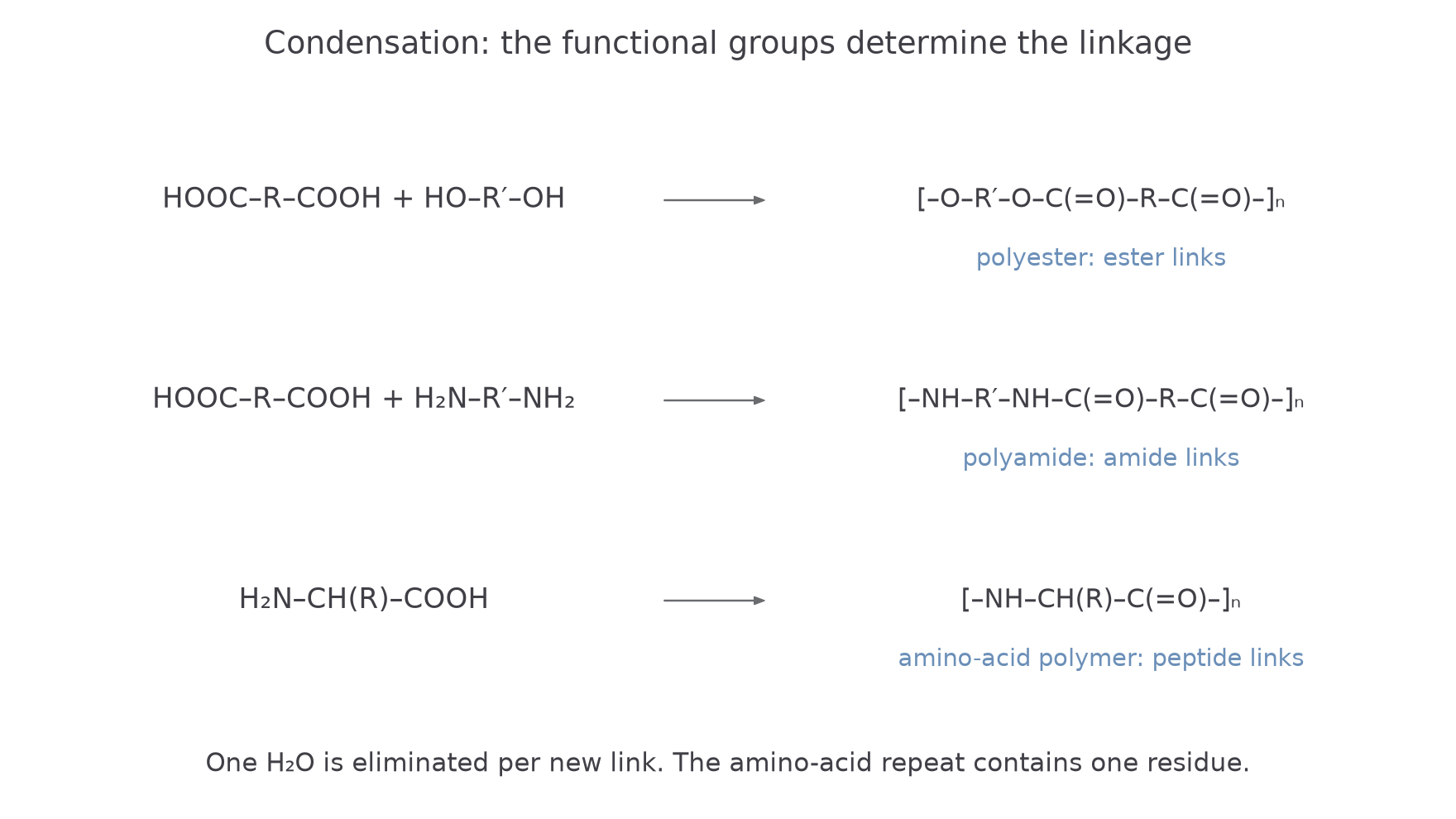
The diagram below summarises the three condensation-polymer routes you need to recognise from the functional groups in the monomers.
[DIAGRAM: asset_name: 3.12.1 - Condensation Polymers - Diagram 1; asset_slug: 3.12.1 - Condensation Polymers - Diagram 1; recommended_method: code_generated; description: Condensation monomers and correct repeat structures for polyester, polyamide and one-residue amino-acid polymer.]
Polyesters and how to recognise the repeat
Polyesters form when a dicarboxylic acid reacts with a diol. Each time a link forms, the from the acid and an H from the alcohol are removed as water, leaving an ester link in the chain.
Polyester
A condensation polymer whose backbone contains repeated ester links, .
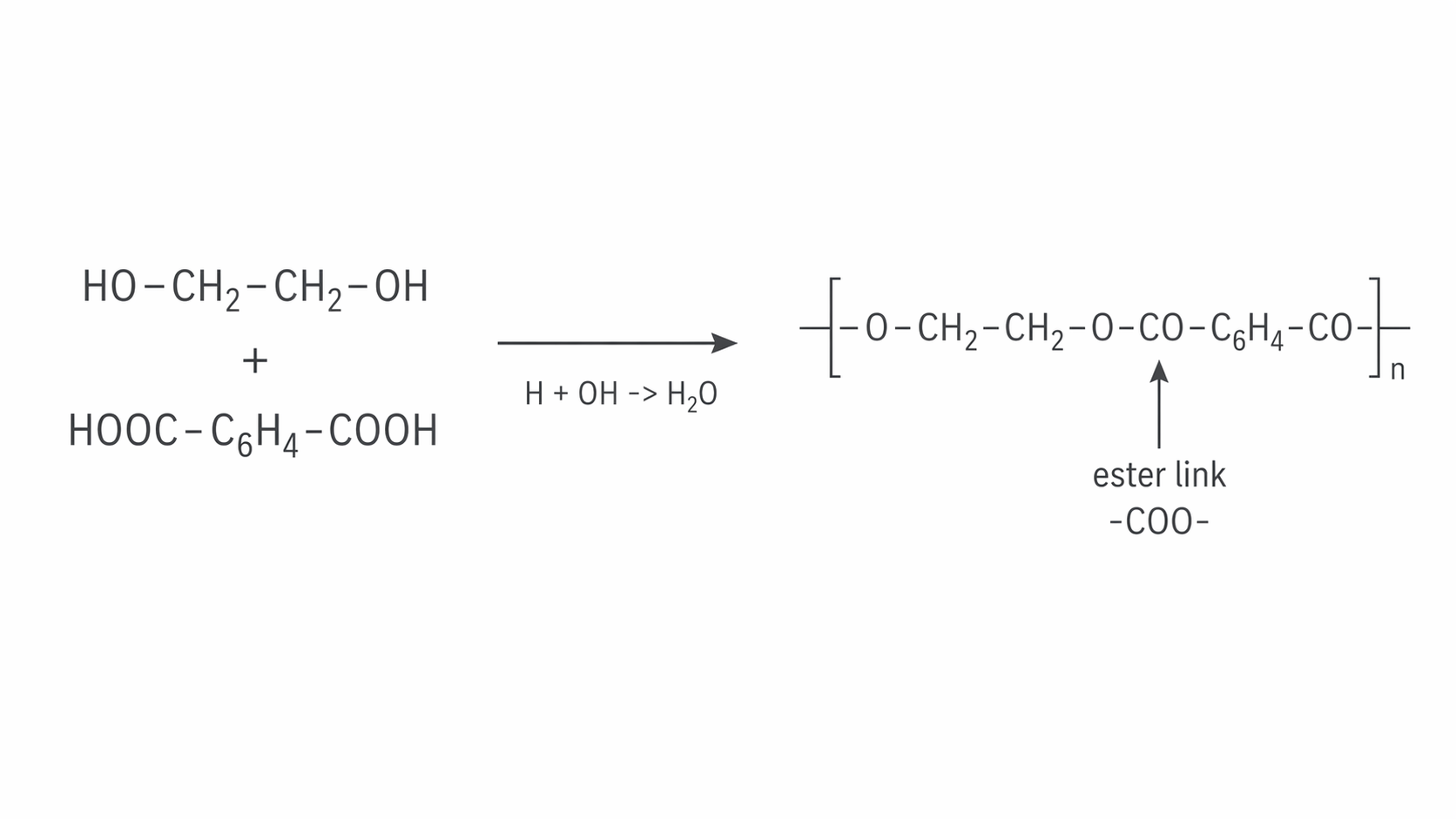
Terylene is a polyester made from ethane-1,2-diol, , and benzene-1,4-dicarboxylic acid, . Its repeat unit can be written as:
Notice what has happened. The two oxygen atoms from the diol stay in the chain. The carbonyl groups and the benzene ring come from the dicarboxylic acid. If you start the bracket one atom later but keep the same repeating pattern, that still represents the same polymer.
The diagram below shows how the diol and dicarboxylic acid fragments combine to make the Terylene repeat unit, with the ester link identified explicitly.
[DIAGRAM: asset_name: 3.12.1 - Condensation Polymers - Diagram 2; asset_slug: 3.12.1 - Condensation Polymers - Diagram 2; recommended_method: retained_png; description: Exam-clean reaction scheme for Terylene formation. Left: monomers HO-CH2-CH2-OH and HOOC-C6H4-COOH. Centre: a reaction arrow labelled H + OH -> H2O to show the eliminated parts. Right: repeat unit [-O-CH2-CH2-O-CO-C6H4-CO-]n with continuation bonds, and one ester linkage labelled ester link and -COO-.]
If you are given a section of polymer chain instead of separate monomers, scan along it until the same pattern of atoms starts again. Then put brackets around the smallest repeating section. In
the smallest repeat is , not two copies of that pattern.
Worked example: start with and . Remove H from each alcohol group and from each carboxylic acid group. The remaining fragments join through , giving the polyester repeat unit.
Polyesters contain polar bonds, especially in the ester group, so neighbouring chains attract one another more strongly than the chains in a non-polar polymer such as poly(ethene). That helps to make polyester fibres durable and useful.
Notebook practice (ungraded): Draw the polyester repeat from and , with brackets, continuation bonds and . Compare your drawing with the worked repeat above. Use the typed check below to test your interpretation.
Polyamides and working back to monomers
Polyamides form when a dicarboxylic acid reacts with a diamine, or when amino acids join together. In both cases, the link in the chain is an amide link.
Polyamide
A condensation polymer whose backbone contains repeated amide links, .
Nylon 6,6 is made from hexane-1,6-diamine, , and hexanedioic acid, . Its repeat unit is:
Kevlar is also a polyamide, but both of its monomers contain benzene rings: benzene-1,4-diamine and benzene-1,4-dicarboxylic acid. Its repeat unit is:
Continue this lesson.
You’re previewing NovaLearn without an account. Create a free account to read the rest.
Create free account