3.3.13.1 - Amino Acids
Amino acids are unusual because one part of the molecule can behave like an acid while another part can behave like a base. In this lesson, you will learn why that happens, why amino acids often exist as zwitterions, and how to draw the structures present in acidic and alkaline solutions without getting the charges in the wrong places.
Why amino acids can act as both acids and bases
An amino acid contains two important functional groups in the same molecule: an amine group and a carboxylic acid group. For the amino acids in this course, the amine group is attached to the carbon next to the carboxylic acid group, so the general structure is usually written as .
Amino acid
An amino acid is an organic compound that contains both an amine group and a carboxylic acid group.
Here, R represents a side chain with no additional acid-base groups. The acid-base behaviour considered comes from the amine and carboxylic acid groups. The carboxylic acid group can lose a proton, so it shows acidic behaviour. The amine group has a lone pair on nitrogen and can accept a proton, so it shows basic behaviour. The diagram below labels these three parts on the general amino acid structure.
[DIAGRAM: asset_name: 3.13.1 - Amino Acids - Diagram 1; asset_slug: 3.13.1 - Amino Acids - Diagram 1; recommended_method: retained_png; description: General structure of an alpha-amino acid shown as H2N-CH(R)-COOH, with thin callout labels identifying the amine group on the left, the carboxylic acid group on the right, and the R group attached to the central carbon.]
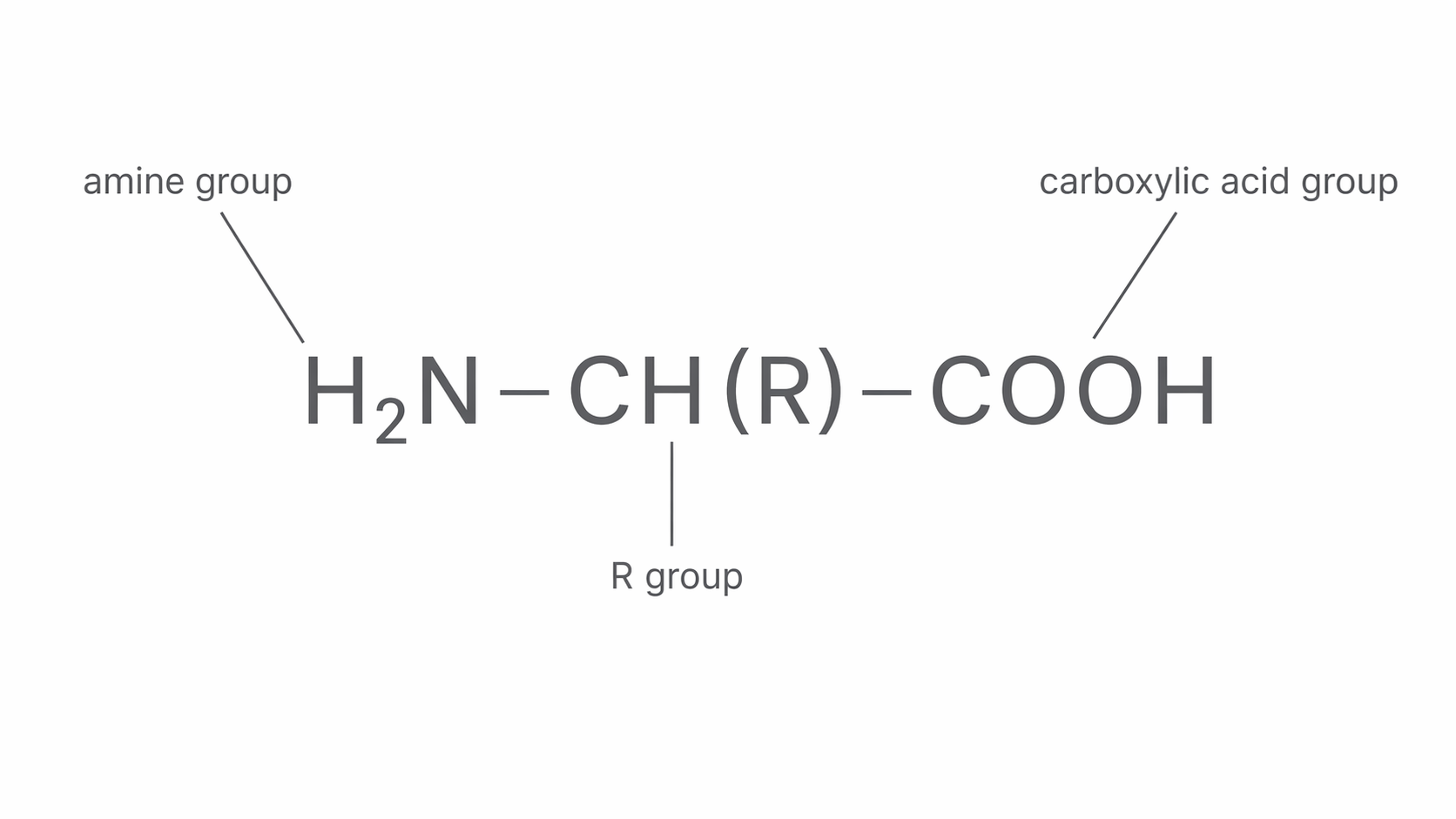
This is the key reason amino acids do not behave like simple carboxylic acids or simple amines. They contain both types of chemistry at once, so the form you draw depends on the conditions.
How a zwitterion forms
Because both functional groups are present in one molecule, an amino acid can transfer a proton internally. The carboxylic acid group can lose , and the amine group can gain . That gives the zwitterion form:
Zwitterion
A zwitterion is an ion that contains both a positive charge and a negative charge but has no overall charge.
The positive charge is on the nitrogen because the amine has been protonated to . The negative charge is on the carboxylate group because the carboxylic acid has lost a proton to form . A very common mistake is to draw the zwitterion with and together. If the nitrogen is still , it has not accepted the proton, so that is not the zwitterion.
Many amino acids exist mainly as zwitterions in the solid state and in aqueous conditions near the middle of the pH range. That is why the zwitterion is the best starting point when you work out what happens in acidic or alkaline solution.
Zwitterions also explain the properties of solid amino acids. Although each molecule has zero overall charge, neighbouring molecules have oppositely charged sites that attract strongly. Much energy is needed to overcome these ionic attractions, so amino acids commonly have high melting/decomposition temperatures compared with similar neutral molecular compounds. Overall neutral does not mean “no charges”.
Continue this lesson.
You’re previewing NovaLearn without an account. Create a free account to read the rest.
Create free account